Optimization of Structural Steel Fabrication via Robotic MAG Welding
In the current industrial landscape, the fabrication of heavy steel structures—such as H-beams, box columns, and trusses—requires a transition from manual processes to automated Robotic Welding. The primary driver is the demand for consistent penetration and bead morphology that manual operators struggle to maintain over long shifts. Industrial engineers are now prioritizing systems that utilize Metal Active Gas (MAG) welding due to its high deposition rates and suitability for carbon steel. By implementing an Intelligent Robotic Welder, facilities can achieve a duty cycle of nearly 85%, compared to the 20-30% typically seen in manual operations where positioning and fatigue limit productivity.
The Mechanics of Zero-tailing Technology in Wire Feeding
A significant inefficiency in traditional robotic welding is the “tail” or excess wire left at the contact tip after a weld completion. Zero-tailing technology utilizes a precise retraction and synchronized motor control system within the wire feeder to ensure the wire is perfectly positioned for the next arc strike. This eliminates the need for mechanical wire clipping between cycles. By maintaining a consistent wire stick-out, the system reduces spatter during the initial arc ignition phase. For structural steel plants consuming tons of welding wire annually, the cumulative reduction in wire waste and the elimination of “bird-nesting” at the feeder drive rolls represent a direct reduction in material overhead.
Furthermore, zero-tailing ensures that the arc-start reliability approaches 99.8%. In structural welding, where multi-pass fillets are common, a failed arc start can lead to inclusions and rework. The intelligent controller monitors the electrical signature of the wire as it approaches the workpiece, adjusting the approach speed in real-time to prevent “cold starts.” This level of precision is unattainable in manual environments and is the cornerstone of high-throughput steel fabrication.
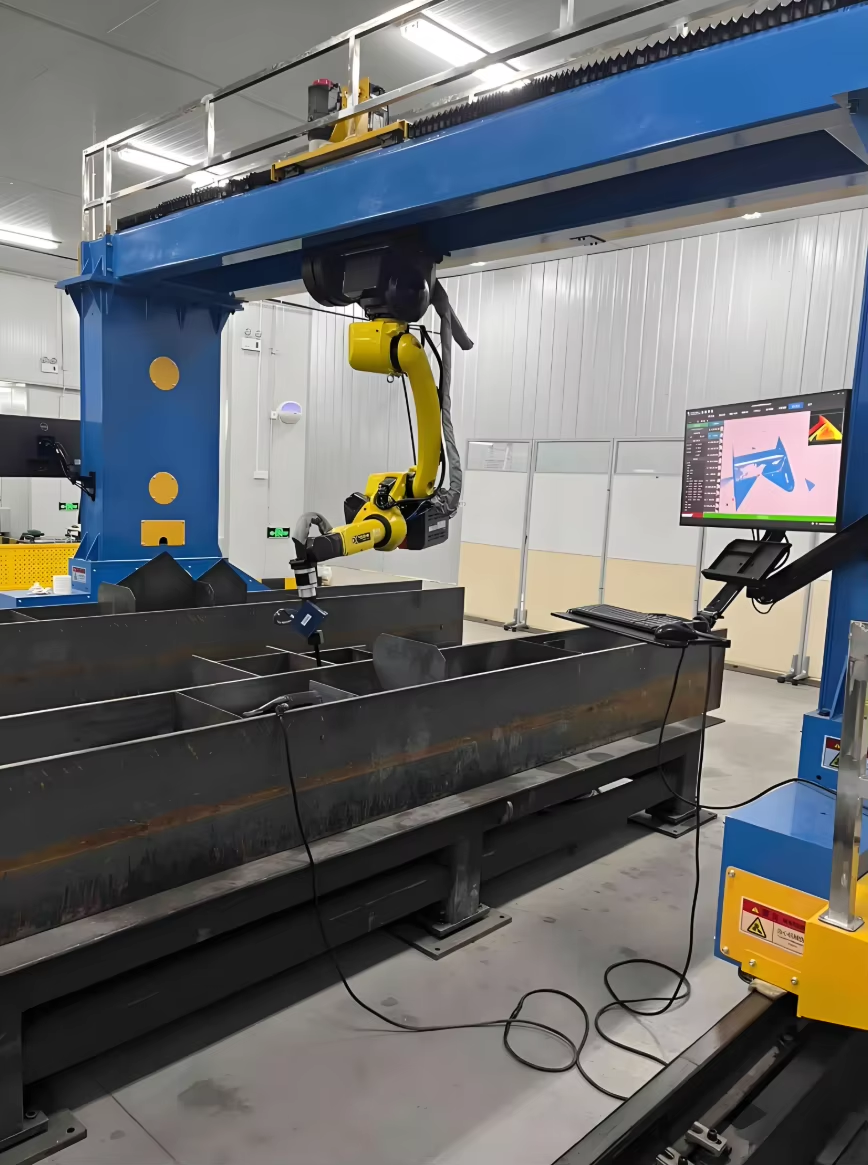
Intelligent Seam Tracking and Parametric Programming
Structural steel components are rarely perfect; thermal distortion and fit-up tolerances often lead to gaps that vary by several millimeters. An intelligent robotic welder employs laser-based seam tracking or “Through-the-Arc” Sensing (TASN) to compensate for these variances. The robot does not simply follow a pre-programmed path; it senses the actual joint geometry and adjusts the welding torch trajectory and weave pattern dynamically.
From an engineering perspective, the shift toward parametric programming is vital. Rather than teaching every point manually, engineers input the beam dimensions and weld specifications into the system. The software generates the toolpath automatically, incorporating the zero-tailing logic at every stop-start point. This reduces the “High-Mix, Low-Volume” barrier that previously made robotics impractical for custom structural projects.
Preventive Maintenance Protocols for High-Uptime Robotic Cells
To maintain the Return on Investment (ROI), the robotic cell must operate with minimal unplanned downtime. Maintenance in a robotic MAG environment focuses on the consumables and the wire delivery path. The welding torch liners must be replaced according to wire throughput volume rather than time intervals to prevent friction-induced feed fluctuations. A clogged liner directly negates the benefits of zero-tailing by introducing wire slip.
Automatic torch reaming stations are essential components of the cell. These stations perform mechanical cleaning of the gas nozzle, spray anti-spatter fluid, and can even check the Tool Center Point (TCP) to ensure the robot hasn’t deviated due to a collision. Industrial engineers should schedule a “Quick-Check” every 50-100 cycles where the robot verifies its own calibration against a fixed pointer. This preventive measure ensures that weld quality consistency remains within the strict tolerances required for seismic-rated structural steel.
Labor ROI and Economic Impact Analysis
The financial justification for an intelligent robotic welder is built on three pillars: labor substitution, throughput increase, and consumable savings. In a typical manual setup, a welder’s cost includes not just wages, but insurance, training, and the logistical burden of safety equipment. A single robotic welding cell can often replace three manual welding stations in terms of raw output, particularly when configured with a dual-station positioner that allows for loading/unloading while the robot is active.
When calculating labor ROI, the engineer must account for the “arc-on time.” If a manual welder achieves 2 hours of arc-on time in an 8-hour shift, and the robot achieves 6.5 hours, the throughput productivity gain is over 200%. When zero-tailing technology is factored in, the reduction in post-weld cleanup (grinding spatter) further reduces the labor hours required per ton of fabricated steel. The payback period for these systems in a two-shift operation typically falls between 12 and 18 months.
Enhancing Structural Integrity Through Controlled Deposition
Beyond the financial metrics, the technical superiority of robotic MAG welding contributes to the overall structural integrity of the building. The robot maintains a constant travel speed and torch angle, resulting in a Heat Affected Zone (HAZ) that is uniform across the entire length of the member. This uniformity is critical in preventing localized stress concentrations that can lead to fatigue failure. By utilizing intelligent feedback loops, the system ensures that the voltage and amperage remain within the qualified Welding Procedure Specification (WPS) limits, automatically logging data for quality assurance compliance.
Conclusion: The Strategic Shift to Automated Welding
The implementation of an intelligent robotic welder with zero-tailing technology is no longer an optional upgrade for competitive steel fabricators; it is a fundamental requirement for scaling operations. By focusing on high-precision MAG processes, rigorous maintenance of the wire delivery system, and leveraging intelligent sensing for real-world tolerances, firms can overcome labor shortages while increasing the quality of their output. The integration of these systems represents a shift from “craft-based” welding to a “process-controlled” manufacturing environment, ensuring long-term viability in the global structural steel market.
-

LT240S tube laser cutting machine
-
LT120S tube laser cutting machine
-
Sale

Tank Fillet Welding Machine
Original price was: $1,000.00.$900.00Current price is: $900.00. -
Sale

MAK100 tube laser cutting machine
Original price was: $5,500.00.$5,000.00Current price is: $5,000.00. -

portable plasma air cutting machine
$1,200.00 -

2in1 fiber laser cutting machine
-

Air cooling Laser welding machine
-

HF h beam laser cutting machine
-

LT240 laser cutting machine
-

Laser welding machine
-

Cobotic Welding Station
-

Gantry welding robot solution
-

Tracked Wheeled AGV Welding robot
-

LFH6020 Fiber laser cutting machine
-
LFP6020
-

robotic welidng machine
Advanced Fiber Laser Tube Processing Technology
Our CNC Fiber Laser Tube Cutting systems revolutionize metal fabrication by integrating high-precision cutting, punching, and profiling into a single automated workflow. Designed for versatility, this technology handles a wide array of profiles including Round, Square, Rectangular, and Oval tubes, as well as complex L-shaped and U-shaped channels.
- Precision Punching: High-speed hole punching with micron-level accuracy, eliminating the need for mechanical drilling or die-stamping.
- Complex Profiling: Advanced 3D pathing allows for intricate interlocking joints and specialized notch cuts, ideal for structural frames.
- High Material Efficiency: Intelligent nesting software minimizes scrap, reducing raw material costs across large production runs.
- Clean Finish: Delivers oxide-free, burr-free edges that require zero secondary grinding before welding.

Seamlessly processing multiple profiles with consistent precision.
Global Delivery & Logistics



From our high-tech manufacturing facility directly to your global site. PCL WeldCut ensures secure packaging, professional handling, and reliable international logistics to safeguard your equipment throughout the entire journey.
