The Engineering Shift to Intelligent MAG Systems in LNG
In the landscape of LNG infrastructure, the structural integrity of storage tanks, heat exchangers, and distribution piping is non-negotiable. Industrial engineering teams are increasingly moving away from manual arc processes in favor of intelligent robotic MAG (Metal Active Gas) welding. This shift is driven by the need for extreme repeatability and the reduction of weld defects that lead to costly rework. The introduction of Zero-tailing technology represents a significant leap in wire management, ensuring that the end of each weld cycle is as clean as the start, eliminating the common “tail” or excess wire that typically requires manual intervention or causes arc-start instability in subsequent passes.
Technical Mechanics of Zero-tailing in MAG Welding
Zero-tailing technology functions through a high-speed synchronized retraction mechanism combined with precise current termination. In standard robotic MAG setups, a small globule or extended wire “tail” often remains at the contact tip after the arc is extinguished. This leads to inconsistent arc strikes and potential inclusions at the weld crater. Intelligent systems now utilize digital signal processors to monitor the wire feed speed (WFS) and voltage in real-time. At the moment of crater fill, the system executes a reverse-pulse or a rapid mechanical retraction of the wire.
for LNG Projects, where thick-walled carbon steel and specialized alloys are common, maintaining a consistent stick-out is vital. The removal of the wire tail ensures that the robotic arm can move to the next weld segment without the risk of wire-to-workpiece interference. This level of MAG welding optimization reduces the mechanical wear on the drive rolls and prevents the “bird-nesting” phenomenon often seen in high-speed production environments. By perfecting the end-of-weld geometry, engineers can guarantee a higher X-ray pass rate, which is a primary KPI in cryogenic storage fabrication.
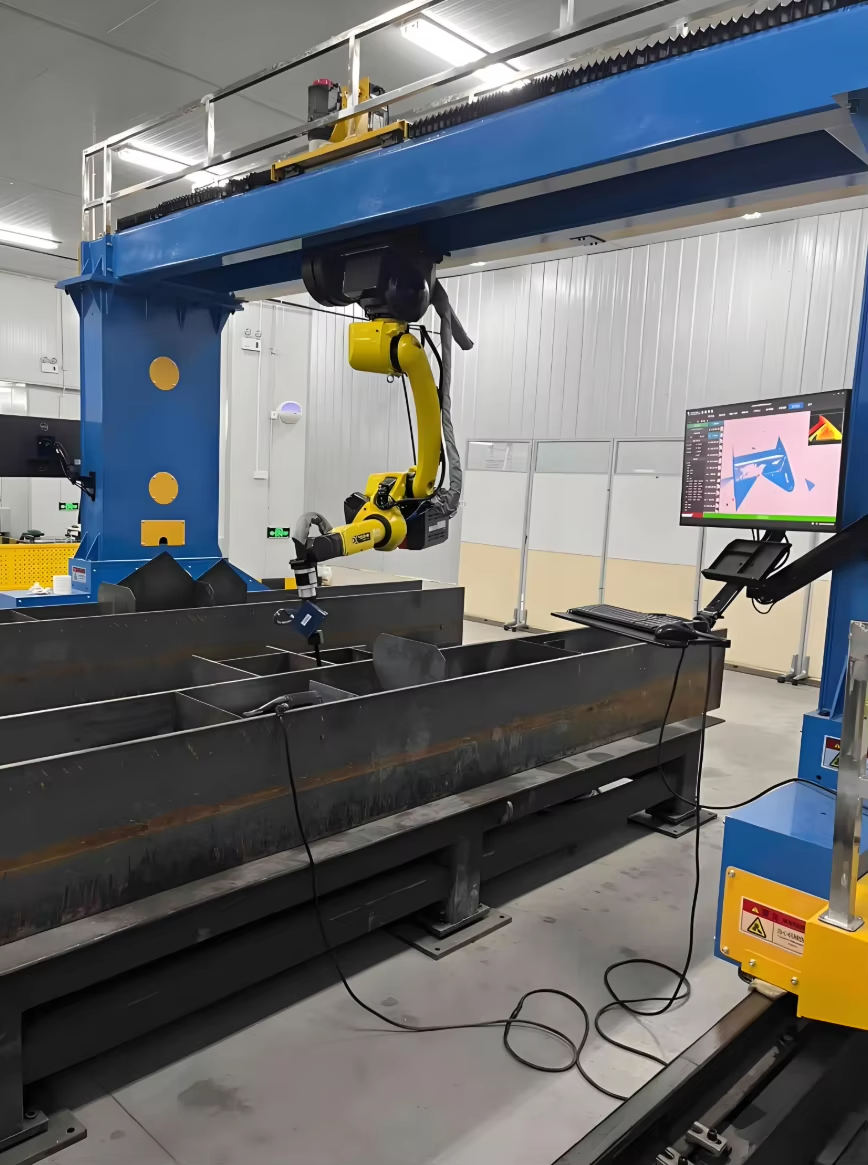
Quantifying Robotic Welding ROI for Large-Scale Projects
The financial justification for integrating robotic welders into LNG fabrication yards centers on the duty cycle and the labor arbitrage. A manual welder typically operates at a 20-30% duty cycle due to fatigue, repositioning, and environmental factors. In contrast, an intelligent robotic system maintains a duty cycle exceeding 75-80%. When calculating Robotic welding ROI, industrial engineers must look beyond the initial capital expenditure (CAPEX) and focus on the cost per meter of weld.
Labor scarcity in specialized welding fields has driven wages to a premium. By utilizing a single operator to oversee two or three robotic cells, the labor cost per unit of production is slashed by approximately 60%. Furthermore, the reduction in consumable waste—specifically welding wire and shielding gas—contributes to a faster payback period. Zero-tailing technology specifically impacts this by reducing the 2-5mm of wire usually wasted at every stop, which, across kilometers of LNG piping, translates into significant material savings.
Maintenance Protocols and Consumable Longevity
System uptime is the backbone of industrial efficiency. For robotic MAG systems, maintenance focuses on the torch geometry, the wire delivery path, and the cooling system. Intelligent welders now feature predictive maintenance sensors that track the health of the contact tip and the nozzle. In LNG environments, where dust and metallic particles can contaminate the wire feed, automated torch cleaning stations are integrated into the robotic workflow.
The zero-tailing feature also serves a maintenance function. By preventing the formation of large globules at the wire end, it minimizes spatter accumulation inside the gas nozzle. This extends the life of the contact tip and the gas diffuser. A standardized maintenance schedule for these systems typically includes a weekly calibration check of the robotic TCP (Tool Center Point) and a monthly inspection of the wire conduit liners. High-quality liners are essential to prevent friction-induced feed fluctuations that could undermine the precision of the zero-tailing mechanism.
Workflow Integration and Quality Assurance Metrics
Integrating intelligent robotics into an LNG workflow requires a structured approach to data. Modern robotic controllers log every parameter of the MAG process, including current, voltage, gas flow rates, and travel speed. This data is indispensable for meeting the stringent quality assurance (QA) requirements of international energy standards. Industrial engineers can utilize this data to create a “digital twin” of the welding process, allowing for real-time monitoring of thermal input.
The zero-tailing system plays a role here by ensuring that the “crater-fill” phase of the weld is recorded with high precision. In manual welding, crater cracks are a common failure point; however, the robotic system’s ability to execute a programmed deceleration and wire retraction ensures that the weld pool solidifies uniformly. This level of control is virtually impossible to maintain manually over a 10-hour shift.
Addressing Environmental and Safety Constraints
Safety is paramount in LNG fabrication. Robotic welding removes the human operator from the immediate vicinity of hazardous fumes and high-intensity UV radiation. Intelligent systems are equipped with integrated fume extraction that follows the torch head, capturing particulates at the source. This not only improves the air quality of the fabrication shop but also reduces the HVAC load, providing a secondary boost to the facility’s operational efficiency.
Furthermore, the precision of the MAG process in a robotic environment means less post-weld cleaning. Manual welding often requires extensive grinding to remove spatter or to fix poor tie-ins. Since the robotic system with zero-tailing produces virtually spatter-free starts and stops, the noise pollution and physical strain associated with grinding are significantly mitigated.
Conclusion: The Future of Energy Sector Fabrication
The implementation of intelligent robotic MAG welders with Zero-tailing technology is no longer an optional upgrade for competitive LNG contractors; it is a technical necessity. By focusing on the mechanical precision of the wire end and the data-driven optimization of the welding arc, industrial engineers can achieve unprecedented levels of throughput and quality. The ROI is realized not just through faster production, but through the elimination of waste, the reduction of specialized labor dependencies, and the extension of consumable lifecycles. As the demand for LNG infrastructure continues to grow globally, the adoption of these automated systems will define the leaders in high-stakes energy engineering.
-

LT240S tube laser cutting machine
-
LT120S tube laser cutting machine
-
Sale

Tank Fillet Welding Machine
Original price was: $1,000.00.$900.00Current price is: $900.00. -
Sale

MAK100 tube laser cutting machine
Original price was: $5,500.00.$5,000.00Current price is: $5,000.00. -

portable plasma air cutting machine
$1,200.00 -

2in1 fiber laser cutting machine
-

Air cooling Laser welding machine
-

HF h beam laser cutting machine
-

LT240 laser cutting machine
-

Laser welding machine
-

Cobotic Welding Station
-

Gantry welding robot solution
-

Tracked Wheeled AGV Welding robot
-

LFH6020 Fiber laser cutting machine
-
LFP6020
-

robotic welidng machine
Advanced Fiber Laser Tube Processing Technology
Our CNC Fiber Laser Tube Cutting systems revolutionize metal fabrication by integrating high-precision cutting, punching, and profiling into a single automated workflow. Designed for versatility, this technology handles a wide array of profiles including Round, Square, Rectangular, and Oval tubes, as well as complex L-shaped and U-shaped channels.
- Precision Punching: High-speed hole punching with micron-level accuracy, eliminating the need for mechanical drilling or die-stamping.
- Complex Profiling: Advanced 3D pathing allows for intricate interlocking joints and specialized notch cuts, ideal for structural frames.
- High Material Efficiency: Intelligent nesting software minimizes scrap, reducing raw material costs across large production runs.
- Clean Finish: Delivers oxide-free, burr-free edges that require zero secondary grinding before welding.

Seamlessly processing multiple profiles with consistent precision.
Global Delivery & Logistics



From our high-tech manufacturing facility directly to your global site. PCL WeldCut ensures secure packaging, professional handling, and reliable international logistics to safeguard your equipment throughout the entire journey.
