Intelligent Robotic Welder with Offline Programming for Steel Structure

In this article
Technical Integration of Robotic MAG Welding in Steel Construction
The structural steel fabrication industry is currently facing a convergence of rising material costs and a diminishing pool of certified manual welders. To maintain throughput and ensure structural integrity, the implementation of Robotic MAG welding (Metal Active Gas) has moved from a luxury to a baseline requirement for competitive operations. Unlike manual welding, which is subject to human fatigue and variability in travel speed, an intelligent robotic system delivers consistent heat input and penetration profiles, which are essential for the heavy-duty connections required in high-rise buildings, bridges, and industrial frameworks.
The primary objective of an industrial engineer in this space is to maximize the arc-on time. Manual welding processes often see a duty cycle of 20% to 30% due to repositioning, slag removal, and operator breaks. In contrast, a robotic cell, when properly optimized, can push duty cycles toward 70% to 80%. This leap in productivity is achieved through the synchronization of the power source, the wire feeder, and the robotic manipulator, ensuring that the arc remains active for the majority of the shift.
The Role of Offline Programming (OLP) in High-Mix Production
Traditionally, the “teach pendant” method was the standard for programming industrial robots. However, for structural steel—where parts are large and often unique—the downtime required to lead a robot through every weld path manually is economically unfeasible. This is where offline programming (OLP) transforms the workflow. OLP allows engineers to create, simulate, and optimize welding paths in a virtual 3D environment using CAD data, while the robot is simultaneously working on a different project.
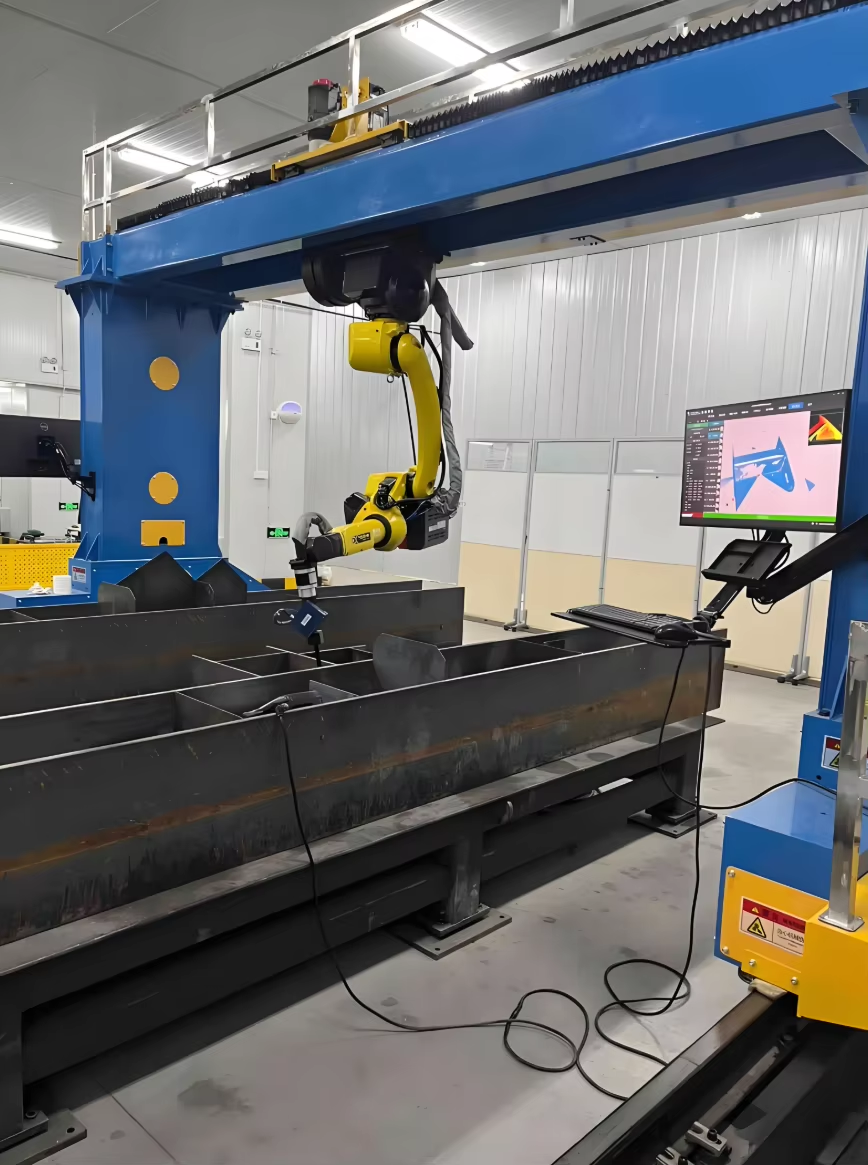
OLP software calculates the optimal torch angles and avoids collisions with fixtures or the workpiece itself. By utilizing “digital twins” of the welding cell, engineers can detect reach issues or singularities before the first spark is struck. This shift from physical teaching to digital simulation reduces machine downtime by up to 90% during the setup phase of new structural assemblies. Furthermore, intelligent OLP systems can automatically generate weld paths for complex geometries, such as stiffener plates or multi-pass heavy flange joins, by extracting geometric data directly from the BIM (Building Information Modeling) model.
Optimizing the MAG Process for Heavy Steel
Robotic MAG welding in structural steel typically utilizes a mixture of Argon and CO2 to balance arc stability with penetration depth. In an automated environment, the system controls the “spray transfer” mode with precision. This mode is characterized by a stream of fine droplets across the arc, resulting in high deposition rates and minimal spatter.
From an engineering standpoint, the robotic system must manage the following variables dynamically:
- Wire Feed Speed: Correlated to current and deposition volume.
- Travel Speed: Maintained to ensure consistent throat thickness and leg length.
- Voltage Control: Adjusted to manage arc length and bead width.
- Gas Flow Rate: Monitored to prevent porosity in the weld pool, especially in drafty shop environments.
By automating these variables, the facility achieves a level of metallurgical consistency that manual operators cannot replicate over an eight-hour shift. This consistency directly impacts the secondary costs of ultrasonic and radiographic testing, as the rate of weld defects and subsequent rework is significantly lowered.
Maintenance Protocols for Robotic Welding Cells
To ensure the weld cycle time reduction is maintained over the long term, a rigorous preventative maintenance (PM) schedule is mandatory. Unlike manual torches, a robotic torch is subject to continuous, high-intensity use. The most critical component is the contact tip. Even slight wear in the contact tip can lead to arc instability or “wire hunting,” where the wire deviates from the programmed path.
Daily and Weekly Maintenance Requirements
The integration of an automatic torch cleaning station (reamer) is essential. This station clears spatter from the gas nozzle and applies anti-spatter fluid at programmed intervals, ensuring unobstructed shielding gas flow. Additionally, the wire delivery system, including the liners and feed rollers, must be inspected weekly. A clogged liner introduces friction, causing “bird-nesting” at the wire feeder, which can stop production for hours.
Mechanical calibration of the robot’s Tool Center Point (TCP) is another vital task. In structural steel, where tolerances may be tight, a deviation of even 1mm in the TCP can result in a weld that misses the root of the joint. Modern intelligent systems often include automated TCP check routines where the robot touches a sensing probe to verify its alignment and auto-corrects any deviations caused by minor collisions or thermal expansion.
Labor ROI and Economic Impact
The most significant metric for any industrial investment is industrial automation ROI. When calculating the return on a robotic welding system for Steel Structures, the analysis must go beyond simple wage replacement. The true value lies in the reallocation of labor and the increase in total shop capacity.
In a manual environment, a project might require ten certified welders to meet a deadline. By implementing two robotic cells, the same project might only require two operators (to load/unload and supervise the robots) and one technician (for OLP and maintenance). The remaining seven welders can be moved to high-value manual tasks that are too complex for robots, such as intricate fit-ups or field welding.
Furthermore, the reduction in consumables waste contributes to the ROI. Robotic systems use precise amounts of wire and gas, eliminating the “over-welding” common in manual processes where operators might lay down a 10mm fillet when an 8mm fillet was specified. This reduction in filler metal consumption, combined with the near-elimination of grinding and post-weld cleanup, shortens the payback period of the equipment, typically achieving break-even within 18 to 24 months in a high-volume structural shop.
Strategic Implementation for Future Growth
As the industry moves toward more complex architectural designs, the ability to handle large-scale MAG welding with robotic precision becomes a key differentiator. The integration of offline programming ensures that the fabrication shop remains agile, capable of switching between different structural components without the bottleneck of manual programming.
In conclusion, the transition to an intelligent robotic welding system is not merely about replacing a person with a machine; it is about upgrading the entire manufacturing philosophy. By focusing on MAG process stability, leveraging OLP for zero-downtime setup, and adhering to strict maintenance standards, structural steel fabricators can achieve a level of operational efficiency that secures their position in an increasingly demanding global market.






