Intelligent Robotic Welder with Offline Programming for Construction Machinery

In this article
- Optimizing Heavy Fabrication with Intelligent MAG Systems
- The Technical Advantage of Robotic MAG Welding
- Offline Programming: Decoupling Programming from Production
- Digital Twin Integration and Collision Avoidance
- Maintenance Strategies for High-Availability Welding
- Preventive Protocols for Torch and Feeder Components
- Labor ROI and Economic Justification
- Calculating the True Value of Automation
- Conclusion: The Path to Competitive Manufacturing
Optimizing Heavy Fabrication with Intelligent MAG Systems
In the production of construction machinery, structural integrity is non-negotiable. Components such as excavator arms, bulldozer blades, and crane pedestals undergo extreme cyclic loading. Traditionally, these parts required extensive manual Metal Active Gas (MAG) welding, a process heavily dependent on the operator’s skill and consistency. However, the shift toward intelligent Robotic Welding systems has redefined the throughput capabilities of modern fabrication shops. By utilizing robotic welding, manufacturers transition from a variable-output manual process to a predictable, high-precision automated workflow.
The Technical Advantage of Robotic MAG Welding
MAG welding remains the industry standard for thick-plate carbon steel fabrication due to its high deposition rates and deep penetration characteristics. In an automated environment, the robot controls the wire feed speed, voltage, and travel speed with a precision that exceeds human capability. This consistency is vital for maintaining the mechanical properties of the Heat Affected Zone (HAZ). Unlike manual operations where travel speeds might fluctuate, a robotic system maintains a constant thermal input, which minimizes distortion and reduces the need for secondary straightening operations.
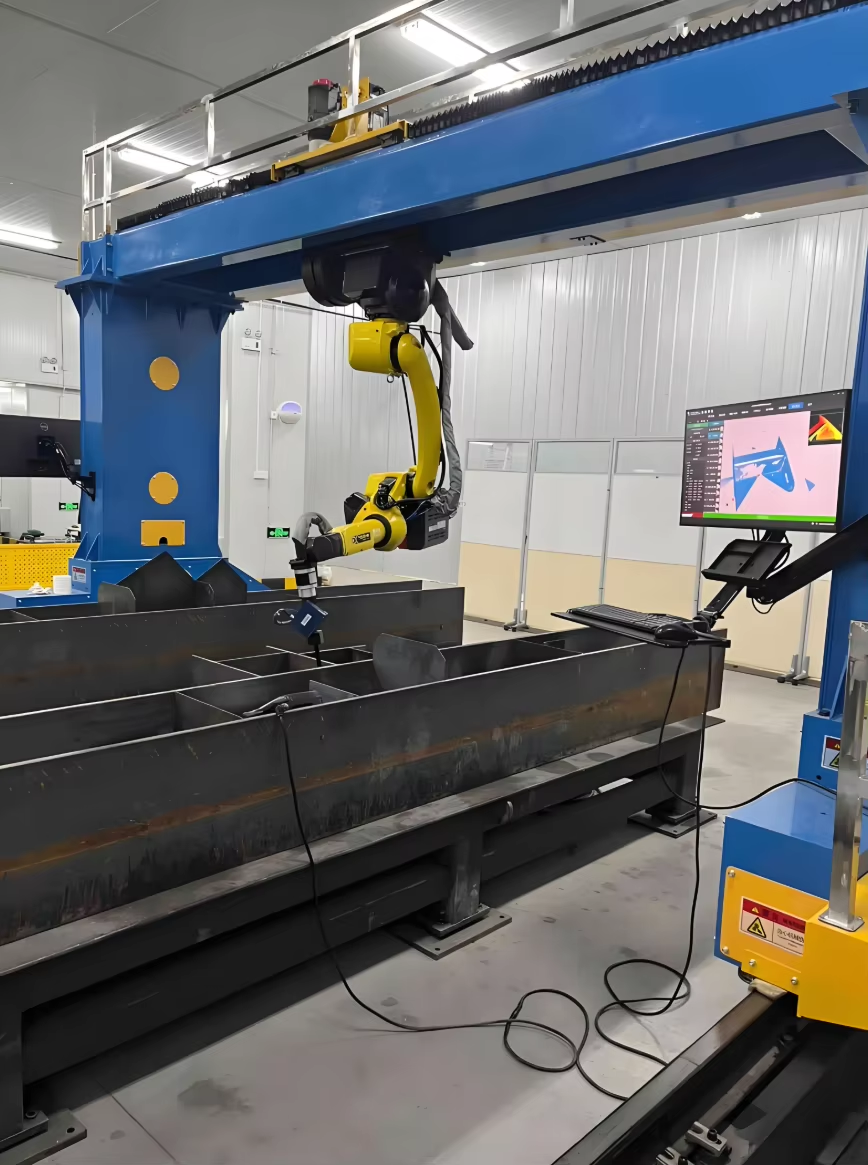
Modern intelligent welders are equipped with advanced sensors for seam tracking. Through “Touch Sensing” and “Arc Seam Tracking,” the robot compensates for part tolerances and thermal warping in real-time. This is particularly critical in construction machinery, where large-scale weldments may have deviations of several millimeters. The ability of the system to adjust the torch trajectory dynamically ensures that the welding ROI is maximized through a reduction in scrap and rework.
Offline Programming: Decoupling Programming from Production
The historical bottleneck for robotics in heavy industry was the downtime required for teach-pendant programming. For complex, low-volume parts typical in construction equipment, taking a robot offline for days to program a new chassis was economically unviable. Offline programming (OLP) software has eliminated this barrier. OLP allows industrial engineers to create, simulate, and optimize weld paths in a virtual environment using 3D CAD models while the robot remains active on the shop floor.
Digital Twin Integration and Collision Avoidance
OLP software functions as a digital twin of the welding cell. Engineers can select weld joints, assign parameters, and simulate the robot’s kinematics to identify potential collisions between the torch and the workpiece or jig. This simulation includes “Air Cut” optimizations, reducing the non-productive movement time of the robot arm. By the time the program reaches the controller, it is 95% optimized, requiring only minor touch-ups. This capability transforms the robotic cell from a mass-production tool into a flexible manufacturing system capable of handling high-mix, low-volume product lines.
Parameter Libraries and Standardization
A significant benefit of OLP is the ability to maintain a centralized weld parameter library. Engineers can standardize wire stick-out, torch angles, and gas flow rates across multiple robotic cells. This standardization ensures that a weld performed in one facility is identical to a weld performed in another, regardless of the individual operator’s experience level. This level of control is fundamental for meeting international quality standards such as ISO 3834.
Maintenance Strategies for High-Availability Welding
The reliability of an automated welding system is only as good as its maintenance program. In the harsh environment of a heavy fabrication shop—characterized by dust, spatter, and high temperatures—robotic systems require specific preventive maintenance protocols to avoid unplanned downtime. The primary focus of maintenance in robotic welding cells involves the wire delivery system and the torch consumables.
Preventive Protocols for Torch and Feeder Components
The contact tip and the gas nozzle are the most vulnerable components. To mitigate spatter build-up, intelligent cells incorporate automatic torch cleaning stations (reams). These stations mechanically clean the nozzle and apply anti-spatter fluid at scheduled intervals, typically after every few weld cycles. Furthermore, the wire feed liner must be inspected for friction increases, which can lead to “bird-nesting” at the drive rolls. Monitoring the motor current of the wire feeder can provide predictive data; a spike in current often indicates a clogged liner or a worn contact tip before a failure occurs.
Gas Delivery and Shielding Integrity
Shielding gas consistency (typically an Argon/CO2 mix) is paramount for preventing porosity. Maintenance teams should verify the integrity of gas hoses and solenoid valves monthly. Any leak in the delivery system not only wastes expensive gas but also risks contaminating the weld pool, leading to structural defects that are costly to repair in heavy-plate applications.
Labor ROI and Economic Justification
The primary driver for adopting intelligent robotic welding is the labor ROI. The global manufacturing sector is facing a critical shortage of certified welders, especially those capable of working on large-scale structural components. A single robotic welding cell can often replace three to four manual welding stations, depending on the complexity of the parts. However, the calculation of ROI extends beyond mere headcount reduction.
Calculating the True Value of Automation
Industrial engineers must look at “Arc-On Time.” In manual welding, the arc-on time—the actual time spent depositing metal—rarely exceeds 25-30% of a shift due to operator fatigue, part positioning, and breaks. A robotic system, supported by a dual-station positioner, can achieve arc-on times exceeding 70-80%. This massive increase in duty cycle allows manufacturers to accelerate production schedules without increasing the physical footprint of the factory.
Furthermore, the cost of quality must be factored into the ROI. Manual welding of a large excavator boom may require hours of post-weld inspection and grinding. The precision of an intelligent robotic system significantly reduces spatter and ensures consistent bead geometry, nearly eliminating the need for post-weld cleaning. When the reduction in consumables (due to optimized wire usage) and the decrease in rework are combined with increased throughput, the payback period for a high-end robotic welding system in the construction machinery sector typically falls between 18 and 24 months.
Strategic Upskilling of the Workforce
Transitioning to robotics does not eliminate the need for human expertise; it shifts the requirement. Manual welders are transitioned into “Robot Operators” and “Weld Technicians.” These individuals use their metallurgical knowledge to fine-tune programs and oversee quality control. This transition improves the workplace environment by removing workers from the direct vicinity of welding fumes and intense UV radiation, leading to higher employee retention and lower long-term liability costs.
Conclusion: The Path to Competitive Manufacturing
The integration of intelligent robotic welding with offline programming is no longer a luxury for Construction Machinery manufacturers; it is a strategic necessity. By focusing on the technical nuances of MAG welding, maintaining strict equipment uptime protocols, and leveraging the efficiency of OLP, companies can secure a significant labor ROI. This approach ensures that the massive structures required for the world’s infrastructure are built with the highest possible standards of efficiency and structural integrity.






