Intelligent Robotic Welder with Narrow Gap welding for Pressure Vessels

In this article
Engineering the Shift to Narrow Gap Robotic Systems
In the heavy fabrication sector, specifically regarding pressure vessel manufacturing, the transition from traditional wide-groove submerged arc welding to narrow gap welding (NGW) represents a significant leap in process efficiency. Standard V-groove preparations require massive amounts of filler metal and involve high heat input, which can degrade the heat-affected zone (HAZ) properties of pressure-rated steels. An Intelligent Robotic Welder configured for NGW utilizes a nearly parallel-sided groove, typically between 6 and 10 degrees, dramatically reducing the volume of the weld joint.
The industrial engineering objective here is twofold: minimize the “arc-on” time per vessel and reduce the cumulative thermal stress on the workpiece. By utilizing a robotic arm with high repeatability, the system can execute multi-pass MAG (Metal Active Gas) welding with precision that manual operators cannot sustain over long shifts. This precision is critical because in a narrow gap, the margin for error regarding sidewall fusion is extremely slim. A deviation of even one millimeter can lead to lack-of-fusion defects, necessitating expensive gouging and repair.
Intelligent MAG Process Control and Adaptive Feedback
The “intelligence” in modern robotic pressure vessel welding stems from integrated sensing technologies. In narrow gap applications, the robot cannot rely solely on pre-programmed paths due to workpiece tolerances and thermal expansion during the weld. Thru-arc seam tracking (TAST) and laser-based vision systems allow the robot to adjust its torch position in real-time. TAST monitors changes in welding current as the wire stick-out varies, allowing the controller to maintain the center of the groove effectively.
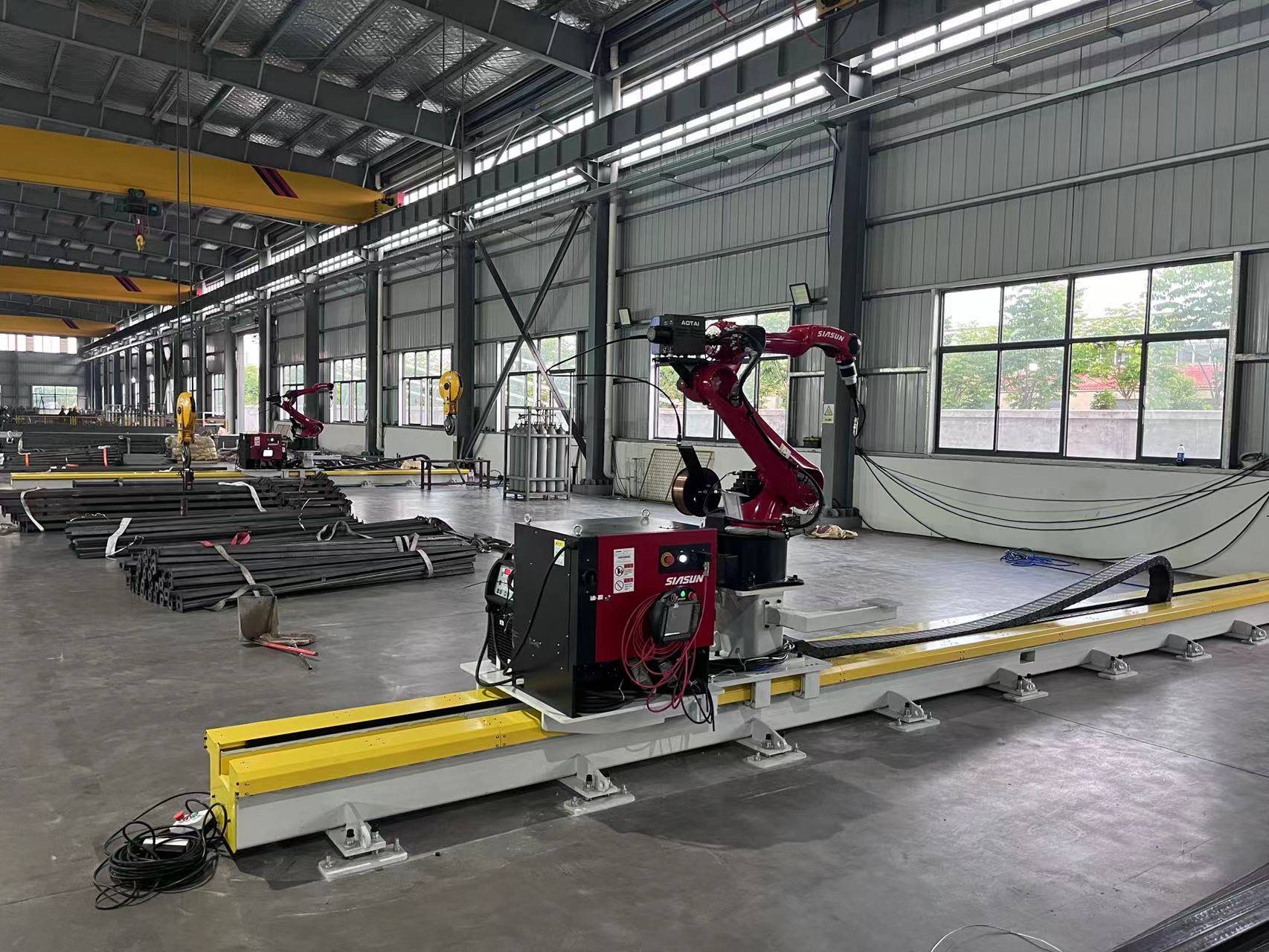
for Pressure Vessels, the MAG process is typically tuned to a pulsed-spray transfer mode. This configuration provides the energy required for deep penetration while minimizing spatter, which is essential for maintaining the cleanliness of the narrow groove. Intelligent power sources now feature waveform control that can oscillate the arc electromagnetically. This “virtual” weave ensures that both sidewalls of the narrow gap are sufficiently wetted without the mechanical wear associated with high-frequency physical torch oscillation.
Maintenance Framework for High-Duty Cycle Robots
From an operational maintenance perspective, a robotic MAG cell is a high-precision machine tool that happens to generate heat and smoke. To ensure 95%+ uptime, maintenance must move from reactive to predictive models. The most common point of failure in MAG welding automation is the wire delivery system. Because NGW torches are often elongated to reach deep into narrow joints, the friction within the liner is increased.
Consumable Management and Torch Calibration
The contact tip is the primary consumable that dictates arc stability. In an intelligent system, the controller monitors the “arc hours” and can trigger an automatic tip change via a tool changer or alert an operator before the orifice erodes enough to cause arc wander. Furthermore, the robotic cell must include an automated torch cleaning station (reamer). Every 30 to 60 minutes of arc-on time, the robot should cycle through a cleaning station to remove spatter from the nozzle and apply anti-spatter fluid, ensuring gas flow remains laminar and shielding remains 100% effective.
Mechanical Integrity of the Manipulator
The secondary maintenance focus is the calibration of the Tool Center Point (TCP). In pressure vessel welding, where welds may take dozens of passes over several hours, any drift in the robot’s encoders or a slight collision can ruin the piece. Daily automated TCP checks using a fixed sensing point ensure that the robot’s spatial orientation remains within a +/- 0.1mm tolerance. This is non-negotiable for high-pressure applications where radiographic testing (RT) is the standard for acceptance.
Economic Impact and Labor ROI Analysis
The ROI for an intelligent robotic welder is not merely found in the replacement of a human welder, but in the radical change in “Duty Cycle.” A skilled manual welder typically maintains a 20-30% arc-on time due to fatigue, heat exposure, and the need for frequent repositioning. A robotic system, particularly when paired with a heavy-duty positioner or rotators, can achieve an arc-on time of 75-85%.
Calculating Throughput Gains
Consider a pressure vessel with a 50mm wall thickness. A standard V-groove requires approximately 15-20 passes. A narrow gap preparation might reduce that to 8-10 passes. When combined with the increased duty cycle of the robot, the total fabrication time for the longitudinal and circumferential seams is often reduced by 50% to 70%. This allows a single facility to double its annual vessel output without expanding its physical footprint.
Labor Transition and Skill Upshift
While the initial capital expenditure (CAPEX) for a robotic NGW system is high, the labor ROI is realized through the shift from “manual welders” to “robotic technicians.” One technician can often oversee two robotic cells simultaneously. The “intelligence” of the system—specifically automated weld tracking—reduces the need for the operator to have the manual dexterity of a master welder, focusing instead on parameters, metallurgy, and system uptime. This mitigates the risk posed by the global shortage of certified high-pressure welders.
Quality Assurance and Defect Mitigation
In the context of ASME Section VIII or similar international standards, weld consistency is paramount. Robotic systems provide a digital footprint for every weldment. Every inch of the weld can be logged with voltage, current, travel speed, and gas flow data. This data logging serves as a “digital twin” of the physical weld, providing a level of quality assurance that manual logs cannot match. If a defect is found during ultrasonic testing (UT), the engineering team can review the data logs to identify the exact parameter deviation that caused the issue, facilitating a root-cause analysis that prevents future occurrences.
Furthermore, the reduction in filler metal volume directly correlates to a reduction in total weld shrinkage. This results in better dimensional stability of the pressure vessel, reducing the need for post-weld heat treatment (PWHT) corrections or mechanical straightening. The lower net heat input also preserves the toughness of the base material, which is a critical safety factor for vessels operating in cryogenic or high-cycle fatigue environments.
Closing Engineering Summary
The implementation of an intelligent robotic welder for narrow gap MAG welding is a strategic pivot for any heavy industrial manufacturer. By focusing on the reduction of weld volume through narrow gap geometry and ensuring process stability via adaptive sensing and rigorous maintenance, companies can achieve a quantum leap in productivity. The ROI is driven by three factors: the reduction in consumable costs, the massive increase in arc-on duty cycles, and the elimination of costly rework through digitized process control. As the industry moves toward more stringent safety standards and leaner manufacturing models, robotic MAG welding becomes the baseline for competitive pressure vessel production.






