Optimizing Shipbuilding Through Magnetic Crawler Automation
In the heavy industrial sector of shipbuilding, the structural integrity of a vessel is primarily dictated by the quality and consistency of kilometers of welded seams. Traditional manual welding in shipyards presents significant bottlenecks, including ergonomic constraints, fluctuating weld quality, and high labor turnover. The introduction of the Intelligent Robotic Welder with a magnetic crawler addresses these variables by providing a stabilized platform for magnetic crawler welding applications. This system utilizes high-strength permanent magnets or electromagnets to adhere to the curved and flat steel plates of a hull, allowing for continuous operation in vertical, horizontal, and overhead positions without the need for extensive scaffolding or secondary support structures.
Process Parameters of Integrated MAG Welding
The core of this robotic system is the Metal Active Gas (MAG) welding torch integration. Unlike manual processes where the welder must maintain a steady hand-to-workpiece distance while navigating heat stress, the robotic crawler utilizes advanced sensors for real-time seam tracking. The MAG process, typically employing a mixture of Argon and CO2, is optimized for high deposition rates. By automating this, engineers can standardize wire feed speeds, voltage settings, and travel speeds to achieve a uniform weld bead profile.
The robotic controller manages the arc length and weave patterns, ensuring that the fusion zone remains consistent even when the crawler encounters slight surface irregularities. This precision reduces the occurrence of common defects such as undercut, porosity, and lack of fusion. In a shipyard environment, the ability to maintain a constant “torch-on” time is the primary driver for throughput, shifting the focus from individual welder skill to system-level process control.
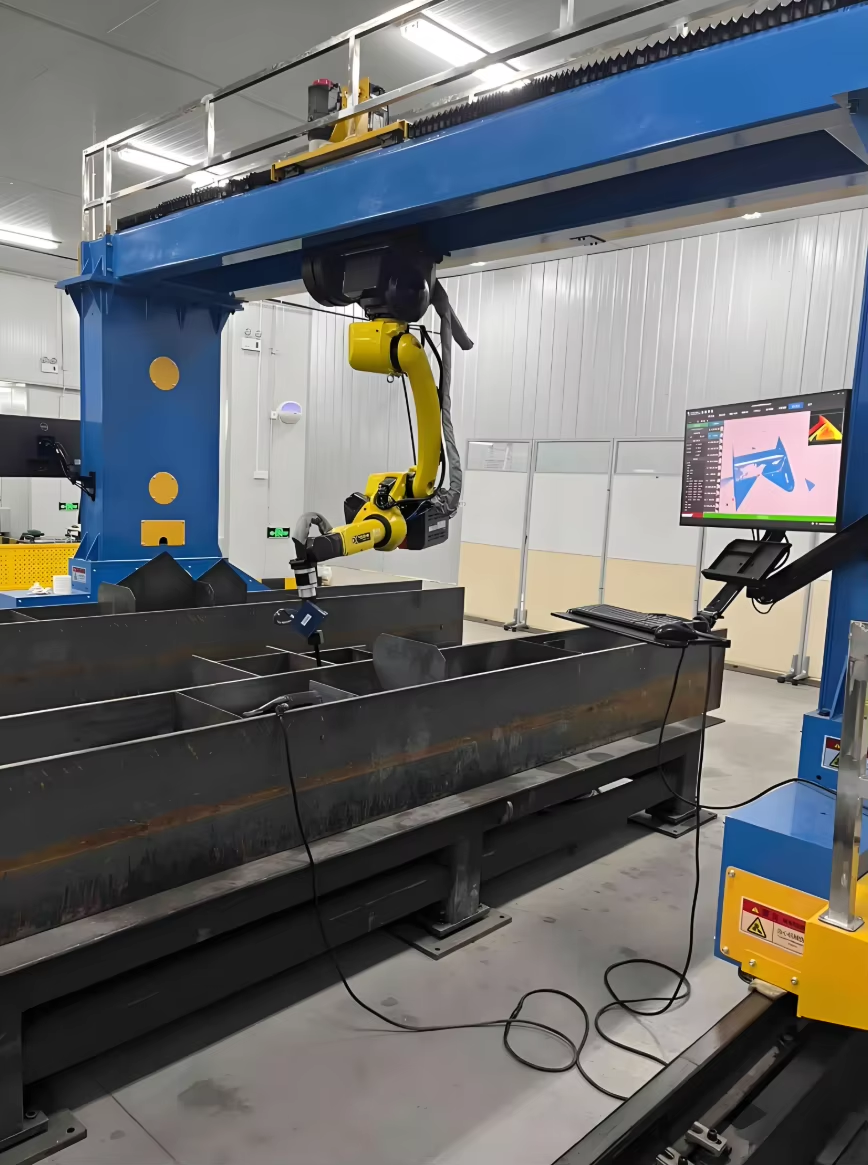
Labor ROI and Economic Impact Analysis
The shift toward MAG welding automation is fundamentally an economic decision driven by the Return on Investment (ROI). To calculate the ROI of a robotic magnetic crawler, industrial engineers must compare the “Duty Cycle” of a human welder versus the machine. A manual welder in a shipyard typically achieves a duty cycle of 20% to 30%, accounting for breaks, repositioning, and fatigue. In contrast, a magnetic crawler system can operate at a duty cycle exceeding 75%.
Consider the following ROI factors:
- Deposition Rates: Robotic MAG systems can deposit 5-8 kg of weld metal per hour, compared to 2-3 kg in manual applications.
- Rework Reduction: Manual welding in confined or awkward spaces often results in a 10-15% NDT (Non-Destructive Testing) failure rate. Automation typically brings this below 2%.
- Labor Allocation: Implementing robots does not eliminate the need for skilled workers; it shifts them from high-risk, low-ergonomic tasks to “Robot Operator” roles, where one technician can oversee multiple crawler units simultaneously.
By quantifying the reduction in gas consumption, wire waste, and the elimination of scaffolding costs, the shipbuilding productivity metrics show that most magnetic crawler units reach a break-even point within 12 to 18 months of active deployment in a high-volume shipyard.
System Maintenance and Reliability Protocols
For an automated system to remain profitable, a rigorous maintenance schedule must be enforced, particularly given the harsh, saline, and dusty environment of a shipyard. The magnetic crawler is subjected to metallic dust, which can accumulate on the magnetic wheels and interfere with the traction or the encoder accuracy. Maintenance protocols should be divided into three categories: Mechanical, Electrical, and Torch-End components.
Mechanical and Magnetic Integrity
The crawler’s magnetic modules must be inspected weekly for debris accumulation. Metallic filings attracted to the magnets can score the hull plating or cause the crawler to “slip.” Drive chains and gearboxes require lubrication intervals based on “arc-on” hours. Furthermore, the seals on the motor housings must be checked to prevent the ingress of fine grinding dust or moisture.
MAG Torch and Consumables Management
The welding torch is the most frequent point of failure. Automated “reamer” stations or nozzle cleaners should be integrated into the workflow to remove spatter automatically. Contact tips must be replaced according to a predictive schedule—not just when they fail—to ensure consistent electrical conductivity and wire positioning. Additionally, the wire conduit (liner) should be blown out with compressed air every shift change to prevent friction buildup which can lead to “bird-nesting” at the wire feeder.
Seam Tracking and Intelligent Feedback Loops
The “intelligence” of the robotic welder refers to its ability to adapt to real-world deviations. In shipbuilding, large-scale assemblies rarely align with 100% theoretical accuracy. High-speed laser sensors (used for tracking, not cutting) or “through-the-arc” sensing technology allow the crawler to adjust its path in real-time. If the gap between two plates widens, the system automatically slows its travel speed and increases the weave width to fill the joint effectively.
This closed-loop feedback system ensures that the Robotic Welding ROI is protected against material variability. Instead of stopping the process to recalibrate, the machine makes micro-adjustments that maintain the structural integrity required by maritime classification societies (such as ABS or DNV). This level of autonomy is critical for long-seam welding on hull sections where the crawler may travel 10 or 20 meters without direct human intervention.
Safety and Environmental Considerations
Moving the welder away from the immediate vicinity of the arc significantly improves occupational health and safety (OHS) outcomes. The reduction in exposure to hexavalent chromium and other welding fumes is substantial. From an environmental standpoint, the precision of robotic MAG welding results in less shielding gas waste and lower energy consumption per meter of weld. By optimizing the arc parameters, the system minimizes spatter, which reduces the post-weld cleaning labor—a frequently overlooked cost in industrial engineering audits.
Conclusion of Implementation Strategy
The transition to intelligent magnetic crawler welders is not merely a hardware upgrade but a fundamental shift in shipbuilding manufacturing philosophy. By focusing on the MAG process and the mechanical reliability of the crawler, shipyards can achieve a level of standardization previously impossible. The ROI is substantiated not just by speed, but by the radical reduction in rework and the stabilization of production schedules. As the industry moves toward more complex vessel designs, the ability to deploy autonomous, high-quality welding units in challenging environments will be the defining factor in competitive shipyard throughput.
-


LT240S tube laser cutting machine
-
LT120S tube laser cutting machine
-
Sale

Tank Fillet Welding Machine
Original price was: $1,000.00.$900.00Current price is: $900.00. -
Sale

MAK100 tube laser cutting machine
Original price was: $5,500.00.$5,000.00Current price is: $5,000.00. -

portable plasma air cutting machine
$1,200.00 -

2in1 fiber laser cutting machine
-

Air cooling Laser welding machine
-

HF h beam laser cutting machine
-

LT240 laser cutting machine
-

Laser welding machine
-


Cobotic Welding Station
-

Gantry welding robot solution
-

Tracked Wheeled AGV Welding robot
-

LFH6020 Fiber laser cutting machine
-
LFP6020
-

robotic welidng machine
