Optimization of LNG Infrastructure via Robotic MAG Welding
Liquefied Natural Gas (LNG) storage tanks and transport vessels require thousands of linear meters of high-integrity welds. Traditionally, these structures, often composed of 9% nickel steel or specialized stainless alloys, were welded using manual or semi-automatic processes. However, the scale of modern energy projects necessitates a transition toward automated MAG welding. An Intelligent Robotic Welder equipped with a magnetic crawler provides the precision required for these high-stakes environments, ensuring that the structural integrity of cryogenic containment systems meets international safety standards while drastically reducing the project timeline.
Mechanical Architecture of Magnetic Crawler Systems
The core of the robotic system is the magnetic crawler, a high-traction mobile platform designed to traverse vertical and inverted ferromagnetic surfaces. Unlike track-based systems that require the manual installation of guide rails, the magnetic crawler utilizes high-strength permanent magnets or switchable electromagnets. This allows for rapid deployment on the large radii of LNG storage tanks. The kinematics of the crawler are controlled by onboard encoders that provide real-time feedback on travel speed, ensuring a constant torch velocity which is critical for maintaining uniform heat input.
Stability is the primary engineering challenge for vertical-up welding. The magnetic force must be sufficient to support the weight of the crawler, the wire feeder, and the umbilical cables while maintaining a low center of gravity to prevent peeling or sliding. Advanced systems utilize four-wheel or continuous track drives with independent suspension to compensate for surface irregularities, such as weld reinforcement from previous passes or plate misalignment.
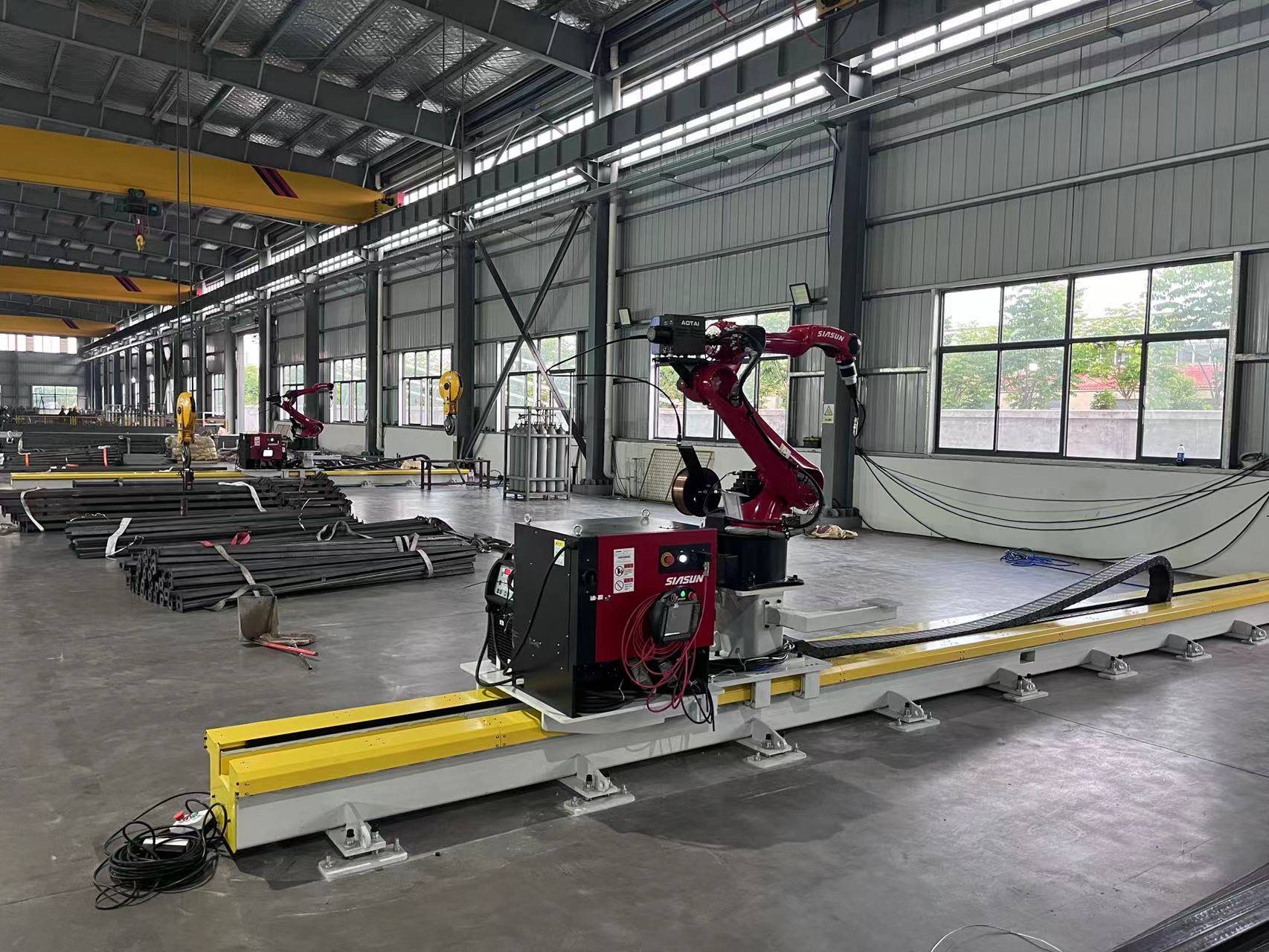
Intelligent MAG Welding Parameters for LNG Projects
Metal Active Gas (MAG) welding is the preferred process for these robotic systems due to its high deposition rate and ability to be easily automated. In the context of LNG projects, the shielding gas composition typically involves a mixture of Argon and CO2, optimized to stabilize the arc and minimize spatter. The robotic controller manages the pulsing parameters of the power source, allowing for “spray transfer” mode even in vertical positions, which is traditionally difficult for manual welders to sustain.
The integration of “intelligent” features refers to the seam tracking sensors—often ultrasonic or laser-profile based (for tracking, not cutting)—that adjust the torch position in real-time. If the crawler deviates from the joint centerline due to gravitational pull or surface slip, the system compensates instantly. This ensures that the weld bead remains centered, achieving 100% penetration and reducing the likelihood of lack-of-fusion defects that are common in manual out-of-position welding.
Metallurgical Consistency and Heat Input Control
For cryogenic applications, controlling the Heat Affected Zone (HAZ) is vital. Excessive heat input can lead to grain growth and reduced fracture toughness at extremely low temperatures. The robotic system’s ability to maintain a precise travel speed ensures that the heat input (kJ/mm) remains within the strict tolerances defined by the Welding Procedure Specification (WPS). This level of consistency is virtually impossible to achieve manually over an eight-hour shift due to operator fatigue.
Labor ROI and Productivity Metrics
The shift from manual labor to labor ROI through automation is driven by the “Duty Cycle” metric. A manual welder typically maintains an “arc-on” time of 25% to 30% due to the need for repositioning, electrode changes, and physical breaks. In contrast, a magnetic crawler system can achieve a duty cycle of 70% to 85%. When calculating the Return on Investment, project engineers must look beyond the initial capital expenditure (CAPEX) and focus on the cost per kilogram of weld metal deposited.
Consider a standard LNG tank project:
The robotic system can operate at travel speeds 2x to 3x faster than manual vertical-up welding. Furthermore, the defect rate—and subsequent repair costs—drops significantly. In manual welding, the “Repair Rate” often hovers between 3% and 5% in difficult positions. Robotic systems frequently bring this below 0.5%. When the cost of Non-Destructive Testing (NDT) and the time required for gouging out and re-welding defects are factored in, the robotic system typically pays for itself within the first 6 to 9 months of active site work.
Maintenance Protocols for Robotic Welders
To maintain peak performance, a strict preventative maintenance schedule is required. Unlike a manual welding power source that requires minimal upkeep, the magnetic crawler is a complex mechatronic assembly. Maintenance is categorized into three tiers:
Daily Operational Checks
Operators must inspect the magnetic drive wheels for the accumulation of metallic dust and spatter, which can interfere with magnetic adhesion. The contact tip and gas nozzle must be cleaned or replaced to ensure stable gas flow and electrical contact. The wire feed rollers must be checked for tension to prevent “bird-nesting” of the welding wire within the umbilical.
Periodic Mechanical Calibration
Every 200 hours of operation, the crawler’s drive train and encoders require calibration. This ensures that the travel speed reported by the software matches the physical displacement on the steel plate. Additionally, the umbilical cables should be inspected for thermal damage or insulation wear, as any resistance change can affect the voltage drop and, consequently, the arc characteristics.
Software and Sensor Integration
The “intelligence” of the system relies on the accuracy of its sensors. Periodic firmware updates and sensor recalibration are necessary to ensure the seam-tracking algorithms remain responsive to the specific reflective properties of the base metal. Ensuring cryogenic containment integrity depends on these sensors correctly identifying the root gap and adjusting the oscillation width of the MAG torch accordingly.
Workforce Transition and Technical Skillsets
The introduction of robotic crawlers does not eliminate the need for skilled labor but rather shifts the required skillset. The “Welder” becomes a “Robotic Systems Operator.” This individual must understand both the metallurgy of MAG welding and the basics of robotic troubleshooting. This transition reduces the physical strain on the workforce—moving them from hazardous, cramped positions at height to a ground-based control station—thereby reducing long-term health and safety liabilities for the contractor.
Enhancing Project Scalability
For large-scale LNG exporters, the ability to deploy multiple magnetic crawler kinematics units simultaneously allows for parallel construction paths. While one crew focuses on the floor plates, multiple robots can work on the shell rings. This modularity in the construction process is what allows modern energy infrastructure to meet the aggressive timelines of the global gas market. The repeatability of the robotic process ensures that the first weld of the project is identical in quality to the last, a feat that is statistically improbable with a 100% manual workforce.
Conclusion on Industrial Implementation
In summary, the integration of intelligent magnetic crawlers for MAG welding in LNG projects is an industrial necessity. By focusing on high-deposition MAG processes and leveraging the mechanical advantages of magnetic adhesion, engineering firms can ensure superior weld quality and optimized labor costs. The maintenance of these systems, while more intensive than manual equipment, is a minor trade-off for the substantial gains in productivity and the drastic reduction in rework. As LNG infrastructure continues to grow in scale, the reliance on automated Robotic Welding will become the benchmark for operational excellence.
-


LT240S tube laser cutting machine
-
LT120S tube laser cutting machine
-
Sale

Tank Fillet Welding Machine
Original price was: $1,000.00.$900.00Current price is: $900.00. -
Sale

MAK100 tube laser cutting machine
Original price was: $5,500.00.$5,000.00Current price is: $5,000.00. -

portable plasma air cutting machine
$1,200.00 -

2in1 fiber laser cutting machine
-

Air cooling Laser welding machine
-

HF h beam laser cutting machine
-

LT240 laser cutting machine
-

Laser welding machine
-


Cobotic Welding Station
-

Gantry welding robot solution
-

Tracked Wheeled AGV Welding robot
-

LFH6020 Fiber laser cutting machine
-
LFP6020
-

robotic welidng machine
