Advancing Bridge Truss Fabrication via Magnetic Crawler Robotics
The structural integrity of bridge trusses depends heavily on the consistency and quality of deep-penetration welds. Traditional manual welding in these environments presents significant logistical challenges, including welder fatigue, ergonomic constraints at height, and the inherent difficulty of maintaining a constant travel speed across vertical or overhead sections. The introduction of the magnetic crawler welder represents a shift toward mobile automation, where the robot moves to the workpiece rather than the workpiece being positioned for the robot.
These systems utilize high-flux permanent magnets or switchable electromagnets to adhere to the steel surfaces of the trusses. This allows for precise movement across the webs and chords of the structure, providing a stable platform for the Metal Active Gas (MAG) welding process. By digitizing the welding parameters and automating the motion path, manufacturers can achieve structural certifications with a higher degree of repeatability than manual processes allow.
Kinematics and Adhesion Mechanics
An intelligent crawler system typically features a four-wheel or continuous track drive system integrated with a compact 6-axis robotic arm. The adhesion force must be calculated to account for the weight of the crawler, the welding torch, the wire feeder, and the dynamic forces generated during movement. for Bridge Trusses, which often involve thick-plate carbon steel, the magnetic interface must be capable of overcoming surface irregularities like mill scale or rust while maintaining a constant gap for encoder accuracy.
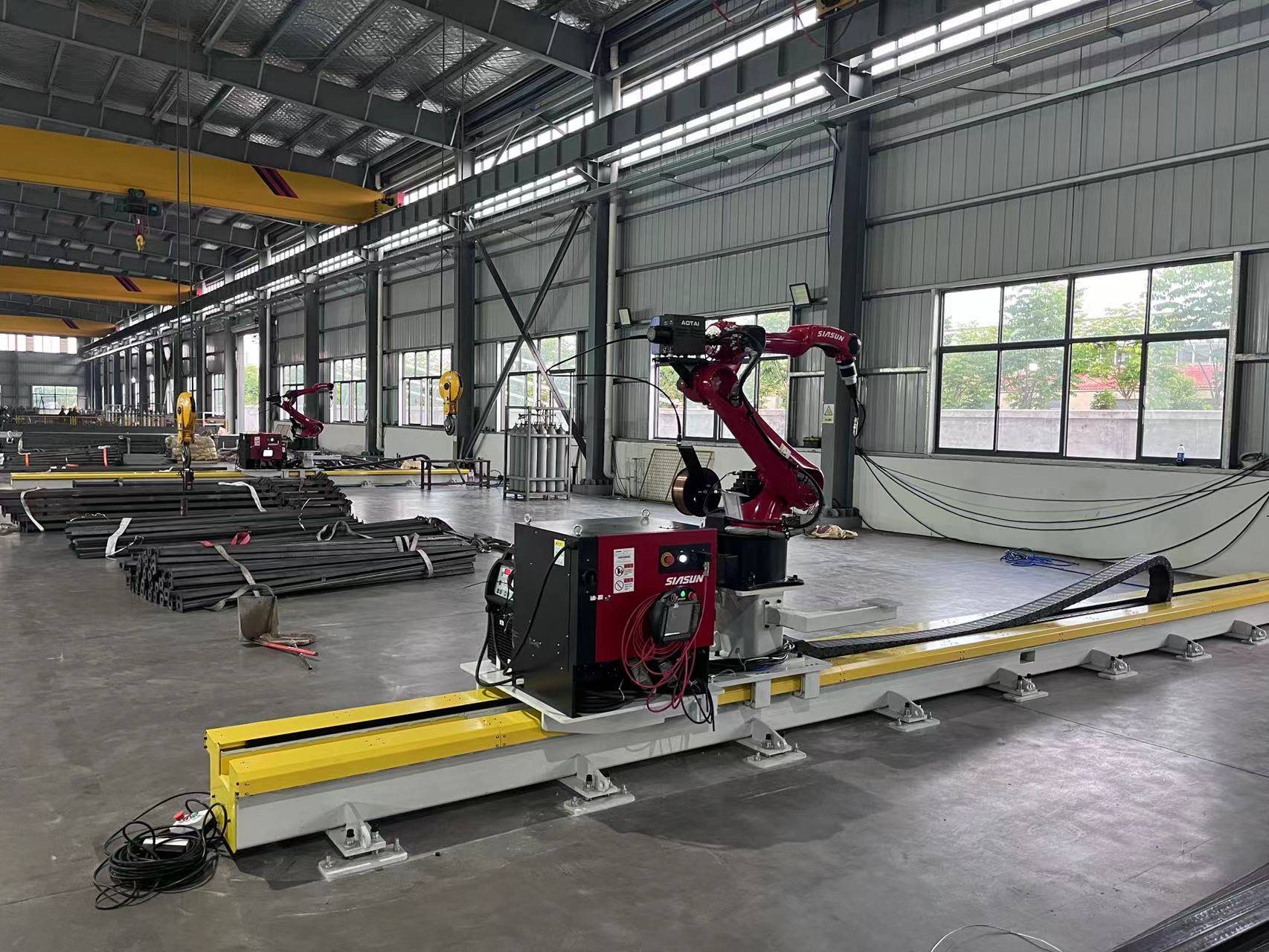
The integration of a localized controller allows the robot to perform adaptive seam tracking. Using tactile or through-the-arc sensing, the system adjusts the torch position in real-time to compensate for fit-up discrepancies or thermal distortion. This is critical in bridge fabrication, where large-scale components rarely meet the tight tolerances required for pre-programmed robotic paths.
Optimizing the MAG Welding Process for Structural Steel
Metal Active Gas (MAG) welding is the preferred process for bridge trusses due to its high deposition rates and suitability for carbon steel. In automated crawler applications, the system is usually configured for spray transfer or pulsed-arc modes to minimize spatter and ensure deep fusion into the root of the joint. The use of CO2 and Argon gas mixtures facilitates a stable arc that can withstand the environmental drafts often found in large-scale assembly shops.
Deposition Efficiency and Duty Cycle
In manual welding, the duty cycle (arc-on time) rarely exceeds 25% to 30% due to the need for repositioning, electrode changes, and operator breaks. A robotic MAG welding crawler can push the duty cycle toward 75% or higher. Because the crawler carries the wire feeder or is fed by a continuous drum, interruptions are minimized. For a standard bridge truss joint, this translates to a 2x or 3x increase in the linear meters of weld produced per shift.
Wire Feed and Torch Management
The crawler system must manage the umbilical containing the power cables, gas hoses, and wire liners. Industrial engineers must optimize the wire feed speed (WFS) in relation to travel speed to maintain the required throat thickness and leg length of the fillet welds. Intelligent systems monitor the arc voltage and current continuously; any deviation from the qualified Welding Procedure Specification (WPS) triggers an immediate stop, preventing the production of sub-standard joints that would require expensive gouging and repair.
Maintenance Protocols for High-Availability Systems
Maintenance for robotic crawlers is divided into the mechanical chassis and the welding subsystem. Given the harsh environment of a fabrication shop, a preventative maintenance schedule is mandatory to avoid unplanned downtime. The presence of metallic dust and spatter requires specific attention to the magnetic drive units to prevent buildup that could interfere with adhesion or movement.
Crawler Chassis and Drive Train
The magnets must be inspected weekly for cracks or loss of flux density. In electromagnetic models, the integrity of the power supply and fail-safe mechanical brakes must be verified. The tracks or wheels require cleaning to ensure the coefficient of friction remains high enough to prevent slipping on vertical surfaces. Bearings and gearboxes should be lubricated according to the manufacturer’s MTBF (Mean Time Between Failures) data, typically every 500 hours of operation.
Welding Torch and Consumables
The MAG torch on a robot undergoes higher thermal stress than a manual torch due to extended arc-on times. Maintenance includes:
1. Contact Tip Inspection: Automated systems often use harder alloys for contact tips to resist wear from continuous wire feeding. These should be replaced based on wire throughput metrics.
2. Nozzle Cleaning: Automated reaming stations should be used to clear spatter buildup, ensuring laminar flow of the shielding gas.
3. Liner Replacement: The wire liner must be blown out with compressed air to remove copper flaking, preventing wire feed hesitations that cause arc instability.
Economic Feasibility and Labor ROI
The primary driver for adopting magnetic crawler robots in bridge construction is the labor ROI. The global shortage of certified structural welders has increased labor costs and extended project timelines. By implementing robotic solutions, firms can shift their highly skilled human capital from performing repetitive, grueling welds to supervising multiple robotic units and performing complex fit-up tasks.
Quantitative Labor Displacement and Efficiency
To calculate the ROI, consider a standard truss project requiring 10,000 meters of weld. A manual welder may average 2 meters per hour when accounting for setup and fatigue. A magnetic crawler can average 5 meters per hour. Over the course of the project, the robot reduces the total man-hours required for welding by 60%. When factoring in the reduction in rework—often 10-15% in manual bridge welding but less than 1% in robotic applications—the capital expenditure (CAPEX) for the robot is often recovered within the first 12 to 18 months of operation.
Reduction in Indirect Costs
Beyond direct labor, the ROI is bolstered by a reduction in indirect costs. These include the elimination of scaffolding or specialized lift equipment required for manual welders to reach high points on a truss. The crawler inherently navigates these areas, reducing the safety risk profile and the associated insurance premiums. Furthermore, the precise control over MAG parameters reduces the over-welding common in manual processes, leading to a 5-10% saving in consumable wire and shielding gas usage.
Quality Assurance and Digital Documentation
Modern bridge fabrication requires stringent documentation for every joint. Intelligent Robotic Welders provide a digital footprint of the welding process. Parameters such as heat input, travel speed, and gas flow are logged in real-time. This automated structural welding data can be integrated into a Building Information Modeling (BIM) system, providing an “as-built” digital twin of the truss. This transparency simplifies the inspection process for third-party quality auditors and provides long-term liability protection for the fabricator.
Conclusion on Systemic Integration
The transition to intelligent magnetic crawler robots for bridge truss MAG welding is an engineering necessity in the face of rising labor costs and tightening quality requirements. By focusing on the mechanical reliability of the crawler, the precision of the MAG process, and a rigorous maintenance schedule, industrial facilities can significantly improve their throughput. The resulting ROI is not merely found in faster weld times, but in the systematic reduction of rework, consumables waste, and safety-related overhead.
-


LT240S tube laser cutting machine
-
LT120S tube laser cutting machine
-
Sale

Tank Fillet Welding Machine
Original price was: $1,000.00.$900.00Current price is: $900.00. -
Sale

MAK100 tube laser cutting machine
Original price was: $5,500.00.$5,000.00Current price is: $5,000.00. -

portable plasma air cutting machine
$1,200.00 -

2in1 fiber laser cutting machine
-

Air cooling Laser welding machine
-

HF h beam laser cutting machine
-

LT240 laser cutting machine
-

Laser welding machine
-


Cobotic Welding Station
-

Gantry welding robot solution
-

Tracked Wheeled AGV Welding robot
-

LFH6020 Fiber laser cutting machine
-
LFP6020
-

robotic welidng machine
