Integrating Intelligent Robotic MAG Welding in Naval Architecture
The shipbuilding industry is currently navigating a structural transition from manual intensive labor to high-output automated systems. The core of this evolution lies in the deployment of Intelligent Robotic Welders equipped with laser seam tracking capabilities. Unlike standard automotive welding, shipbuilding requires the management of massive plate thicknesses and extended weld paths that are susceptible to significant thermal deformation. By utilizing automated metal active gas welding, shipyards can achieve deposition rates that far exceed manual capabilities while maintaining the structural integrity required for oceanic vessels.
Industrial engineers focus on the MAG process because of its versatility and efficiency. In shipbuilding, the ability to control wire feed speeds, voltage, and travel speed through a centralized robotic controller allows for precise heat input management. This precision is critical when working with high-tensile steels where the heat-affected zone (HAZ) must be minimized to prevent brittle fractures. The integration of intelligent sensors allows the robot to adapt to the reality of the shipyard floor—where fit-up tolerances are rarely perfect.
The Mechanics of Laser Seam Tracking for Path Correction
In large-scale steel fabrication, pre-weld fit-up often presents gaps and misalignments that manual welders compensate for visually. An intelligent robotic system replaces this human intuition with laser-based triangulation. The sensor, mounted ahead of the welding torch, scans the joint geometry in real-time. This data is processed by the robot’s motion controller to adjust the torch position in three dimensions, ensuring the arc remains perfectly centered in the groove.
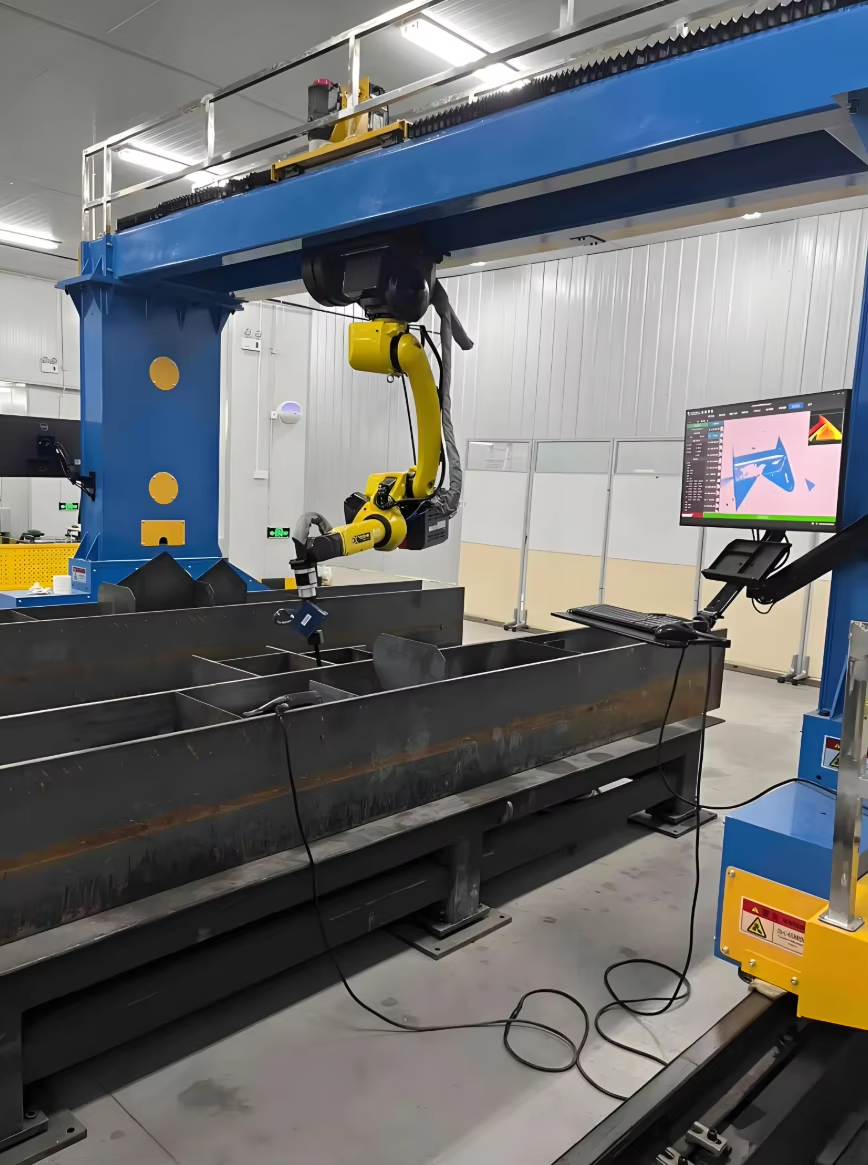
This “look-ahead” capability is essential for return on investment calculations because it drastically reduces the rate of weld defects. In shipbuilding, a single failed NDT (Non-Destructive Testing) result can lead to hours of carbon-arc gouging and rework. By ensuring the root pass is placed accurately despite plate warping, the robotic system secures the structural foundation of the vessel without human intervention. The system handles variations in root openings and bevel angles by dynamically adjusting the weave pattern and travel speed on the fly.
Operational Maintenance and Consumable Management
To maintain a high duty cycle, the Robotic Welding cell must be managed through a rigorous preventative maintenance schedule. Robotic MAG welding is a high-wear process; the mechanical components are exposed to constant spatter, heat, and metallic dust. An industrial engineer’s priority is to minimize unplanned downtime by standardizing the maintenance of the welding torch and wire delivery system.
Torch and Contact Tip Longevity
The contact tip is the most frequent point of failure. Constant friction with the welding wire leads to “keyholing,” which destabilizes the arc. Intelligent cells often include automated tip-changing stations or cleaning stations equipped with pneumatic reamers and anti-spatter injection systems. These sub-routines should be programmed to occur during part-loading cycles to ensure zero impact on the overall takt time.
Wire Feed System Integrity
In shipbuilding, wire drums are often located at a distance from the robotic arm. This requires a low-friction conduit system to prevent wire shavings from clogging the liner. Periodic inspection of the drive rolls and the tension settings is mandatory. If the wire feed speed fluctuates by even a small percentage, the deposition rate is compromised, leading to potential lack-of-fusion defects in the thick plate joints.
Labor ROI and Economic Impact Analysis
The primary driver for adopting robotic welding in shipyards is the scarcity of certified high-pressure welders and the rising cost of manual labor. However, the ROI calculation extends beyond simple wage replacement. It encompasses throughput increases, reduction in filler metal waste, and the elimination of secondary grinding operations.
Throughput and Deposition Rates
A manual welder typically operates at a 20-30% duty cycle due to the need for repositioning, slag removal (in SMAW), and fatigue. A robotic MAG system can operate at an 80-85% duty cycle. By increasing the arc-on time, the shipyard can move hull blocks through the assembly hall significantly faster. This acceleration reduces the overall build cycle of the vessel, allowing for higher yard turnover and increased revenue capacity.
Quality-Related Cost Reductions
Manual welding in awkward positions (overhead or vertical-up) is prone to porosity and inclusion defects. Robots, paired with laser tracking, maintain consistent torch angles and travel speeds that are physically impossible for a human to replicate over an eight-hour shift. When the “first-time-through” rate increases from 85% (manual) to 98% (robotic), the savings in inspection costs and repair materials contribute directly to the bottom line.
Skill Shift and Workforce Transition
The implementation of these systems does not eliminate the need for skilled personnel; rather, it shifts the requirement from manual dexterity to system programming and weld engineering. A single technician can oversee three to four robotic cells. This leverage of human capital is the cornerstone of modern industrial engineering in the maritime sector. The focus moves to optimizing parameters and supervising the preventative maintenance of the fleet of robots.
Technical Conclusion on MAG Process Optimization
The success of intelligent robotic welding in shipbuilding depends on the synergy between the laser tracking hardware and the MAG power source. Advanced waveforms, such as pulsed-MAG or modified short-circuit transfers, are utilized to control the droplet transfer precisely. This reduces spatter, which in turn reduces the cleaning time required for the finished hull sections. By integrating these advanced power sources with robotic precision, shipyards can weld thinner sections with less distortion and thicker sections with deeper penetration.
From an engineering perspective, the transition to automated metal active gas welding is an objective necessity. As vessel designs become more complex and global competition intensifies, the ability to produce high-quality, defect-free welds at a predictable rate is the only way to ensure long-term viability. The investment in robotic infrastructure, while significant, is amortized rapidly through the drastic reduction in rework and the exponential increase in daily steel throughput.
-


LT240S tube laser cutting machine
-
LT120S tube laser cutting machine
-
Sale

Tank Fillet Welding Machine
Original price was: $1,000.00.$900.00Current price is: $900.00. -
Sale

MAK100 tube laser cutting machine
Original price was: $5,500.00.$5,000.00Current price is: $5,000.00. -

portable plasma air cutting machine
$1,200.00 -

2in1 fiber laser cutting machine
-

Air cooling Laser welding machine
-

HF h beam laser cutting machine
-

LT240 laser cutting machine
-

Laser welding machine
-


Cobotic Welding Station
-

Gantry welding robot solution
-

Tracked Wheeled AGV Welding robot
-

LFH6020 Fiber laser cutting machine
-
LFP6020
-

robotic welidng machine
Advanced Fiber Laser Tube Processing Technology
Our CNC Fiber Laser Tube Cutting systems revolutionize metal fabrication by integrating high-precision cutting, punching, and profiling into a single automated workflow. Designed for versatility, this technology handles a wide array of profiles including Round, Square, Rectangular, and Oval tubes, as well as complex L-shaped and U-shaped channels.
- Precision Punching: High-speed hole punching with micron-level accuracy, eliminating the need for mechanical drilling or die-stamping.
- Complex Profiling: Advanced 3D pathing allows for intricate interlocking joints and specialized notch cuts, ideal for structural frames.
- High Material Efficiency: Intelligent nesting software minimizes scrap, reducing raw material costs across large production runs.
- Clean Finish: Delivers oxide-free, burr-free edges that require zero secondary grinding before welding.

Seamlessly processing multiple profiles with consistent precision.
Global Delivery & Logistics



From our high-tech manufacturing facility directly to your global site. PCL WeldCut ensures secure packaging, professional handling, and reliable international logistics to safeguard your equipment throughout the entire journey.
