Optimization of LNG Infrastructure through Robotic MAG Welding
The global demand for Liquefied Natural Gas (LNG) has necessitated a rapid expansion of storage terminals and regasification facilities. From an industrial engineering perspective, the construction of these facilities represents a massive logistical and technical challenge, particularly regarding the integrity of cryogenic storage tanks and high-pressure piping. Traditional manual welding methods are increasingly insufficient to meet the stringent quality standards and compressed timelines of modern energy projects. The transition toward an Intelligent Robotic Welder platform is no longer optional; it is a strategic requirement for maintaining structural integrity while optimizing throughput.
The primary welding methodology employed in these robotic cells is the Metal Active Gas (MAG) process. Unlike manual applications where human error can lead to fluctuations in travel speed or arc length, robotic MAG welding provides a controlled environment for consistent heat input. This is critical when working with specialized materials like 9% nickel steel, which is common in LNG inner tanks due to its toughness at cryogenic temperatures. Precise control over the weld pool ensures that the mechanical properties of the base metal are preserved, particularly within the heat-affected zone (HAZ).
The Mechanics of Laser Seam Tracking in Heavy-Wall Fabrication
In the context of large-scale LNG tank fabrication, variations in joint fit-up are inevitable. Thermal expansion, tack welding inconsistencies, and plate curvature create deviations that a “blind” robot cannot accommodate. This is where Laser Seam Tracking becomes the critical feedback loop for the system. By utilizing a laser triangulation sensor mounted ahead of the welding torch, the system scans the groove geometry in real-time. This data is processed by the robot controller to adjust the torch position (horizontal and vertical) and modify welding parameters such as wire feed speed or voltage on the fly.
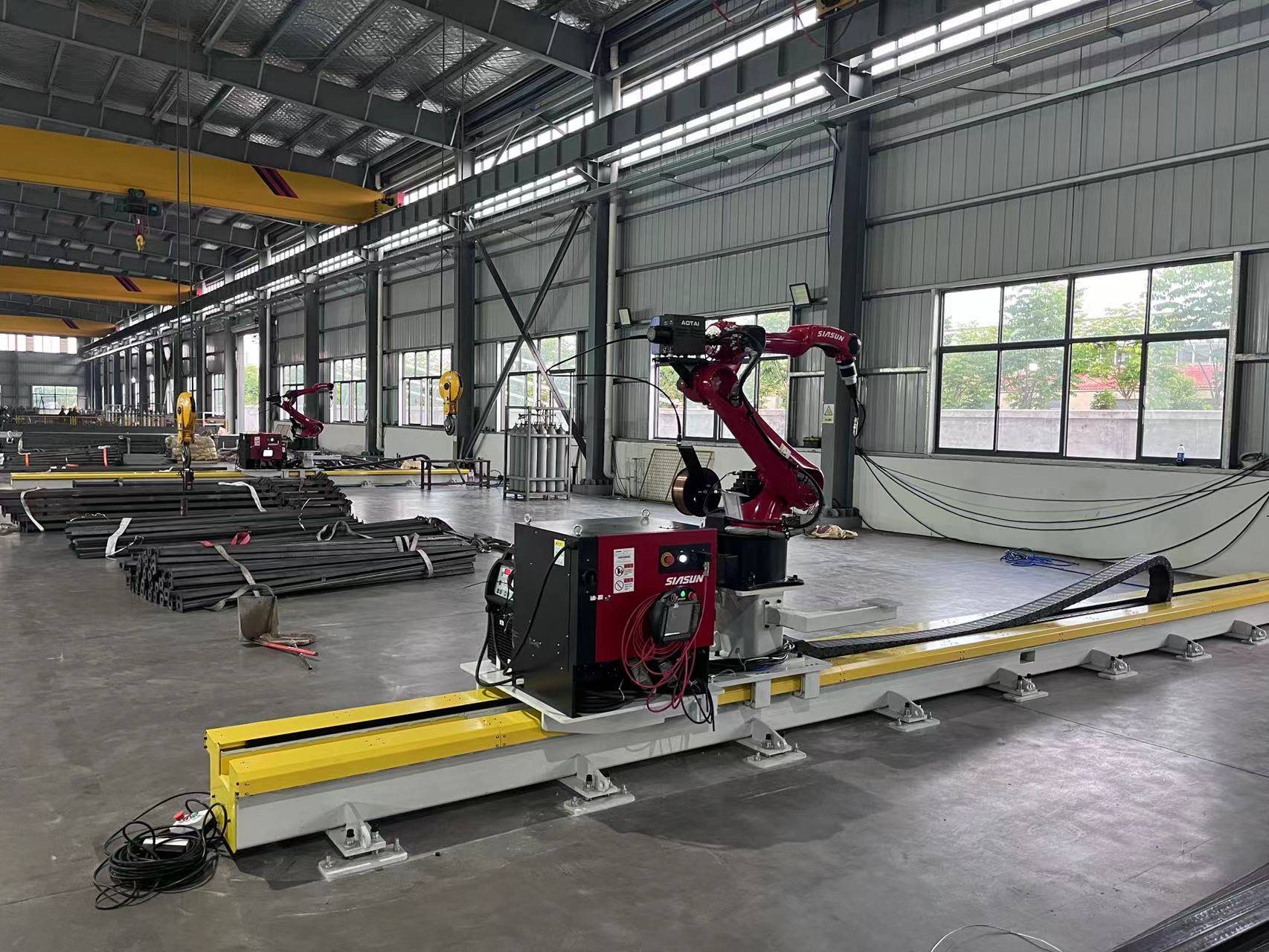
For industrial engineers, the value of seam tracking lies in the reduction of “non-value-added” time. Without real-time tracking, operators must spend significant hours on manual teach-pendant programming for every individual seam. With an intelligent system, the robot compensates for gaps and offsets automatically. This capability is particularly vital for long-seam girth welds on storage tanks, where a single continuous weld can span dozens of meters. The integration ensures that the arc remains perfectly centered in the root, regardless of minor structural misalignments.
Analyzing the MAG Welding Process for Cryogenic Applications
The MAG welding process in an automated environment focuses on three primary variables: deposition rate, shielding gas composition, and electrical stick-out. In LNG projects, high-deposition rates are required to fill thick-walled joints (often exceeding 25mm in thickness). Robotic systems allow for the use of pulsed-spray transfer modes, which minimize spatter and ensure deep penetration without the risk of burn-through. This level of control is impossible to maintain manually over an eight-hour shift due to physical fatigue.
Furthermore, the gas metal arc dynamics are stabilized through the robot’s ability to maintain a constant torch angle. In manual welding, the “drag” or “push” angle often fluctuates, leading to porosity or slag inclusions. The robotic interface integrates directly with high-performance power sources to synchronize the wire feed motor with the robotic arm’s velocity. If the seam tracker detects a wider gap, the system can automatically increase the weave width and decrease travel speed, ensuring the volume of the weld metal precisely matches the joint preparation.
Labor ROI and Economic Impact of Automation
One of the most significant metrics for an industrial engineer is the labor ROI. The shortage of certified high-pressure vessel welders has driven labor costs to historic highs. A Robotic Welding cell typically replaces three to four manual welders in terms of pure arc-on time. While the initial capital expenditure (CAPEX) for an intelligent robotic system is substantial, the payback period is shortened by the drastic reduction in rework and non-destructive testing (NDT) failures.
Manual welding in the LNG sector often sees repair rates between 3% and 5% due to human-induced defects like lack of fusion or undercut. In contrast, a calibrated robotic system with seam tracking can bring repair rates down to less than 0.5%. When considering the cost of grinding out a defective weld in a 30mm nickel-steel plate, the savings in consumables, labor, and project delays provide a compelling case for automation. Moreover, the “arc-on” time for a robot often exceeds 70%, compared to roughly 25-30% for a manual welder who requires breaks, repositioning, and equipment adjustments.
Maintenance Protocols for High-Availability Systems
To ensure the longevity and reliability of robotic welding units in harsh construction environments, a rigorous preventive maintenance schedule is essential. Industrial engineers must focus on the “Total Productive Maintenance” (TPM) of the cell. Key areas of focus include:
- Torch Consumables: Automatic nozzle cleaning stations must be programmed to clear spatter every 30-60 minutes of arc time to prevent shielding gas turbulence.
- Wire Feed Liners: Regular replacement of liners is necessary to prevent friction-induced “bird-nesting” at the feeder, which can stop production.
- Sensor Calibration: The laser seam tracking optics must be protected by sacrificial splash guards or air knives. Periodic recalibration ensures the spatial accuracy of the triangulation remains within the required +/- 0.1mm tolerance.
- Cable Management: In LNG tank welding, the robot often moves on long tracks or gantry systems. Managing the umbilical cables to prevent fatigue failure is a critical design consideration.
Predictive maintenance is the next frontier for these systems. By monitoring the motor current of the robot joints and the wire feed motor’s torque, engineers can identify impending failures before they cause downtime. For instance, an increase in wire feed torque often indicates a clogging liner or a degrading contact tip, allowing for a scheduled intervention during a shift change rather than an emergency stop during a critical weld pass.
Strategic Integration and Quality Assurance
The final pillar of intelligent robotic welding is the data logging capability. In LNG projects, every weld must be traceable. Modern robotic controllers can record “birth certificates” for every seam, logging the exact voltage, current, gas flow, and travel speed at every millisecond of the process. This digital twin of the welding procedure provides an unprecedented level of quality assurance. If an NDT scan eventually shows a localized defect, engineers can review the digital logs to identify the exact atmospheric or electrical anomaly that occurred at that specific coordinate.
This level of transparency is highly valued by project owners and regulatory bodies. It shifts the burden of quality from retrospective testing to real-time process control. By ensuring that the parameters never deviate from the qualified Welding Procedure Specification (WPS), the robot acts as both the fabricator and the first line of quality inspection.
Conclusion: The Future of LNG Construction
The transition to intelligent robotic welding with integrated tracking systems represents a fundamental shift in how global energy infrastructure is built. By focusing on the technical nuances of the MAG process and the economic realities of labor ROI, industrial engineers can drive significant improvements in project margins and safety. The combination of high-deposition automation and real-time path correction ensures that the massive storage solutions required for the global energy transition are built to the highest possible standards, with maximum efficiency and minimal waste.
-


LT240S tube laser cutting machine
-
LT120S tube laser cutting machine
-
Sale

Tank Fillet Welding Machine
Original price was: $1,000.00.$900.00Current price is: $900.00. -
Sale

MAK100 tube laser cutting machine
Original price was: $5,500.00.$5,000.00Current price is: $5,000.00. -

portable plasma air cutting machine
$1,200.00 -

2in1 fiber laser cutting machine
-

Air cooling Laser welding machine
-

HF h beam laser cutting machine
-

LT240 laser cutting machine
-

Laser welding machine
-


Cobotic Welding Station
-

Gantry welding robot solution
-

Tracked Wheeled AGV Welding robot
-

LFH6020 Fiber laser cutting machine
-
LFP6020
-

robotic welidng machine
