Optimization of Wind Tower Fabrication through Robotic MAG Systems
The manufacturing of utility-scale wind towers presents a unique set of structural engineering challenges. These structures, often exceeding 80 meters in height with base diameters surpassing 4 meters, require the welding of heavy-gauge carbon steel plates ranging from 20mm to over 50mm in thickness. Traditionally, these longitudinal and circumferential seams were managed via manual or semi-automated processes. However, the industry shift toward Intelligent Robotic Welder systems has redefined the benchmarks for throughput and structural integrity.
Industrial engineers are now prioritizing the deployment of 6-axis articulated robots integrated with advanced Metal Active Gas (MAG) power sources. Unlike traditional submerged arc welding (SAW) which is often limited to flat or horizontal positions, robotic MAG welding offers the dexterity required for complex geometry and multi-pass strategies. The core advantage lies in the consistency of the heat-affected zone (HAZ) and the minimization of weld defects such as porosity and cold laps, which are common in manual operations.
The Role of 3D Vision in Heavy-Duty Positioning
In wind tower fabrication, “perfect” fit-up is a theoretical ideal rather than a floor reality. Variations in plate rolling, thermal expansion, and tack-welding tolerances result in groove deviations that can cause catastrophic weld failure if not addressed in real-time. This is where 3D vision positioning becomes the critical “eye” of the system.
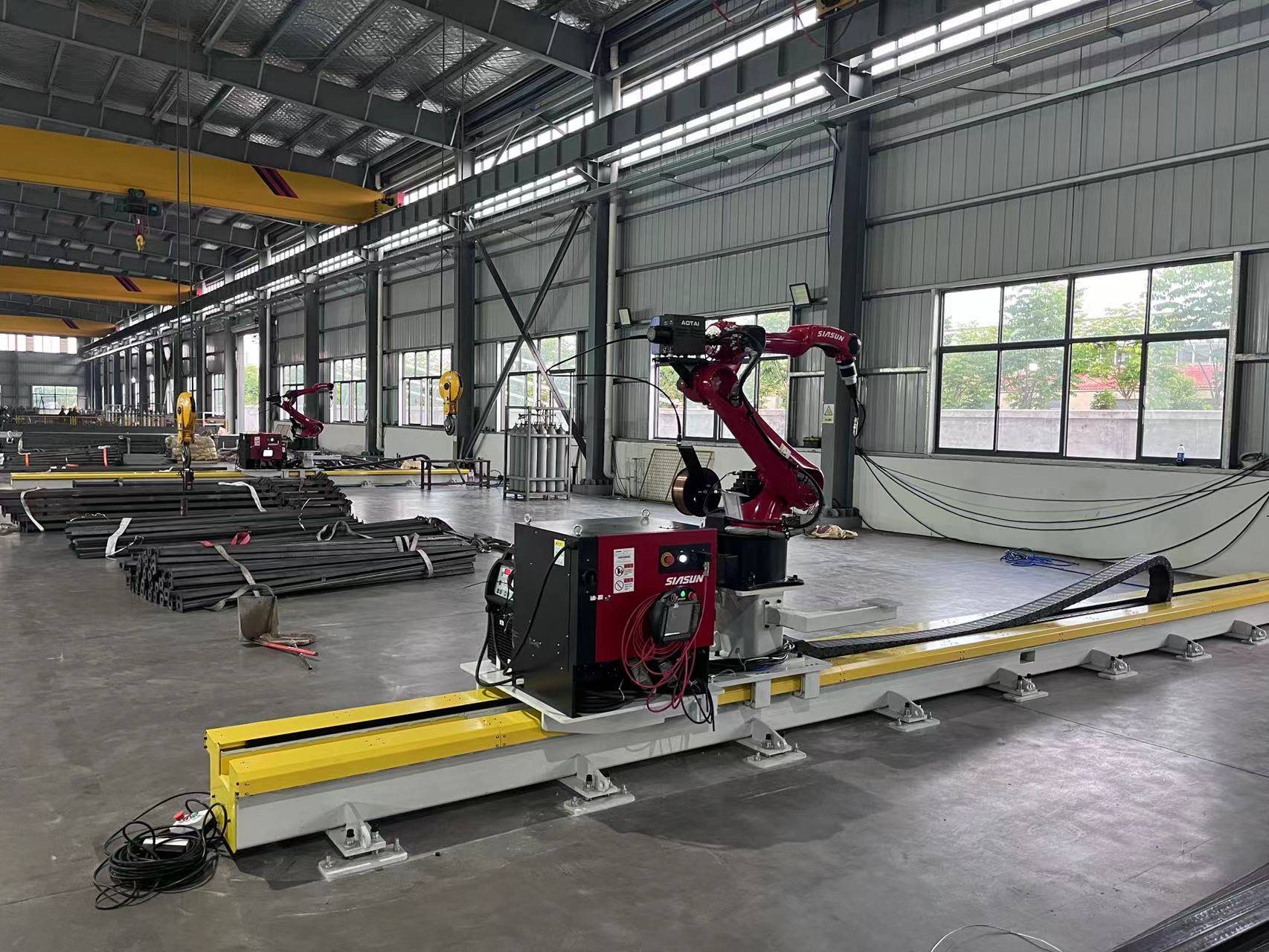
Modern systems utilize structured light or laser-profile sensors mounted to the robot’s faceplate. These sensors scan the weld joint ahead of the arc, generating a high-resolution point cloud. The system’s controller compares this real-time data against the programmed CAD path. By calculating the 3D Vision positioning offsets, the robot dynamically adjusts its Tool Center Point (TCP), travel speed, and oscillation width to compensate for gap variances. This ensures that the root pass achieves 100% penetration regardless of minor fit-up inconsistencies.
Technical Parameters of the MAG Process
For wind tower applications, the MAG process typically utilizes a shielding gas mix of Argon and CO2 (often an 80/20 or 90/10 ratio) to balance penetration depth with spatter control. The engineering focus remains on maximizing the deposition rate without compromising the mechanical properties of the weld metal.
High-performance robotic MAG systems utilize “Spray Transfer” or “Pulsed-MAG” modes. Pulsed-MAG is particularly effective for the out-of-position welds required on large-diameter tower sections, as it allows for a cooler weld pool and better control over the metal transfer. Engineers must calibrate the wire feed speed (WFS) and voltage parameters to match the specific tensile strength requirements of S355 or S420 structural steels commonly used in offshore and onshore towers.
Maintenance Protocols for Robotic Welding Cells
Uptime is the primary metric for any automated welding cell. In a high-duty cycle environment like a wind tower factory, the robotic hardware is subjected to intense thermal radiation and metallic dust. A robust preventive maintenance (PM) schedule is non-negotiable.
Daily and Shift-Based Maintenance
The most frequent point of failure is the torch consumables. Contact tips must be inspected every shift for “keyholing,” which affects the stability of the arc. Automatic nozzle cleaning stations (reamers) should be programmed to cycle every 30 to 60 minutes of arc-on time to remove spatter buildup and ensure laminar gas flow.
Weekly Technical Audits
The wire delivery system requires weekly inspection. This includes checking the drive rolls for wear and blowing out the torch liner with compressed air to remove copper flaking. Furthermore, the 3D Vision positioning sensor’s protective glass must be cleaned and inspected for pitting. Any degradation in the optical clarity of the sensor can lead to path-following errors and rework.
Labor ROI and Economic Impact Analysis
The financial justification for moving from manual to robotic welding in wind tower production is driven by the Labor ROI and the elimination of the “arc-on time” bottleneck. A manual welder typically maintains a duty cycle (the percentage of time spent actually welding) of 25% to 30% due to fatigue, positioning changes, and necessary breaks. In contrast, a robotic system can maintain a duty cycle of 75% to 85%.
Consider the following ROI metrics for a standard tower section:
| Metric | Manual MAG Welding | Robotic MAG with 3D Vision |
|---|---|---|
| Average Arc-On Time | 30% | 80% |
| Weld Defect Rate (NDT Failures) | 5-8% | <1.5% |
| Labor Requirement | 2 Welders / 2 Helpers | 1 Operator / 0.5 Technician |
| Throughput (Sections/Week) | 4 Units | 11 Units |
The reduction in Non-Destructive Testing (NDT) failures alone provides a significant cost saving. In wind tower fabrication, repairing a deep-seated weld defect in a thick plate requires gouging, re-welding, and re-testing, which can cost five times the original weld’s value. The robotic system’s ability to repeat parameters with 99.9% precision virtually eliminates these “hidden” costs.
Strategic Integration and Future Outlook
Integrating a robotic cell into a wind tower facility requires more than just hardware; it requires a shift in the production flow. The “upstream” processes, such as plate rolling and edge preparation, must be stabilized to ensure the 3D vision system operates within its optimal compensation range.
As the wind energy sector moves toward larger turbines (15MW+) and deeper offshore foundations, the demand for thicker plates and more complex welding geometries will grow. Robotic MAG welding, underpinned by intelligent 3D tracking, is the only scalable solution to meet these infrastructure needs while maintaining a competitive cost-per-kilowatt-hour. The transition from manual labor to high-tier automation is not merely a cost-saving measure but a necessary evolution for global energy security.
Summary of Engineering Benefits
In conclusion, the implementation of Intelligent Robotic Welder technology provides a triple-bottom-line benefit: it increases safety by removing human operators from the immediate vicinity of the arc, enhances quality through precision path-following, and secures the production schedule against the volatility of the skilled labor market. Industrial engineers focusing on wind energy must view these systems as the cornerstone of modern heavy fabrication.
-


LT240S tube laser cutting machine
-
LT120S tube laser cutting machine
-
Sale

Tank Fillet Welding Machine
Original price was: $1,000.00.$900.00Current price is: $900.00. -
Sale

MAK100 tube laser cutting machine
Original price was: $5,500.00.$5,000.00Current price is: $5,000.00. -

portable plasma air cutting machine
$1,200.00 -

2in1 fiber laser cutting machine
-

Air cooling Laser welding machine
-

HF h beam laser cutting machine
-

LT240 laser cutting machine
-

Laser welding machine
-


Cobotic Welding Station
-

Gantry welding robot solution
-

Tracked Wheeled AGV Welding robot
-

LFH6020 Fiber laser cutting machine
-
LFP6020
-

robotic welidng machine
