Integrating Intelligent Robotic Welder Systems in Shipyards
Shipbuilding remains one of the most demanding environments for industrial automation due to the sheer scale of components and the variability in fit-up tolerances. Traditional “teach-and-repeat” robotics often fail in this sector because large steel plates undergo thermal deformation during the assembly process. The introduction of an Intelligent Robotic Welder allows for a paradigm shift, moving away from fixed paths toward reactive, data-driven fabrication. By leveraging advanced sensors, these systems can identify the exact geometry of a joint before the arc is struck, ensuring that the weld path adheres to the actual workpiece rather than a theoretical CAD model.
The Role of 3D Vision Positioning in Tolerance Management
In maritime construction, gaps and offsets between hull blocks are inevitable. Standard robotic systems lack the “sight” required to compensate for these discrepancies. 3D Vision positioning solves this by utilizing structured light or stereo-vision cameras to generate a high-resolution point cloud of the weld joint. The system analyzes this data to calculate the gap width, root opening, and groove angle in real-time.
This spatial awareness enables “Adaptive Welding.” If the vision system detects a wider gap than anticipated, the robot controller automatically adjusts the oscillation width, travel speed, and wire feed rate. This prevents common defects such as burn-through or lack of fusion, which are frequent in manual shipbuilding operations. By digitizing the physical joint, the robot ensures that the Metal Active Gas (MAG) welding parameters are perfectly synchronized with the environmental reality.
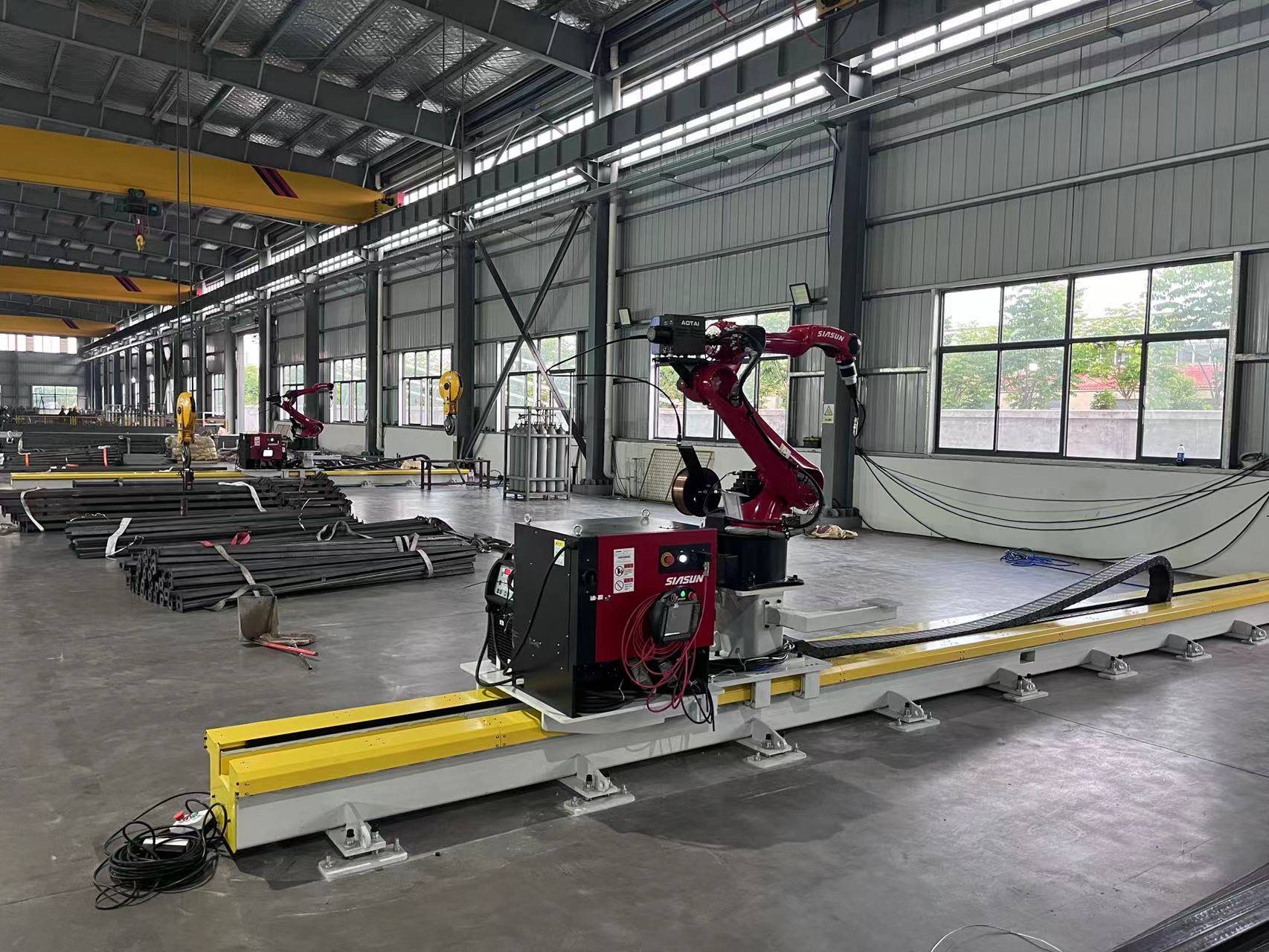
Optimizing the Metal Active Gas (MAG) Process
The selection of MAG welding for robotic ship construction is driven by its high deposition rates and versatility. Unlike manual processes where the welder must constantly adjust their hand position, a robotic system maintains a consistent contact-to-work distance (CTWD). This consistency is vital for maintaining arc stability and controlling the heat-affected zone (HAZ).
Parameter Control and Shielding Gas Efficiency
Intelligent systems utilize synergic power sources where the voltage and amperage are coupled to the wire feed speed. In shipbuilding, where thick-section carbon steel is prevalent, pulse-MAG settings are often employed to reduce spatter and improve out-of-position welding capabilities. The robotic torch can maintain an optimal lead angle that a human operator might struggle to hold over a 10-meter seam, resulting in a uniform weld bead profile and reduced post-weld grinding.
Maintenance Protocols for High-Duty-Cycle Robotics
To achieve maximum uptime, shipyards must implement rigorous maintenance schedules tailored to the high-amperage demands of robotic MAG welding. The robotic cell is not a “set and forget” asset; it requires precision calibration to maintain its ROI.
Torch Consumables and Reaming Stations
One of the most critical maintenance components is the automatic torch reamer or “nozzle cleaner.” During high-duty-cycle operations, spatter accumulates inside the gas nozzle, disrupting the laminar flow of shielding gas and causing porosity. An intelligent robotic welder is programmed to visit a cleaning station at set intervals or after a specific number of arc-on minutes. Here, the nozzle is scraped, and anti-spatter fluid is applied.
Wire Feed Integrity and Liner Replacement
In large-scale shipbuilding, wire drums are often located several meters from the robot arm. This requires high-quality conduits and regular inspection of the feed liners. Any friction in the wire delivery system will cause fluctuations in arc voltage, leading to inconsistent penetration. Industrial engineers must monitor the “motor current” of the wire feeder; an upward trend in current often indicates a clogging liner or a worn contact tip, signaling the need for predictive maintenance before a failure occurs.
Labor ROI and Economic Impact Analysis
The primary driver for adopting Robotic Welding in shipyards is the significant Labor ROI. The maritime industry faces a chronic shortage of certified high-pressure welders. Transitioning to a robotic solution allows a single skilled operator to oversee multiple welding cells, effectively tripling or quadrupling their productivity.
Arc-On Time Metrics
Manual welding in shipyards typically sees an “arc-on” time of 20% to 30% due to operator fatigue, repositioning, and environmental factors. Robotic systems, conversely, can achieve arc-on times exceeding 70%. In a 10-hour shift, this leads to a massive increase in the linear meters of weld deposited. When factoring in the reduction of rework—which can cost up to five times the original weld cost—the payback period for an intelligent robotic system is often less than 18 months in high-volume yards.
Quality Assurance and Data Logging
Beyond direct labor costs, the ROI is bolstered by digital traceability. Intelligent systems log every parameter of every weld. If a structural issue is identified later in the ship’s lifecycle, the shipyard can produce a digital birth certificate for that specific joint, proving that the voltage, wire speed, and gas flow were within the specified Procedure Qualification Record (PQR) limits. This reduces insurance premiums and liability risks.
Future-Proofing Shipyard Throughput
The integration of 3D vision and robotic MAG welding is no longer an optional luxury but a necessity for competitive ship production. As vessel designs become more complex and material costs rise, the ability to minimize waste through precision automation becomes a key differentiator. By focusing on the fundamentals of robotic maintenance and leveraging the adaptive capabilities of vision systems, industrial engineers can ensure that the shipyard operates at peak efficiency while maintaining the highest standards of structural integrity.
-


LT240S tube laser cutting machine
-
LT120S tube laser cutting machine
-
Sale

Tank Fillet Welding Machine
Original price was: $1,000.00.$900.00Current price is: $900.00. -
Sale

MAK100 tube laser cutting machine
Original price was: $5,500.00.$5,000.00Current price is: $5,000.00. -

portable plasma air cutting machine
$1,200.00 -

2in1 fiber laser cutting machine
-

Air cooling Laser welding machine
-

HF h beam laser cutting machine
-

LT240 laser cutting machine
-

Laser welding machine
-


Cobotic Welding Station
-

Gantry welding robot solution
-

Tracked Wheeled AGV Welding robot
-

LFH6020 Fiber laser cutting machine
-
LFP6020
-

robotic welidng machine
