Optimizing Oil and Gas Tank Fabrication via Automated MAG Systems
The construction and maintenance of large-scale storage tanks in the Oil and Gas sector demand rigorous adherence to API 650 and API 653 standards. Traditionally, these structures—often exceeding 50 meters in diameter—have relied on manual or semi-automated girth welders. However, the introduction of an Intelligent Robotic Welder utilizing 3D Vision positioning represents a shift toward localized precision and repeatable metallurgical quality. This system targets the primary challenges of field welding: variable fit-up gaps, environmental interference, and the physical limitations of human operators in confined or elevated positions.
Technical Integration of 3D Vision in Metal Active Gas (MAG) Welding
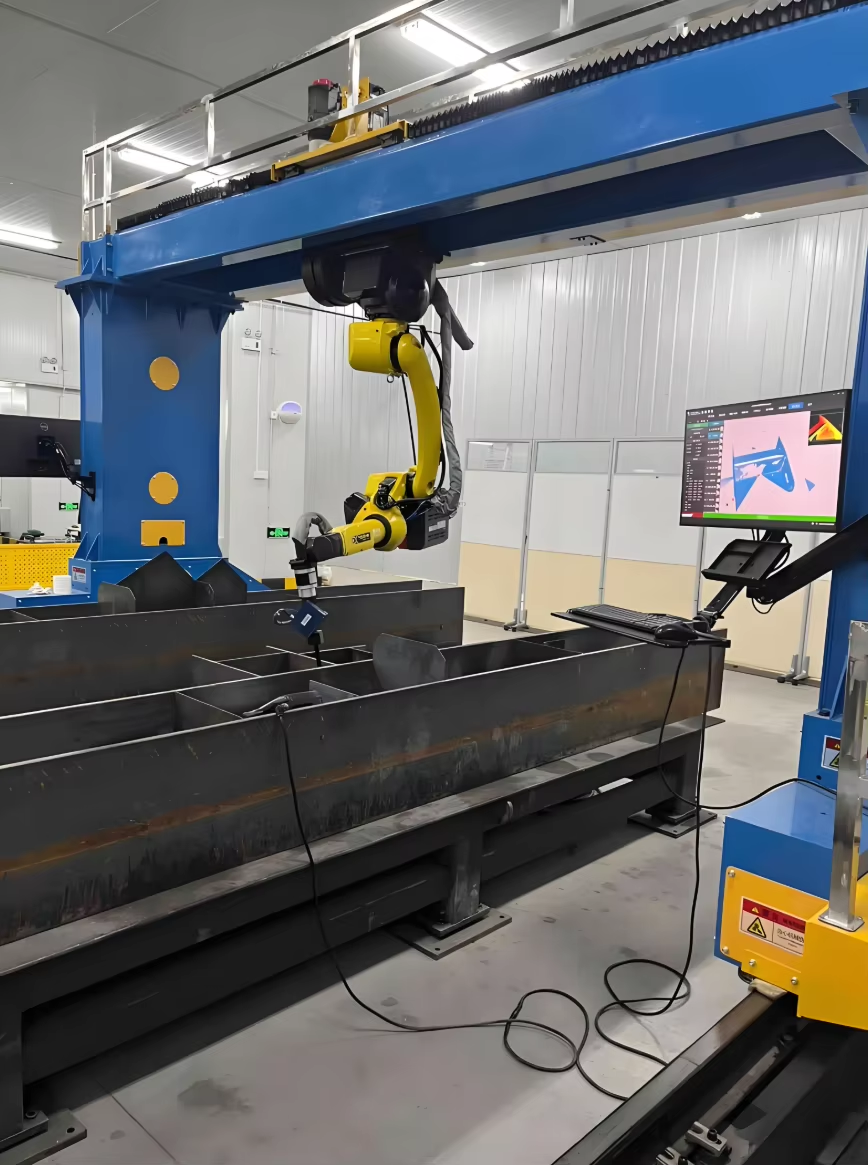
Unlike standard pre-programmed robotic paths, an intelligent system for tank welding must account for the dimensional irregularities inherent in heavy plate fabrication. 3D Vision positioning sensors, typically mounted on the robotic end-effector, utilize structured light or high-speed scanning to map the weld groove in real-time. This spatial data is processed by the controller to adjust the robot’s trajectory and welding parameters—such as wire feed speed and voltage—on the fly.
In Metal Active Gas (MAG) applications, the shielding gas composition (typically an Ar/CO2 mix) is critical for penetration and arc stability. The 3D vision system ensures that the contact-tip-to-work distance remains constant, which is vital for maintaining a stable current density. When the vision system detects a wider gap in a vertical-up seam, the robotic controller automatically modulates the weave pattern to ensure complete sidewall fusion without excessive heat input, which could otherwise compromise the Heat Affected Zone (HAZ).
Operational Efficiency and Weld Deposition Rates
The primary engineering metric for evaluating welding automation is the deposition rate, measured in kilograms per hour. Manual MAG welding often suffers from a low duty cycle due to operator fatigue and the need for frequent repositioning. An automated robotic cell can operate at a 75-85% duty cycle, compared to 30-40% for manual processes.
Volumetric Accuracy and Defect Reduction
By utilizing vision-guided seam tracking, the robot maintains the center of the joint within tolerances of +/- 0.1mm. This level of precision significantly reduces the occurrence of undercut and lack of fusion defects, which are common in manual tank welding due to the difficulty of maintaining a steady hand over long horizontal or vertical runs. The reduction in “re-work” hours directly correlates to a decrease in project lead times and NDT (Non-Destructive Testing) failure rates.
Maintenance Protocols for Robotic Welding Assets
To ensure a high Mean Time Between Failures (MTBF) in the harsh environments of oil refineries and tank farms, a proactive maintenance schedule is mandatory. The robotic arm and the MAG power source are the two primary subsystems requiring attention.
Consumable Management
The welding torch assembly involves high-wear components including the contact tip, gas shroud, and wire liner. In an intelligent robotic setup, automated nozzle cleaning stations are integrated into the cell. These stations perform mechanical reaming and anti-spatter injection at set intervals—for example, every 10 meters of weld bead. This prevents spatter buildup that can disrupt gas flow and cause porosity, a critical defect in high-pressure storage vessels.
Vision System Calibration
The 3D sensors are sensitive to the intense UV radiation and smoke generated during the MAG process. Maintenance engineers must ensure the protective glass of the vision system is clean and replaced periodically. Furthermore, recalibration of the “TCP” (Tool Center Point) is required after any collision or major component change to ensure the vision data aligns perfectly with the physical wire position.
Analyzing Labor ROI and Workforce Transition
The financial justification for an intelligent welding robot is anchored in the Labor ROI calculation. While the initial capital expenditure (CAPEX) for a vision-equipped robotic system is higher than manual equipment, the operational expenditure (OPEX) per meter of weld is significantly lower.
In traditional tank construction, a crew consists of several certified welders and helpers. By implementing a robotic solution, the labor requirement shifts from multiple manual welders to a single “Robot Operator” or “Welding Technician.” This individual does not need to possess the manual dexterity of a master welder but must be skilled in robotic interface management and parameter optimization.
Quantifying the ROI
The ROI is calculated by aggregating the following factors:
1. Throughput Increase: A robot can weld 2-3 times faster than a human when considering total “arc-on” time over a 12-hour shift.
2. Consumable Savings: Precise control of the weld puddle leads to lower wire wastage and optimized gas consumption.
3. Safety and Insurance: Moving the human operator away from the immediate vicinity of the arc reduces exposure to hexavalent chromium fumes and the risk of falls from scaffolding. In many jurisdictions, this leads to lower insurance premiums and reduced liability costs.
Over the course of a single large-scale tank farm project involving 10-15 tanks, the savings in man-hours alone often recoup the cost of the robotic system. When including the avoided costs of defect remediation (gouging, re-welding, and re-testing), the payback period is typically shortened to less than 18 months.
Structural Integrity and Quality Assurance
For Oil and Gas tanks, structural failure is not an option. The data logging capabilities of an intelligent robotic welder provide a digital “birth certificate” for every seam. Every centimeter of the weld is recorded with corresponding data on current, voltage, and travel speed. This level of traceability is impossible with manual welding.
The 3D vision system contributes to this by providing pre-weld and post-weld profile analysis. Before the arc is struck, the sensor verifies the root gap and bevel angle. Post-weld, the sensor can measure the reinforcement height and toe angles, ensuring they fall within the specified engineering limits. This data-driven approach allows for predictive quality control, where the system can alert engineers if a trend in the data suggests a potential deviation from the welding procedure specification (WPS).
Conclusion
The deployment of an Intelligent Robotic Welder in the Oil and Gas sector is a strategic necessity for firms aiming to maintain competitiveness in a landscape of rising labor costs and stricter safety regulations. By leveraging 3D Vision positioning and optimized MAG processes, engineers can ensure that storage tanks are built faster, safer, and with a level of metallurgical consistency that manual processes cannot replicate. The transition from labor-intensive manual welding to a technology-driven automated approach provides a clear path to high Labor ROI and long-term asset reliability.
-


LT240S tube laser cutting machine
-
LT120S tube laser cutting machine
-
Sale

Tank Fillet Welding Machine
Original price was: $1,000.00.$900.00Current price is: $900.00. -
Sale

MAK100 tube laser cutting machine
Original price was: $5,500.00.$5,000.00Current price is: $5,000.00. -

portable plasma air cutting machine
$1,200.00 -

2in1 fiber laser cutting machine
-

Air cooling Laser welding machine
-

HF h beam laser cutting machine
-

LT240 laser cutting machine
-

Laser welding machine
-


Cobotic Welding Station
-

Gantry welding robot solution
-

Tracked Wheeled AGV Welding robot
-

LFH6020 Fiber laser cutting machine
-
LFP6020
-

robotic welidng machine
Advanced Fiber Laser Tube Processing Technology
Our CNC Fiber Laser Tube Cutting systems revolutionize metal fabrication by integrating high-precision cutting, punching, and profiling into a single automated workflow. Designed for versatility, this technology handles a wide array of profiles including Round, Square, Rectangular, and Oval tubes, as well as complex L-shaped and U-shaped channels.
- Precision Punching: High-speed hole punching with micron-level accuracy, eliminating the need for mechanical drilling or die-stamping.
- Complex Profiling: Advanced 3D pathing allows for intricate interlocking joints and specialized notch cuts, ideal for structural frames.
- High Material Efficiency: Intelligent nesting software minimizes scrap, reducing raw material costs across large production runs.
- Clean Finish: Delivers oxide-free, burr-free edges that require zero secondary grinding before welding.

Seamlessly processing multiple profiles with consistent precision.
Global Delivery & Logistics



From our high-tech manufacturing facility directly to your global site. PCL WeldCut ensures secure packaging, professional handling, and reliable international logistics to safeguard your equipment throughout the entire journey.
