Engineering Precision in Large-Scale Tank Fabrication
The fabrication of Oil and Gas storage tanks represents one of the most demanding environments for structural integrity and weld consistency. Traditionally, these structures, often exceeding 50 meters in diameter, relied heavily on manual Metal Active Gas (MAG) welding. However, the industrial shift toward MAG welding optimization has introduced intelligent robotic systems equipped with 3D vision. Unlike stationary automotive robots, these systems must navigate the spatial complexities of large-diameter cylinders and spherical vessels where fit-up tolerances are often inconsistent.
From an industrial engineering perspective, the primary challenge is not the weld itself, but the variability of the workpiece. Large plates used in tank shells frequently exhibit deformations due to gravity, heat-induced warping, or imperfect edge preparation. An Intelligent Robotic Welder utilizes 3D vision sensors to map the actual joint geometry in real-time, adjusting the torch orientation and travel speed to compensate for gaps that would otherwise lead to structural failure or excessive rework in a manual setup.
3D Vision Systems and Trajectory Correction
The “intelligence” of these systems is rooted in the integration of structured light or stereo vision sensors mounted on the robot’s sixth axis. Before the arc is struck, the robot performs a scanning pass or utilizes “look-ahead” sensing during the welding process. This data creates a high-density point cloud, allowing the controller to calculate the precise centerline of the weld joint.
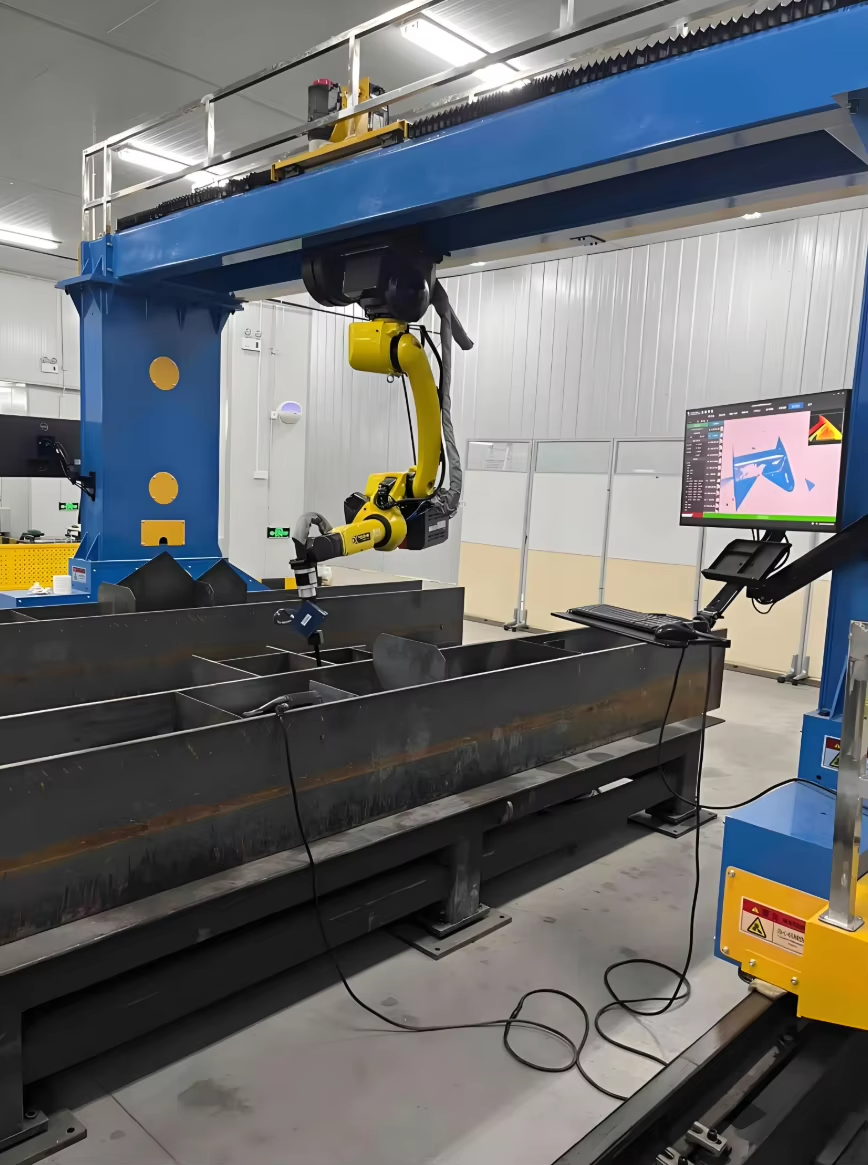
Implementing 3D vision trajectory planning allows the system to manage multi-pass welds on thick-walled sections of oil tanks. For instance, in a 25mm thick V-groove joint, the vision system identifies the volume of the gap and dynamically adjusts the wire feed speed and oscillation width. This ensures that the root pass achieves full penetration while the cap passes maintain a profile that meets API 650 or similar international standards. This level of adaptation eliminates the “over-welding” common in manual processes, where welders often deposit more metal than necessary to compensate for uncertainty, thereby wasting consumables and increasing heat input.
MAG Welding Parameters and Volumetric Efficiency
Metal Active Gas (MAG) welding is the preferred process for tank fabrication due to its high deposition rates and the ability to operate in various positions. When coupled with a robotic arm, the process achieves a duty cycle significantly higher than that of a human operator. While a manual welder might maintain an “arc-on” time of 30-40%, a robotic system can exceed 75%, stopping only for workpiece repositioning or nozzle maintenance.
The robotic controller manages the synergic power source, balancing voltage and amperage to maintain a stable spray transfer or globular transfer mode. By precisely controlling the stick-out distance via the 3D sensor’s feedback, the robot minimizes spatter. Spatter reduction is critical in the Oil and Gas sector, as surface irregularities can become focal points for corrosion once the tank is commissioned and filled with volatile or corrosive hydrocarbons.
Maintenance Protocols for High-Uptime Systems
To maintain the reliability of an automated welding cell in a field or heavy-shop environment, rigorous maintenance schedules are mandatory. The robotic torch is a high-wear component. Automated reaming stations are integrated into the cell to periodically clean the gas nozzle, removing spatter that could obstruct shielding gas flow. A disruption in gas coverage leads to porosity, a defect that is unacceptable in high-pressure storage environments.
Furthermore, the 3D vision hardware requires protection from the intense UV radiation and heat generated by the MAG process. Industrial engineers specify pressurized sensor housings or sacrificial optical windows that can be replaced at low cost. Wire delivery systems also represent a critical maintenance point; the use of large-capacity “marathon” drums reduces downtime associated with spool changes, but requires low-friction liners to prevent bird-nesting at the drive rolls. Regular calibration of the 3D sensor to the robot’s Tool Center Point (TCP) ensures that the perceived joint location matches the actual wire contact point within a sub-millimeter margin of error.
Labor ROI and Economic Impact
The transition to Robotic Welding is frequently driven by the robotic ROI in heavy industry metrics. In the current labor market, certified pressure vessel welders are increasingly scarce and expensive. A robotic system does not replace the need for expertise but shifts the human role from manual execution to system oversight and programming.
The ROI calculation for an intelligent tank welder includes several variables:
1. Labor Displacement: One operator can manage two or three robotic cells.
2. Consumable Savings: Precise deposition reduces wire and shielding gas waste by 15-20%.
3. Rework Reduction: Manual weld failure rates in field conditions can hover around 3-5%. Robotic systems, once calibrated, reduce this to under 1%, saving thousands in grinding and re-welding costs.
4. Throughput: Faster travel speeds and higher duty cycles shorten the project timeline, allowing tank farms to become operational sooner, which has a massive impact on the Net Present Value (NPV) of the construction project.
Seam Tracking and Quality Assurance
A significant advantage of the intelligent welder is the digital trail it leaves behind. Every weld bead can be correlated with the 3D scan data and the real-time electrical parameters of the power source. This automated seam tracking and data logging provide a comprehensive “birth certificate” for each tank seam. In the event of a future inspection requirement, engineers can review the exact heat input and penetration profile recorded during the build.
The 3D vision system also performs post-weld inspections. By scanning the completed bead, the robot can detect undercut, excessive reinforcement, or surface porosity immediately. This real-time QA/QC loop allows for corrections while the equipment is still in place, rather than discovering defects days later during X-ray or ultrasonic testing, which would require costly mobilization of repair crews.
Conclusion of System Implementation
The integration of 3D vision with robotic MAG welding represents a paradigm shift for Oil and Gas infrastructure. By moving away from the variability of manual labor and embracing the precision of sensor-driven automation, companies achieve higher safety standards and superior economic outcomes. The technical synergy of high-speed data processing and robust mechanical execution ensures that storage tanks are built to last, with minimized environmental risk and optimized capital expenditure. As the industry moves toward further digitalization, the robotic welder stands as a cornerstone of the modern, efficient fabrication facility.
-

LT240S tube laser cutting machine
-
LT120S tube laser cutting machine
-
Sale

Tank Fillet Welding Machine
Original price was: $1,000.00.$900.00Current price is: $900.00. -
Sale

MAK100 tube laser cutting machine
Original price was: $5,500.00.$5,000.00Current price is: $5,000.00. -

portable plasma air cutting machine
$1,200.00 -

2in1 fiber laser cutting machine
-

Air cooling Laser welding machine
-

HF h beam laser cutting machine
-

LT240 laser cutting machine
-

Laser welding machine
-

Cobotic Welding Station
-

Gantry welding robot solution
-

Tracked Wheeled AGV Welding robot
-

LFH6020 Fiber laser cutting machine
-
LFP6020
-

robotic welidng machine
Advanced Fiber Laser Tube Processing Technology
Our CNC Fiber Laser Tube Cutting systems revolutionize metal fabrication by integrating high-precision cutting, punching, and profiling into a single automated workflow. Designed for versatility, this technology handles a wide array of profiles including Round, Square, Rectangular, and Oval tubes, as well as complex L-shaped and U-shaped channels.
- Precision Punching: High-speed hole punching with micron-level accuracy, eliminating the need for mechanical drilling or die-stamping.
- Complex Profiling: Advanced 3D pathing allows for intricate interlocking joints and specialized notch cuts, ideal for structural frames.
- High Material Efficiency: Intelligent nesting software minimizes scrap, reducing raw material costs across large production runs.
- Clean Finish: Delivers oxide-free, burr-free edges that require zero secondary grinding before welding.

Seamlessly processing multiple profiles with consistent precision.
Global Delivery & Logistics



From our high-tech manufacturing facility directly to your global site. PCL WeldCut ensures secure packaging, professional handling, and reliable international logistics to safeguard your equipment throughout the entire journey.
