Intelligent Robotic Welder with 3D Vision positioning for LNG Projects

In this article
Technical Integration of 3D Vision in LNG Welding Operations
The construction of Liquefied Natural Gas (LNG) facilities demands rigorous adherence to structural integrity standards, particularly concerning cryogenic storage tanks and complex piping manifolds. Conventional manual welding often fails to meet the required consistency under tight project timelines. The introduction of Robotic Welding systems equipped with 3D Vision positioning addresses these challenges by automating the identification of joint geometry and real-time adjustment of torch trajectories.
Intelligent 3D vision systems utilize structured light or stereoscopic sensors to generate high-resolution point clouds of the weld joint. In LNG projects, where large-diameter pipes and thick-walled plates are standard, fit-up tolerances can vary significantly. The 3D vision system scans the groove prior to arc ignition, calculating the exact volume of the joint. This data allows the controller to adjust travel speed, wire feed rate, and oscillation width dynamically, ensuring full penetration and optimal bead profile without manual intervention.
Advanced MAG Welding Parameters for Cryogenic Applications
The MAG welding (Metal Active Gas) process, specifically utilizing pulsed-spray transfer modes, is the preferred method for LNG structural components due to its high deposition rates and controlled heat input. When welding 9% Nickel steel or stainless steel alloys common in LNG environments, managing the Heat Affected Zone (HAZ) is critical to maintaining fracture toughness at sub-zero temperatures.
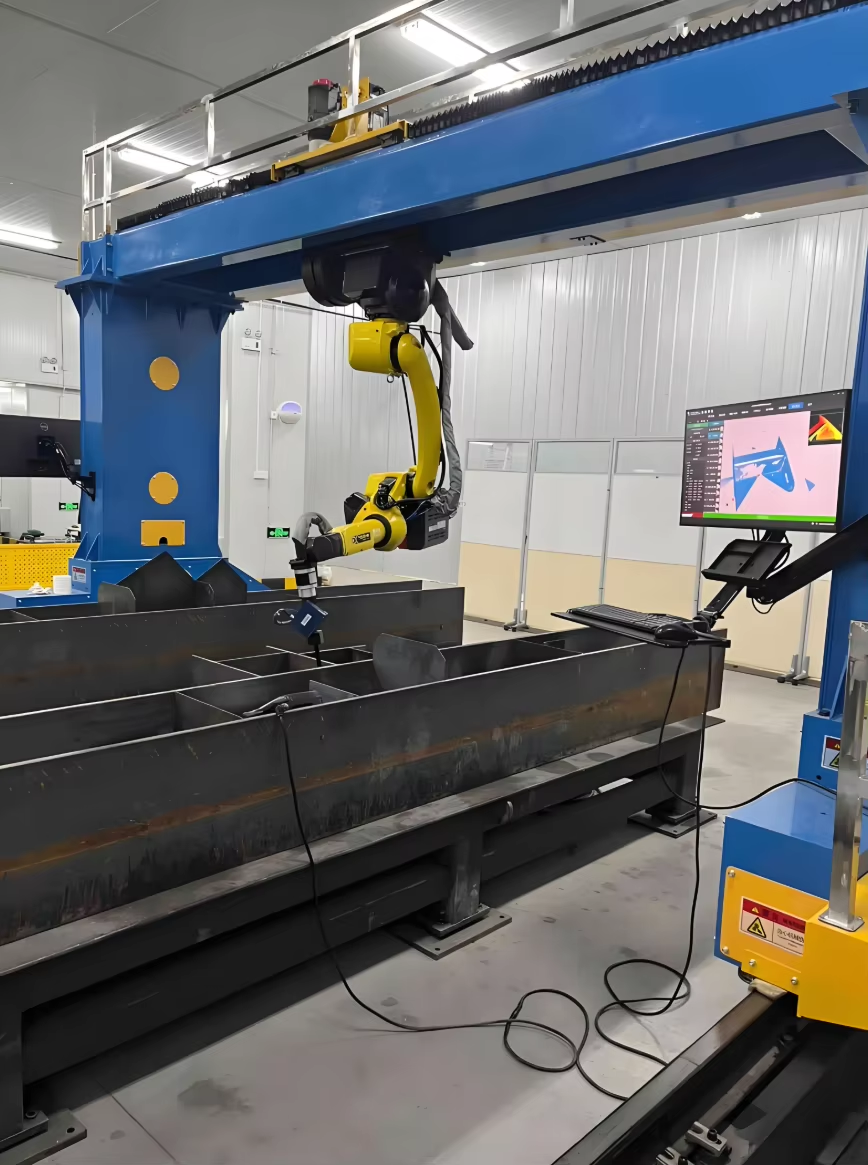
Robotic MAG systems allow for the precise modulation of the current waveform. By using specialized gas mixtures—typically Argon with 5-20% CO2—the system stabilizes the arc and minimizes spatter. This precision reduces post-weld cleaning time. Furthermore, the robotic arm maintains a constant contact-tip-to-work distance (CTWD), which is vital for maintaining consistent current density and weld chemistry. Unlike manual operators who may experience fatigue, the robot executes multi-pass welds with identical thermal profiles, significantly reducing the risk of slag inclusions or lack of fusion.
Operational Maintenance and System Reliability
To ensure the 3D vision positioning system and the robotic cell operate at peak efficiency, a rigorous preventive maintenance schedule is mandatory. Industrial engineers must categorize maintenance into three tiers: the welding torch assembly, the motion system, and the optical sensors.
Torch and Wire Feed Maintenance
The most frequent point of failure in high-duty-cycle MAG welding is the contact tip and the wire liner. Constant friction and micro-arcing degrade the contact tip orifice, leading to arc instability. Robotic cells should be equipped with automated torch cleaning stations that perform reaming, anti-spatter injection, and wire cutting at set intervals (e.g., every 30 minutes of arc-on time). Liners should be replaced based on the volume of wire consumed to prevent “bird-nesting” at the drive rolls.
Vision System Calibration
The 3D vision sensor is sensitive to smoke, spatter, and thermal radiation. Maintenance protocols must include the inspection of protective glass covers and regular calibration checks against a known master gauge. If the sensor’s focal point shifts due to vibration or thermal expansion of the mounting bracket, the spatial coordinates provided to the robot will result in off-center welds. Integrated air knives are often utilized to blow particulates away from the lens during the welding cycle.
Quantitative Analysis of Labor ROI
The primary driver for adopting intelligent robotics in LNG projects is the significant labor ROI. The global shortage of certified high-pressure pipe welders has driven labor costs to record highs, while project schedules remain compressed. An industrial engineering approach to ROI compares the “Arc-on Time” and “Deposition Efficiency” of manual versus robotic systems.
In a manual welding scenario, the average welder maintains a duty cycle (arc-on time) of approximately 20% to 30% due to the need for repositioning, shielding gas checks, and ergonomic breaks. A robotic system, conversely, can sustain a duty cycle of 75% to 85%.
| Metric | Manual Welding | Robotic MAG + 3D Vision |
|---|---|---|
| Duty Cycle (Arc-on Time) | 25% | 80% |
| Deposition Rate (kg/hr) | 1.5 – 2.5 | 4.0 – 6.5 |
| Rework Rate (Defects) | 3% – 5% | < 0.5% |
| Training/Certification Cost | High / Recurring | Medium / Initial |
The ROI calculation also factors in the reduction of Non-Destructive Testing (NDT) failures. In LNG piping, X-ray or Ultrasonic testing is mandatory for 100% of critical joints. A single manual weld failure requires grinding, re-prepping, and re-welding, which can cost five times the original weld cost. The 3D vision system’s ability to track the seam precisely ensures that the defect rate remains below 0.5%, providing indirect savings that often exceed the direct labor cost reduction.
Optimizing Throughput in Multi-Pass Scenarios
LNG tank shells require multi-pass welds on thick plates (25mm to 50mm). Manually managing the inter-pass temperature and bead placement is time-consuming. The intelligent robot utilizes the 3D scan data from the previous pass to calculate the remaining volume and adjust the subsequent pass parameters. This “adaptive fill” capability eliminates the need for manual measurement and significantly reduces the total time per joint.
By standardizing these processes, industrial engineers can accurately predict project completion dates. The variability of human performance is replaced by a deterministic machine output, allowing for more aggressive yet realistic scheduling. This predictability is a cornerstone of the financial justification for the capital expenditure involved in robotic integration.
Conclusion of Engineering Efficiency
The implementation of 3D vision-guided robotic MAG welding represents a fundamental shift in LNG infrastructure construction. By focusing on high-precision spatial data and optimized metal transfer modes, firms can overcome the limitations of the current labor market. The transition from a labor-intensive model to a capital-intensive, automated model is justified not only by the direct reduction in man-hours but by the massive gains in quality consistency and operational uptime. The long-term maintenance of these systems ensures that the initial ROI projections are met or exceeded over the multi-year lifespan of major energy projects.






