Technical Integration of Robotic MAG Welding in LNG Infrastructure
The global demand for Liquefied Natural Gas (LNG) necessitates the construction of massive storage tanks, regasification units, and intricate piping networks. These structures require high-integrity welds capable of withstanding cryogenic temperatures and extreme pressure cycles. Traditionally, manual welding has been the bottleneck in LNG project timelines. The shift toward an Intelligent Robotic Welder equipped with 3D vision sensor technology represents a significant leap in industrial engineering efficiency, moving away from static automation toward adaptive manufacturing.
The Precision Challenge: 3D Vision Positioning
In large-scale LNG projects, the physical dimensions of workpieces—such as thick-walled cryogenic pipes and pressure vessel shells—often deviate from theoretical CAD models due to manufacturing tolerances and thermal expansion. Standard “blind” robots fail in these environments because they follow a fixed path regardless of the actual joint geometry.
The integration of 3D vision systems allows the robotic controller to perform a pre-weld scan of the joint. This system utilizes structured light or laser-triangulation sensors to map the groove profile in real-time. The software calculates the root gap, groove angle, and misalignment (high-low). By processing this spatial data, the robot dynamically adjusts its torch orientation and oscillation parameters. This adaptability ensures that the MAG welding process maintains full penetration and optimal bead profile, which is essential for passing 100% radiographic testing (RT) required by ASME Section VIII and API 620 standards.
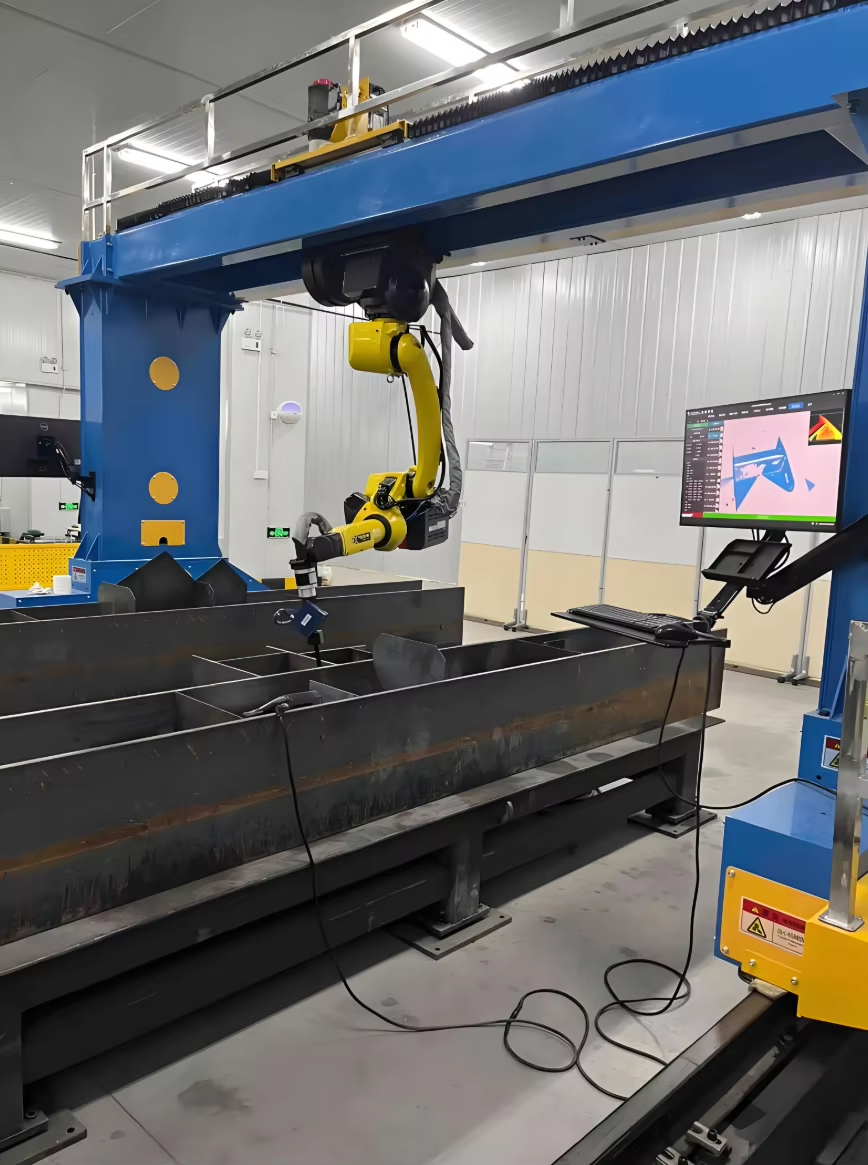
Optimizing the MAG Welding Process for LNG
Metal Active Gas (MAG) welding is the preferred process for robotic integration in LNG projects due to its high deposition rates and continuous wire feed capabilities. Unlike manual Shielded Metal Arc Welding (SMAW), which requires frequent stops to change electrodes, robotic MAG provides a nearly 100% arc-on time during a pass.
Industrial engineers focus on the “duty cycle” as a primary KPI. In a manual setup, a welder’s arc-on time rarely exceeds 40% due to fatigue, cleaning, and repositioning. A robotic cell often achieves an 85% duty cycle. For heavy-walled 9% Nickel steel or stainless steel components common in LNG, the robot can utilize high-current spray transfer modes or pulsed-MAG settings that minimize spatter and heat input, thereby preserving the fracture toughness of the base material.
Labor ROI and Economic Analysis
The Return on Investment (ROI) for Robotic Welding in the LNG sector is driven by three primary variables: labor scarcity, throughput velocity, and defect reduction. Skilled welders with certifications for cryogenic applications are increasingly rare and command high hourly rates, often including overtime and site premiums.
When calculating ROI, the initial capital expenditure (CAPEX) of the robotic system—including the 6-axis arm, 3D vision hardware, and integration software—must be weighed against the total cost of manual labor over the project lifecycle.
Labor Savings Breakdown
A single robotic welding cell can typically replace three to four manual welding stations in terms of volume output. By automating the repetitive fill and cap passes, the project can reallocate highly skilled human welders to complex tie-ins and quality oversight. Furthermore, the reduction in weld repair rates is a critical factor. In manual LNG pipe welding, repair rates often fluctuate between 3% and 5%. Robotic systems, once calibrated, can reduce this to less than 1%, saving thousands of dollars in grinding, re-welding, and additional NDT (Non-Destructive Testing) costs.
Maintenance Protocols for System Longevity
To ensure the robotic system delivers the projected ROI, a rigorous predictive maintenance schedule must be implemented. Robotic welders in LNG fabrication yards often operate in harsh, dusty, or humid environments, which can degrade mechanical and optical components.
Maintenance is categorized into three tiers:
1. Consumable Management: The torch nozzle, contact tip, and wire liner are high-wear items. Automatic torch cleaning stations with “reamer” units should be programmed to cycle every 30 to 60 minutes of arc time to prevent spatter buildup and ensure stable current transfer.
2. Optical Calibration: The 3D vision sensors require periodic calibration to ensure spatial accuracy. Dust accumulation on sensor lenses can lead to “noise” in the point cloud data, resulting in path deviation.
3. Mechanical Integrity: The robot’s 6th axis and the wire feeder’s drive rolls require monthly inspections. for LNG Projects, wire feed consistency is paramount; any slippage in the drive rolls will lead to porosity and fusion defects.
Throughput and Scaling Operations
Scaling a fabrication facility for a major LNG contract requires a modular approach to robotic deployment. Industrial engineers utilize “line balancing” to ensure that the robotic welding stations do not outpace the upstream fit-up and tacking operations. By utilizing 3D vision, the “fit-up” requirements can actually be slightly relaxed compared to traditional automation, as the robot can compensate for minor gaps. This reduces the time spent in the prep stage, further increasing total facility throughput.
Safety and Quality Assurance in the Robotic Cell
Safety is a non-negotiable metric in LNG projects. Robotic welding removes the human operator from the immediate vicinity of hazardous fumes, ultraviolet radiation, and high-heat zones. From a quality assurance (QA) perspective, the robotic controller logs every weld parameter—voltage, amperage, travel speed, and gas flow—for every centimeter of the weld. This digital “birth certificate” provides a level of traceability that manual welding cannot match, simplifying the final documentation package for project owners and regulatory bodies.
Conclusion
The implementation of intelligent robotic welders with 3D vision is no longer an optional innovation but a structural necessity for modern LNG projects. By maximizing the MAG welding process efficiency and leveraging advanced spatial sensors, engineering firms can stabilize their production schedules and mitigate the risks associated with labor shortages. The transition requires significant upfront planning and a dedicated maintenance strategy, but the long-term gains in ROI and structural integrity position it as the gold standard for heavy industrial fabrication.
-

LT240S tube laser cutting machine
-
LT120S tube laser cutting machine
-
Sale

Tank Fillet Welding Machine
Original price was: $1,000.00.$900.00Current price is: $900.00. -
Sale

MAK100 tube laser cutting machine
Original price was: $5,500.00.$5,000.00Current price is: $5,000.00. -

portable plasma air cutting machine
$1,200.00 -

2in1 fiber laser cutting machine
-

Air cooling Laser welding machine
-

HF h beam laser cutting machine
-

LT240 laser cutting machine
-

Laser welding machine
-

Cobotic Welding Station
-

Gantry welding robot solution
-

Tracked Wheeled AGV Welding robot
-

LFH6020 Fiber laser cutting machine
-
LFP6020
-

robotic welidng machine
Advanced Fiber Laser Tube Processing Technology
Our CNC Fiber Laser Tube Cutting systems revolutionize metal fabrication by integrating high-precision cutting, punching, and profiling into a single automated workflow. Designed for versatility, this technology handles a wide array of profiles including Round, Square, Rectangular, and Oval tubes, as well as complex L-shaped and U-shaped channels.
- Precision Punching: High-speed hole punching with micron-level accuracy, eliminating the need for mechanical drilling or die-stamping.
- Complex Profiling: Advanced 3D pathing allows for intricate interlocking joints and specialized notch cuts, ideal for structural frames.
- High Material Efficiency: Intelligent nesting software minimizes scrap, reducing raw material costs across large production runs.
- Clean Finish: Delivers oxide-free, burr-free edges that require zero secondary grinding before welding.

Seamlessly processing multiple profiles with consistent precision.
Global Delivery & Logistics



From our high-tech manufacturing facility directly to your global site. PCL WeldCut ensures secure packaging, professional handling, and reliable international logistics to safeguard your equipment throughout the entire journey.
