Advancing LNG Fabrications with Intelligent MAG Robotic Systems
The global Liquefied Natural Gas (LNG) sector demands unprecedented levels of structural integrity and weld precision. As projects move toward modular construction and ultra-deep cryogenic storage, the limitations of manual welding become a bottleneck. Specifically, the variability in human performance and the physical strain of welding heavy-wall pressure vessels lead to inconsistent MAG welding results. Intelligent robotic systems, integrated with advanced 3D vision, represent the industrial engineer’s solution to these throughput constraints.
Unlike traditional fixed-automation systems, Intelligent Robotic Welders utilize sensory feedback to adjust to real-world conditions. In LNG infrastructure, where large-diameter pipes and plates often exhibit slight variations in bevel preparation or fit-up, a “blind” robot would fail. By implementing 3D vision positioning, the system can identify the start and end points of a joint, calculate the gap width, and adjust the torch trajectory in real-time. This ensures that the MAG process—selected for its high deposition rate—is executed with the precision typically reserved for much slower manual processes.
3D Vision: The Bridge Between Measurement and Execution
In the context of LNG modular yards, fit-up tolerances are rarely perfect. Thermal expansion, heavy-duty handling, and machining variances mean that a predefined path is insufficient. 3D vision systems utilize structured light or stereoscopic imaging to create a high-density point cloud of the weld joint. This data is processed by the robot controller to perform “adaptive welding.”
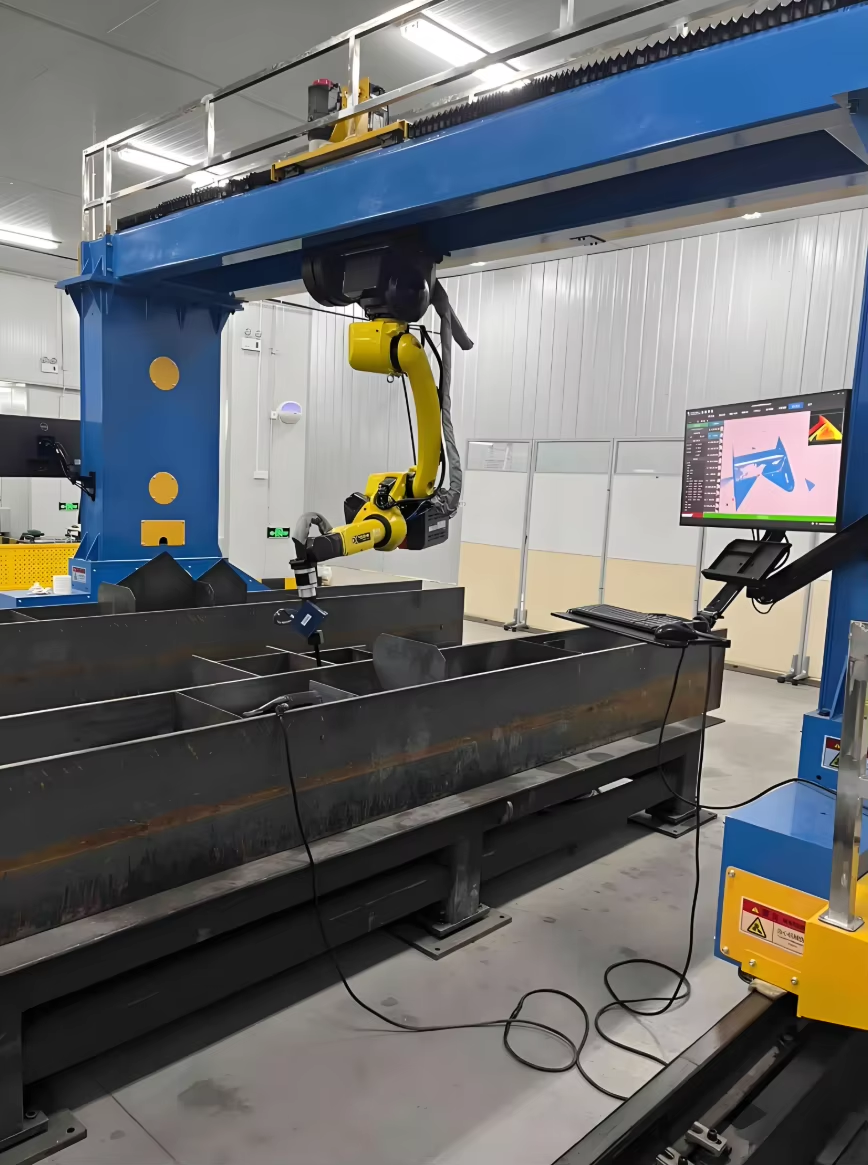
For a thick-walled 9% nickel steel or stainless steel joint, the 3D sensor scans the groove geometry immediately ahead of the arc. If the gap narrows or widens, the system dynamically modifies the wire feed speed, travel speed, and weave width. This capability is critical for maintaining the root pass integrity and ensuring complete fusion in multi-pass scenarios. By eliminating the need for manual tack-welding adjustments, the 3D vision positioning system reduces the total cycle time per joint by approximately 35% compared to semi-automated systems.
Optimization of the MAG Welding Process for Cryogenic Service
The Metal Active Gas (MAG) process is the workhorse of LNG fabrication due to its versatility and efficiency. However, achieving the required Charpy V-Notch impact values at -196°C requires strict control over heat input. Robotic systems excel here by maintaining a constant “Energy Input” (kJ/mm), which is nearly impossible for a manual welder to sustain over an 8-hour shift.
The robot’s ability to synchronize the power source parameters with its movement ensures that the microstructure of the weld metal and the Heat Affected Zone (HAZ) remains within design specifications. In MAG applications, the shielding gas mixture—typically Argon with 2-5% CO2 for stainless steel—is delivered through a robotic torch designed for 100% duty cycles. The precision of the robotic arm ensures consistent contact tip-to-work distance (CTWD), which stabilizes the arc and minimizes spatter, reducing post-weld cleaning requirements.
Maintenance Protocols for High-Availability Robotic Cells
To realize the benefits of automation, the industrial engineer must implement a rigorous preventive maintenance (PM) schedule. Robotic Welding cells in LNG projects often operate in harsh coastal or dusty environments. Failure to maintain the peripheral equipment can lead to unplanned downtime, negating the throughput gains.
Torch and Consumable Management
The torch is the most vulnerable component. Automated reamer stations (torch cleaners) should be programmed to clean the nozzle every 15-30 minutes of arc-on time. This prevents spatter buildup from obstructing the shielding gas flow, which would otherwise cause porosity—a fatal defect in LNG pressure components. Furthermore, the contact tip should be replaced based on wire throughput metrics rather than failure. Monitoring the “wire-on” time allows for predictive replacement, ensuring that the electrical transfer remains stable and the 3D vision positioning data isn’t compromised by arc wander caused by a worn tip.
Wire Delivery and Liner Integrity
In high-volume MAG welding, the wire feeding system must be frictionless. Any resistance in the liner causes fluctuations in the arc, leading to fusion defects. Maintenance teams should use dry-run tests to measure the motor torque of the wire feeder. High torque indicates a clogged liner or a degraded wire spool. By scheduling liner replacements every 500kg of wire consumed, the system maintains the high-fidelity control required for automated multi-pass welding.
Calculating Labor ROI and Strategic Value
The primary driver for robotic adoption in LNG projects is the labor ROI. The industry faces a chronic shortage of Class-A certified welders capable of meeting the stringent radiographic testing (RT) requirements of ASME Section IX. A single robotic cell, supervised by one technician, can often match the output of three to four manual welders.
When calculating labor ROI, it is a mistake to look only at hourly wages. The true value lies in the “Defect Reduction Factor.” Manual welding in difficult positions (6G) often sees a 5-10% repair rate on large projects. Robotic MAG welding, guided by 3D vision, can reduce this to less than 1%. Considering the cost of gouging out a defective weld, re-preparing the joint, and re-testing, the savings from defect prevention alone can pay for the robotic system within the first year of a major LNG project.
Furthermore, the shift from “manual labor” to “technical supervision” allows firms to upskill their workforce. A welder who previously spent the day in a high-heat, ergonomic-straining position now becomes a “Robotic Operator,” managing the 3D sensor parameters and monitoring the MAG process via digital interfaces. This leads to higher employee retention and lower long-term health and safety liabilities.
Integration Challenges and Engineering Solutions
Implementing these systems is not without challenge. The integration of 3D vision requires a robust software backbone that can interpret point clouds and translate them into motion commands without latency. Industrial engineers must ensure that the communication protocol between the sensor, the robot controller, and the MAG power source is optimized—ideally using high-speed fieldbus systems like EtherCAT or Profinet.
Calibration is the second hurdle. The spatial relationship between the 3D sensor and the weld torch (the “TCP” or Tool Center Point) must be calibrated to sub-millimeter accuracy. Any deviation here will result in the robot depositing metal in the wrong location, regardless of how accurate the vision system is. Standardized calibration routines should be performed weekly or after any minor collision to ensure the 3D vision positioning remains the “source of truth” for the welding path.
Conclusion
For LNG infrastructure, the transition to intelligent robotic MAG welding is no longer optional; it is a requirement for staying competitive in a high-spec market. By leveraging 3D vision positioning, engineers can overcome the hurdles of material variability and labor shortages. When backed by a disciplined maintenance strategy, these systems deliver a labor ROI that extends far beyond simple wage replacement, manifesting in superior weld quality, eliminated rework, and accelerated project timelines. The focus must remain on the synergy between the adaptive sensing technology and the metallurgical consistency of the MAG process to ensure the safe and efficient delivery of the world’s energy infrastructure.
-


LT240S tube laser cutting machine
-
LT120S tube laser cutting machine
-
Sale

Tank Fillet Welding Machine
Original price was: $1,000.00.$900.00Current price is: $900.00. -
Sale

MAK100 tube laser cutting machine
Original price was: $5,500.00.$5,000.00Current price is: $5,000.00. -

portable plasma air cutting machine
$1,200.00 -

2in1 fiber laser cutting machine
-

Air cooling Laser welding machine
-

HF h beam laser cutting machine
-

LT240 laser cutting machine
-

Laser welding machine
-


Cobotic Welding Station
-

Gantry welding robot solution
-

Tracked Wheeled AGV Welding robot
-

LFH6020 Fiber laser cutting machine
-
LFP6020
-

robotic welidng machine
Advanced Fiber Laser Tube Processing Technology
Our CNC Fiber Laser Tube Cutting systems revolutionize metal fabrication by integrating high-precision cutting, punching, and profiling into a single automated workflow. Designed for versatility, this technology handles a wide array of profiles including Round, Square, Rectangular, and Oval tubes, as well as complex L-shaped and U-shaped channels.
- Precision Punching: High-speed hole punching with micron-level accuracy, eliminating the need for mechanical drilling or die-stamping.
- Complex Profiling: Advanced 3D pathing allows for intricate interlocking joints and specialized notch cuts, ideal for structural frames.
- High Material Efficiency: Intelligent nesting software minimizes scrap, reducing raw material costs across large production runs.
- Clean Finish: Delivers oxide-free, burr-free edges that require zero secondary grinding before welding.

Seamlessly processing multiple profiles with consistent precision.
Global Delivery & Logistics



From our high-tech manufacturing facility directly to your global site. PCL WeldCut ensures secure packaging, professional handling, and reliable international logistics to safeguard your equipment throughout the entire journey.
