Engineering Review: Heavy-duty Industrial MIG/MAG Welding Robot – Abu Dhabi, UAE
In this article
- Field Report: High-Performance Robotic Integration for Heavy Structural Steel
- Project Overview: Abu Dhabi Industrial Zone (ICAD)
- 1. Technical Specification and System Configuration
- 2. The Synergy Between Hardware and Process Solutions
- 3. Overcoming Abu Dhabi’s Environmental Variables
- 4. Structural Steel Welding: Process Deep-Dive
- 5. Quality Assurance and NDT Results
- 6. Lessons Learned from the Field
- 7. Economic and Safety Impact
- 8. Conclusion and Path Forward
Field Report: High-Performance Robotic Integration for Heavy Structural Steel
Project Overview: Abu Dhabi Industrial Zone (ICAD)
This report summarizes the commissioning and operational performance of the newly integrated Heavy-Duty MIG/MAG Welding Robot at our Abu Dhabi fabrication facility. The primary objective was to automate the high-volume structural steel welding requirements for offshore jacket components and heavy-duty portal frames. Given the local environmental stressors—specifically high ambient temperatures (exceeding 45°C) and fine particulate dust—the deployment required a specialized suite of Arc Welding Solutions to ensure metallurgical integrity and system uptime.
1. Technical Specification and System Configuration
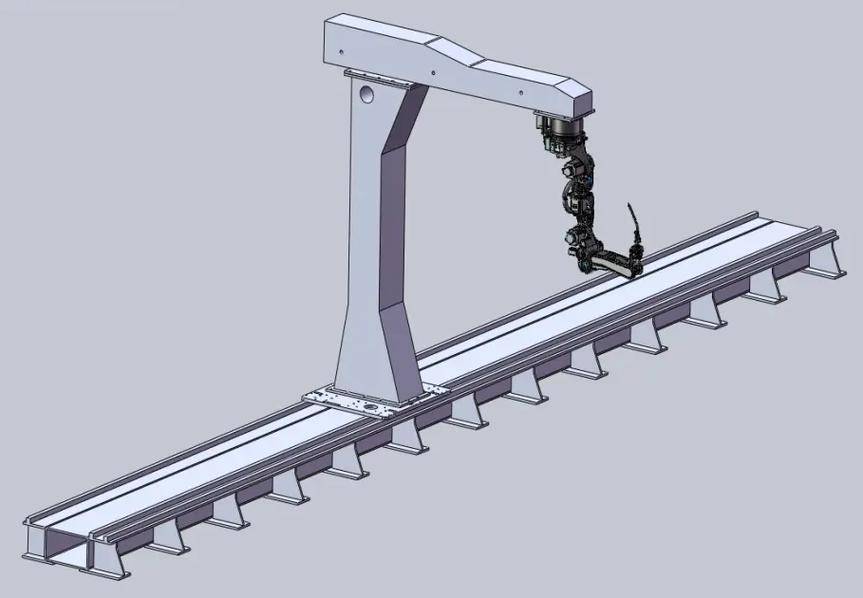
The core of the cell consists of a 6-axis industrial manipulator optimized for heavy-load welding. Unlike standard light-duty arms, this MIG/MAG welding robot features an integrated water-cooled torch lead system and an IP67-rated wrist to withstand the abrasive environment of a structural steel workshop.
Power Source and Waveform Control
The power source is a 500A inverter-based unit, specifically calibrated for “Pulse-on-Pulse” and “High-Speed Spray” transfer modes. In the context of structural steel welding, controlling the heat input (kJ/mm) is critical. The arc welding solutions implemented here include digital communication protocols that allow the robot to adjust voltage and wire feed speed in real-time (at 100MHz cycles), compensating for slight variations in groove geometry detected via laser seam tracking.
2. The Synergy Between Hardware and Process Solutions
The successful application of a MIG/MAG welding robot in the Abu Dhabi climate is not merely a result of the robotic arm’s precision, but the synergy between the hardware and the overarching arc welding solutions. In our field test, we found that a “naked” robot struggled with the 25mm thick S355JR structural plates. It was the integration of adaptive software and specialized gas-delivery systems that bridged the gap.
Adaptive Seam Tracking in Heavy Sections
For structural steel welding, fit-up tolerances are rarely perfect. A static program will result in lack of fusion or excessive burn-through. Our solution involved a Through-Arc Seam Tracking (TAST) system. As the MIG/MAG welding robot weaves across the joint, the system monitors the electrical current. If the arc length changes due to a gap variation, the robot’s path corrects instantly. This synergy ensures that even if the heavy structural members have a 1-2mm deviation, the arc remains centered in the root.
3. Overcoming Abu Dhabi’s Environmental Variables
Working in the UAE presents unique challenges for arc welding solutions. High humidity can lead to hydrogen-induced cracking (HIC) if gas purity is compromised or if the base metal is not properly preheated. Furthermore, the heat affects the duty cycle of the MIG/MAG welding robot‘s power source.
Cooling and Gas Stability
We implemented a closed-loop water-cooling circuit for the robotic torch. In standard environments, air-cooled torches suffice, but for 24/7 structural steel welding in ICAD, air-cooling led to contact tip expansion and wire feeding stumbles. By shifting to a high-capacity liquid cooler, we maintained a 100% duty cycle at 420A. Additionally, the shielding gas (80% Ar / 20% CO2) was fed through a heated regulator system to prevent flow fluctuations caused by the pressure differential in high-heat zones.
4. Structural Steel Welding: Process Deep-Dive
The project focused on multi-pass fillet and butt welds on thick-walled sections. Manual welding of these components typically requires four hours per joint; the MIG/MAG welding robot reduced this to 75 minutes, including cleaning time.
Root Pass Integrity
The most difficult aspect of automated structural steel welding is the root pass on one-sided joints. We utilized a “Modified Short Circuit” (MSC) waveform, part of our advanced arc welding solutions package. This allowed the robot to bridge gaps up to 4mm without a backing bar, providing a flat internal bead profile and excellent tie-in to the side walls. This eliminated the need for back-gouging, which is a major cost-saver in heavy fabrication.
Filler and Cap Passes
For the filler passes, the robot transitioned to a high-deposition spray transfer mode. By using 1.2mm ER70S-6 wire, we achieved deposition rates of approximately 6.5 kg/h. The consistency of the MIG/MAG welding robot ensured that the interpass temperature remained within the 150°C–250°C range, which is vital for maintaining the grain structure of the S355JR steel.
5. Quality Assurance and NDT Results
Post-welding inspection was conducted via Ultrasonic Testing (UT) and Magnetic Particle Inspection (MPI). Out of 150 joints welded by the robot, only two required minor rework—a 98.6% first-pass success rate.
Lessons Learned: The Importance of Wire Quality
Early in the commissioning phase, we experienced “arc wandering.” Technical analysis revealed that the wire spooling from a local supplier had inconsistent cast and helix. For a MIG/MAG welding robot, wire feed consistency is paramount. We switched to “dead-level” precision-wound drums (250kg) with an automated wire-feeding assist motor. This solved the wandering issue and underscored that high-end arc welding solutions must include premium consumables to be effective in structural steel welding.
6. Lessons Learned from the Field
Based on the three-month deployment in Abu Dhabi, several critical engineering lessons were recorded:
- Shielding Gas Protection: In the Abu Dhabi workshop, large industrial fans are used for worker cooling. These fans create cross-drafts that strip the shielding gas from the robotic torch. We had to install localized welding screens/curtains around the robot cell to maintain a stable gas envelope. Without this, porosity in the structural steel welding was inevitable.
- Maintenance of the “Arc Welding Solutions” Suite: The laser sensors used for seam tracking required daily cleaning. The fine dust in the UAE air can occlude the laser lens, causing the MIG/MAG welding robot to lose its path. A simple compressed air-blast nozzle was added to the torch cleaning station to automate this maintenance.
- Program Offsetting: In heavy structural steel welding, thermal expansion of the workpiece is significant. A beam that is 10 meters long can expand by several millimeters during the welding process. We learned to program the robot with “dynamic start points,” using the torch tip as a touch-sensor to recalibrate the coordinate system before every pass.
7. Economic and Safety Impact
The transition to a MIG/MAG welding robot has moved our most skilled welders from the “front line” of heat and fumes to the role of “Robot Technicians.” This is a significant safety improvement in the Abu Dhabi climate, reducing heat-stress incidents. Economically, the cost-per-meter of weld has dropped by 35% when factoring in the reduced gas consumption (due to optimized flow) and the elimination of grinding/rework.
8. Conclusion and Path Forward
The integration of the MIG/MAG welding robot into our Abu Dhabi workflow has proven that automation is viable even in harsh environments, provided that the arc welding solutions are tailored to the specific metallurgical and atmospheric conditions. For future structural steel welding projects, we recommend the mandatory inclusion of water-cooled systems and adaptive TAST software as standard kit. The next phase will involve integrating a twin-wire system to further increase deposition rates for 50mm+ plate thicknesses.
Engineer: J. H. – Senior Welding Engineer
Location: Abu Dhabi, UAE
Status: Commissioning Complete / Production Active







