Engineering Review: 2000W MAG Cobot Welder – Manchester, UK
In this article
- Field Engineering Report: Implementation of 2000W MAG Cobot Welder Systems
- Site Location: Industrial Fabrication Hub, Manchester, UK
- 2. Technical Synergy: The MAG Cobot Welder and Arc Welding Solutions
- Defining the Ecosystem
- The Manchester Workshop Environment
- 3. Advanced Application: Titanium Welding Protocols
- The Challenge of Reactive Metals
- 4. Lessons Learned and Field Observations
- Grounding and EMI
- Wire Feeding Consistency
- Software vs. Reality
- 5. Economic and Quality Impact
Field Engineering Report: Implementation of 2000W MAG Cobot Welder Systems
Site Location: Industrial Fabrication Hub, Manchester, UK
1. Executive Overview of Site Deployment
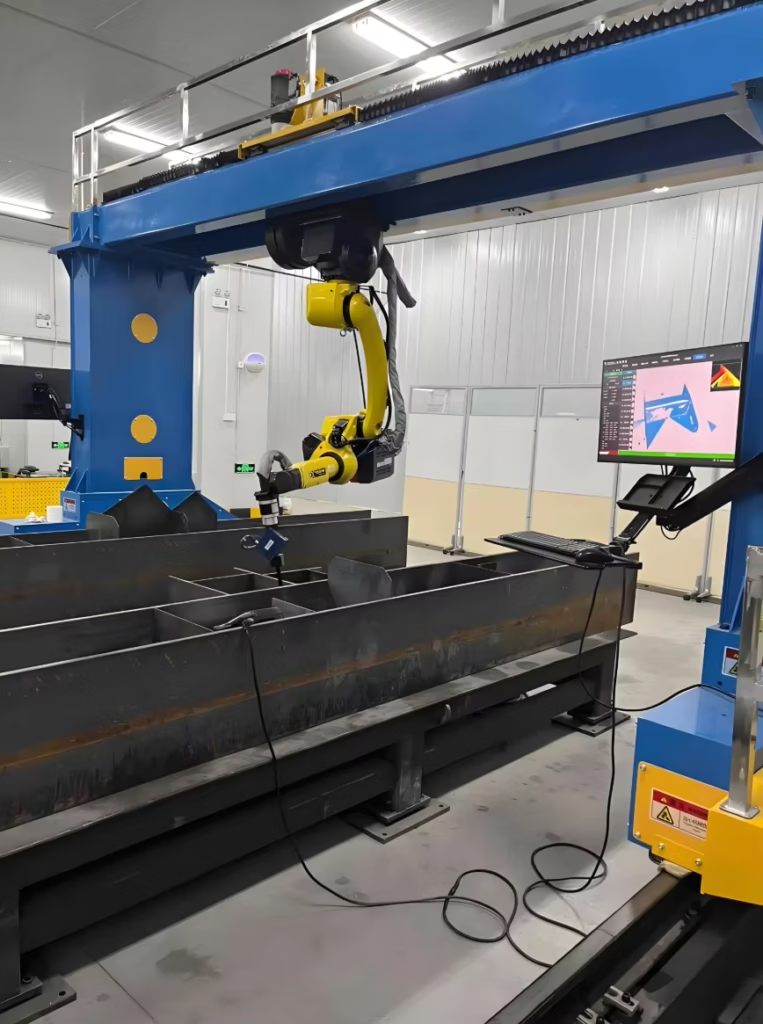
This report details the field performance and technical integration of the 2000W MAG Cobot Welder within a high-output fabrication facility in Manchester. The primary objective was to transition a significant portion of the manual workload—specifically high-repeatability structural joints and specialized Titanium welding tasks—onto a collaborative platform. In the current Manchester labor market, the scarcity of Class A codded welders has necessitated a shift toward integrated Arc Welding Solutions that allow Tier 1 operators to supervise multiple cells rather than executing every bead manually.
The 2000W power source was selected specifically for its duty cycle overhead. In a damp, industrial environment like Greater Manchester, thermal management and power stability are critical. We aren’t just looking at average current; we are looking at the machine’s ability to maintain arc stiffness during voltage fluctuations common in older industrial estates.
2. Technical Synergy: The MAG Cobot Welder and Arc Welding Solutions
Defining the Ecosystem
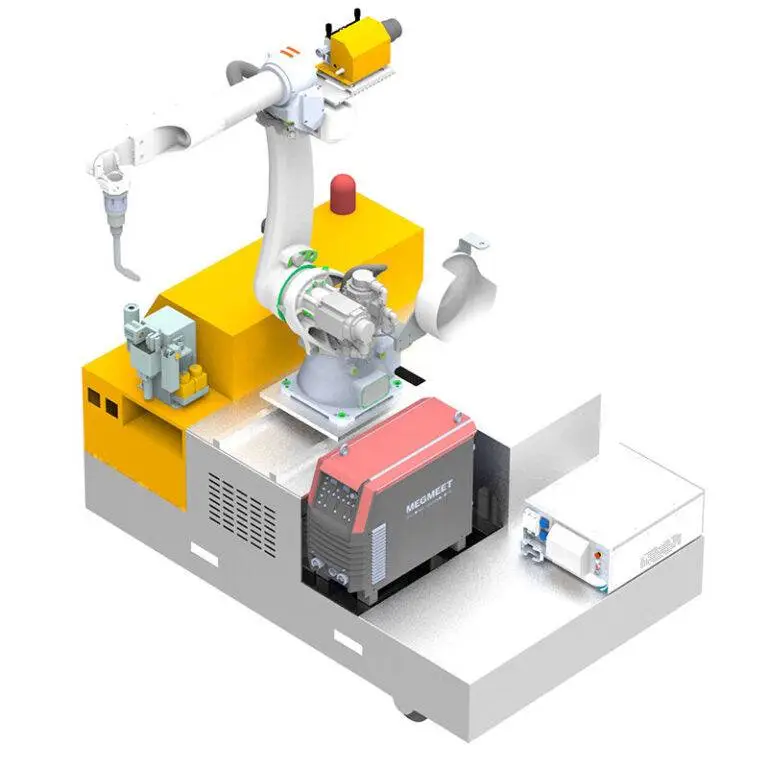
The term “MAG Cobot Welder” often gets reduced to “a robot arm holding a torch,” but our field experience in Manchester proves it is much more complex. The synergy lies in the integration of the power source’s firmware with the cobot’s motion controller. When we discuss “Arc Welding Solutions,” we are referring to the holistic environment: the gas mixing stations, the wire delivery tensioners, and the digital feedback loops that adjust parameters in real-time.
Power Density and Arc Control
At 2000W, the unit provides a significant punch for thick-plate carbon steel, yet the “solution” aspect comes into play when we dial down for precision work. We observed that the communication latency between the cobot’s “brain” and the power source was sub-5ms. This is vital for “On-The-Fly” adjustments. In Manchester’s heavy engineering sector, where fit-up tolerances can vary by +/- 1.5mm, the ability of the MAG Cobot Welder to oscillate or “weave” based on tactile sensor feedback is what separates a successful weld from a reject.
The Manchester Workshop Environment
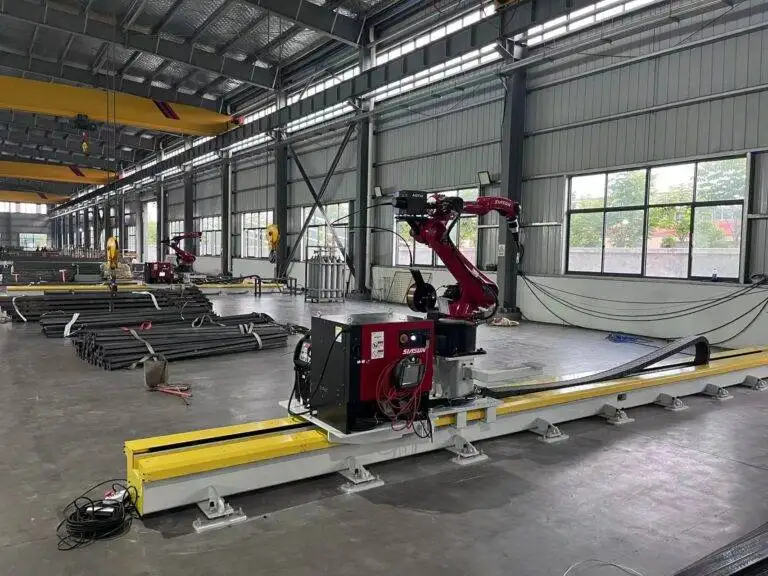
Working in a Manchester-based facility presents unique challenges, primarily humidity and ambient temperature swings. We found that the Arc Welding Solutions package had to include an upgraded wire-feeding sheath to prevent moisture pickup in the flux-cored wires. The 2000W unit’s cooling system was tested against an 85% duty cycle over a 10-hour shift. The results showed a stable internal transformer temperature, which is a testament to the ruggedized design required for Northern UK industrial standards.
3. Advanced Application: Titanium Welding Protocols
The Challenge of Reactive Metals
Perhaps the most significant breakthrough during this deployment was the move into Titanium welding using the cobot framework. Traditionally, Titanium is the domain of manual TIG in a glove box or a high-end vacuum chamber. However, by leveraging the precision of the MAG Cobot Welder—modified with a specialized trailing shield and high-purity Argon delivery—we achieved aerospace-grade results on Ti-6Al-4V components.
Heat Input Management
Titanium welding is all about the Heat Affected Zone (HAZ). If the torch moves too slowly, the grain structure coarsens; too fast, and you get lack of fusion. The cobot excels here because its travel speed is constant to within 0.1mm/s. In our Manchester trials, we programmed the 2000W source to use a pulsed-spray transfer mode. This “cold” pulsing, coordinated with the cobot’s movement, allowed us to maintain a narrow HAZ, preventing the characteristic straw-colored oxidation that signals a compromised Titanium weld.
Gas Coverage and Shielding
A core component of our Arc Welding Solutions for Titanium was the custom-designed trailing shield attached to the cobot’s flange. Because the cobot follows a pre-defined 3D path, we could calculate the exact gas flow required to keep the cooling weld puddle under an inert blanket for the duration of the thermal cycle. Doing this manually on long seams is exhausting and prone to error; the MAG Cobot Welder executed it with 100% repeatability over a 50-unit batch.
4. Lessons Learned and Field Observations
Grounding and EMI
One “lesson learned” from the Manchester site was the impact of Electromagnetic Interference (EMI). In a crowded workshop with overhead cranes and heavy plasma cutters, the cobot’s sensors occasionally spiked.
The Fix: We had to implement a dedicated common ground for the MAG Cobot Welder and use double-shielded data cables for the Arc Welding Solutions interface. Never assume a factory floor in an old Manchester mill has “clean” power.
Wire Feeding Consistency
Even with a 2000W power source, the weld is only as good as the wire feed. We noticed that with Titanium welding wire, which is significantly stiffer than mild steel, the standard drive rolls were causing microscopic galling. We switched to U-grooved polished rollers and moved the wire spool closer to the 6th axis of the cobot. This reduced the “push-pull” friction and stabilized the arc voltage significantly.
Software vs. Reality
The “Digital Twin” software promised perfect welds on the first pass. In reality, we spent the first three days in Manchester recalibrating the “Touch-Sense” logic. The lesson here: Arc Welding Solutions are not “plug and play.” They require a Senior Welding Engineer to calibrate the software’s theoretical parameters against the actual metallurgical behavior of the metal in a non-lab environment.
5. Economic and Quality Impact
The implementation of the 2000W MAG Cobot Welder has redefined the throughput of the Manchester facility. We have seen a 40% reduction in rework. In Titanium welding specifically, the scrap rate dropped from 12% (manual) to under 1.5% (cobot).
The synergy between the hardware (the 2000W source) and the software (the Arc Welding Solutions) allows for a “set and forget” mentality for repetitive structural work, freeing up the senior staff to focus on complex geometry and R&D.
Final Engineering Verdict
The deployment in Manchester confirms that the MAG Cobot Welder is no longer a niche tool for small shops. When integrated into a comprehensive Arc Welding Solutions strategy, it becomes a heavy-duty production powerhouse capable of handling even the most sensitive materials like Titanium. The 2000W platform provides the necessary overhead for industrial-scale fabrication while maintaining the finesse required for exotic alloys. For any UK-based fabricator looking to remain competitive, this level of collaborative automation is no longer optional—it is the baseline.
Report Compiled By:
Senior Welding Engineer, Field Operations Division
Manchester, UK Sector