Automatic Girth Seam Welder with Zero-tailing technology for LNG Projects

In this article
- Technical Overview of Zero-Tailing in LNG Tank Construction
- The MAG Welding Process: Precision for Cryogenic Applications
- Shielding Gas Dynamics and Arc Stability
- Pulse Transfer and Penetration Control
- Labor ROI: Quantifying the Shift to Automation
- Deposition Rates and Arc-On Time
- Reduction in Post-Weld Rework
- Maintenance Protocols for Robotic Girth Welders
- Strategic Implementation in LNG Infrastructure
- Conclusion
Technical Overview of Zero-Tailing in LNG Tank Construction
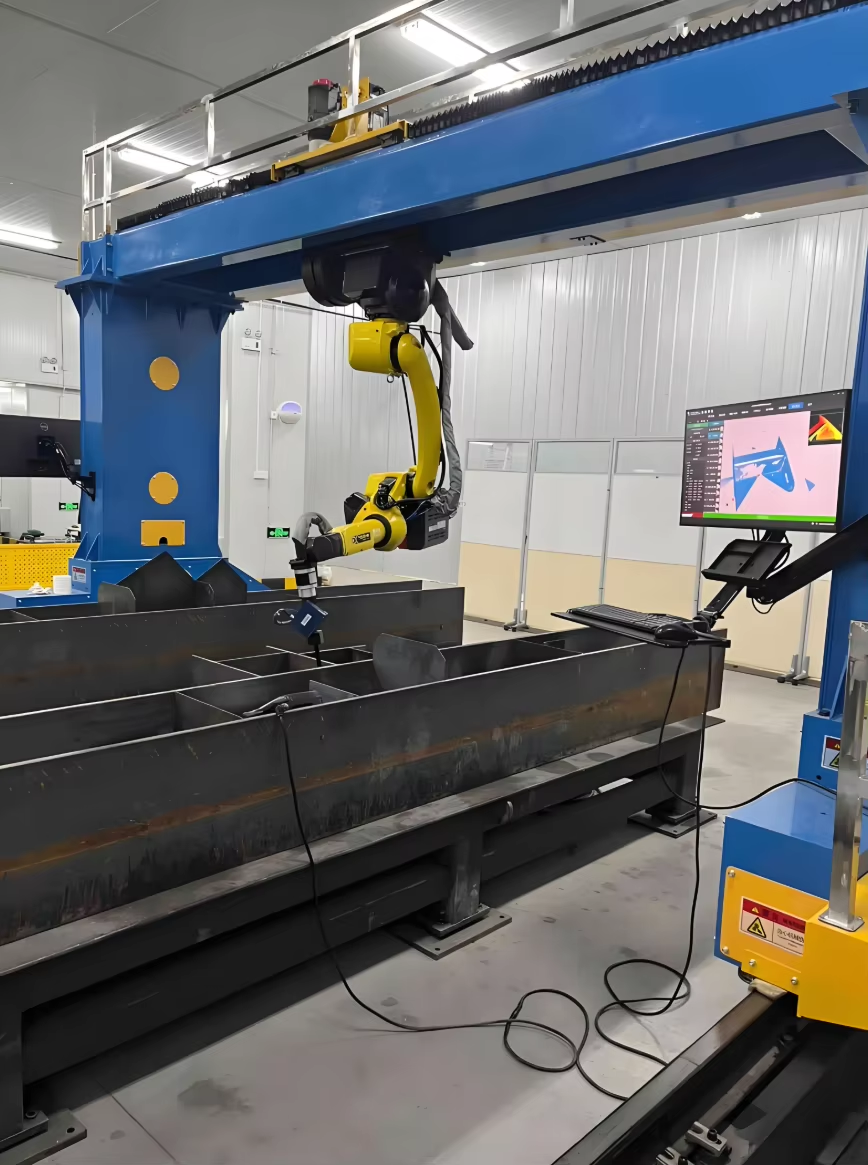
In the construction of Liquefied Natural Gas (LNG) storage tanks, the integrity of horizontal girth seams is paramount. Traditional submerged arc welding (SAW) or manual metal arc welding (MMAW) often leaves “tails” or un-welded gaps at the start and stop points of a circumference pass. The introduction of the Automatic Girth Seam Welder with Zero-tailing technology addresses this inefficiency directly. By utilizing advanced sensor arrays and synchronized drive motors, these robotic systems ensure that the weld bead is deposited with absolute continuity around the entire 360-degree interface of the tank shells.
Zero-tailing technology functions by optimizing the overlap zone. In a standard setup, the operator must manually grind down the start of a weld to allow the finish of the pass to merge seamlessly. Robotic zero-tailing uses encoder-based positioning to calculate the exact millisecond to adjust the wire feed speed and travel velocity as the arc approaches the starting point. This results in a flush joint that meets the stringent radiographic testing (RT) requirements common in LNG projects without the need for secondary manual intervention.
The MAG Welding Process: Precision for Cryogenic Applications
The core of these robotic systems relies on the MAG welding process (Metal Active Gas). For LNG tanks, which typically utilize 9% Nickel steel or specialized stainless steel grades, the MAG process offers a high-deposition rate while maintaining the required fracture toughness at cryogenic temperatures. Unlike manual processes, the robotic MAG system operates with a constant voltage power source that adapts to fluctuations in the arc gap in real-time.
Shielding Gas Dynamics and Arc Stability
The choice of shielding gas in robotic girth welding is critical. Usually, a mixture of Argon and CO2 is employed to stabilize the arc and minimize spatter. The robotic interface allows for precise control over the gas flow rate, ensuring that the weld pool is shielded even in the high-wind environments typical of outdoor tank farms. The stability of the MAG arc under robotic control ensures a uniform heat-affected zone (HAZ), which is vital for maintaining the structural ductility required to withstand the thermal stresses of LNG storage.
Pulse Transfer and Penetration Control
Modern robotic welders utilize pulsed MAG technology. By pulsing the current, the system can achieve spray-transfer characteristics at lower average heat inputs. This prevents burn-through on thinner shell plates while ensuring deep penetration on the thicker base courses of the tank. For an industrial engineer, this level of control translates to a lower reject rate during non-destructive testing (NDT).
Labor ROI: Quantifying the Shift to Automation
The primary driver for adopting zero-tailing technology is the quantifiable return on investment regarding skilled labor. The global shortage of certified pressure vessel welders has driven labor costs to an all-time high. A single automatic girth welder can replace the output of four to six manual welders, depending on the shell thickness and tank diameter.
Deposition Rates and Arc-On Time
In a manual welding scenario, the “arc-on” time—the actual time spent depositing metal—rarely exceeds 30% due to welder fatigue, electrode changes, and repositioning. A robotic girth welder operates at an arc-on time of 85% or higher. Because the machine travels on a dedicated track system or “buggy” along the tank rim, it maintains a constant speed and torch angle that no human can replicate over a 10-hour shift. This consistency reduces the total man-hours per linear meter of weld by approximately 60%.
Reduction in Post-Weld Rework
Rework is the most significant “hidden cost” in LNG projects. Manual starts and stops are prone to porosity and slag inclusions. By utilizing zero-tailing technology, the mechanical consistency of the tie-ins eliminates the need for a dedicated grinding crew to follow the welding team. When the cost of consumables, grinding discs, and the labor for NDT re-tests are factored in, the ROI for the robotic system is typically realized within the construction of the first two LNG tanks on a multi-tank terminal project.
Maintenance Protocols for Robotic Girth Welders
To maintain high availability, the robotic system requires a structured maintenance schedule that differs significantly from simple transformer-based welding machines. The integration of mechanical drive systems, electronic sensors, and fluid-cooled torches necessitates a proactive approach.
Daily Maintenance Checks
Operators must inspect the drive rollers and the track engagement mechanism daily. Any buildup of mill scale or dust can cause “crabbing” or deviation from the seam, which would negate the benefits of the zero-tailing logic. The contact tip and gas nozzle must be cleaned every four hours of arc time to prevent wire feeding issues and gas turbulence.
Calibrating the Zero-Tailing Sensors
The sensors responsible for the zero-tailing synchronization—often laser-based seam trackers or tactile probes—require weekly calibration. These sensors ensure that the torch remains centered in the V-groove. If the sensor calibration drifts, the machine may fail to recognize the “overlap” point, leading to either a crater or an excessive reinforcement buildup at the seam junction.
Consumable Management
The use of bulk wire drums (250kg to 500kg) instead of small spools is recommended for robotic operations to minimize downtime. Maintenance teams must ensure that the wire conduit remains free of kinks, as the increased length of the conduit in a girth welder can lead to friction-induced feed motor strain.
Strategic Implementation in LNG Infrastructure
The shift toward Labor ROI through automation is no longer optional for Tier-1 contractors. As LNG tank capacities increase toward 200,000 cubic meters and beyond, the sheer volume of welding required makes manual methods logistically unfeasible. Implementing an automatic girth seam welder allows project managers to compress the schedule of the critical path—the mechanical completion of the inner and outer shells.
Safety and Environmental Factors
Beyond the financial metrics, automation improves site safety. By reducing the number of personnel working at height on tank scaffolds, the risk of fall-related incidents is lowered. Furthermore, the precise control of the MAG process reduces welding fumes and waste, contributing to a more controlled industrial environment.
Conclusion
The application of robotic girth seam welding with zero-tailing technology represents the pinnacle of current LNG tank fabrication strategy. By optimizing the MAG welding process, companies can achieve unparalleled consistency, drastically reduce the need for skilled manual labor, and ensure that maintenance costs are outweighed by the speed and quality of production. For the industrial engineer, the data is clear: the transition from manual variability to robotic precision is the most effective way to manage the escalating complexities of modern energy infrastructure projects.






