Automatic Girth Seam Welder with Offline Programming for Wind Tower fabrication

In this article
- Engineering Efficiency in Wind Tower Girth Seam Fabrication
- The Strategic Role of Offline Programming (OLP)
- Path Optimization and Collision Avoidance
- Advanced Multi-Pass Management
- Robotic MAG Welding: Process Control and Stability
- Maintenance Protocols for High-Duty Cycle Systems
- Labor ROI and Economic Impact
- Quantifying Labor Displacement and Upskilling
- Reduction in Rework Costs
- Conclusion
Engineering Efficiency in Wind Tower Girth Seam Fabrication
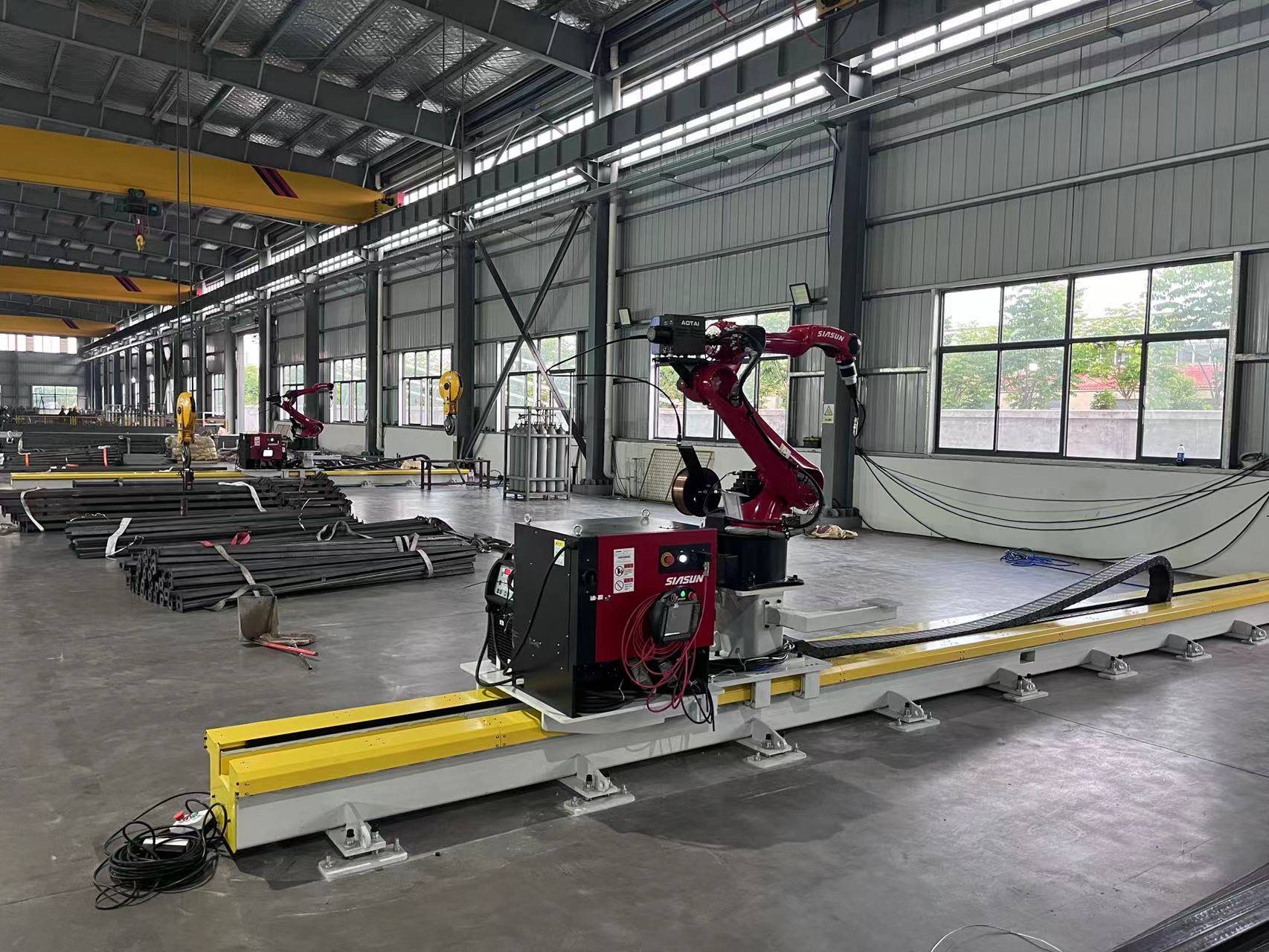
In the heavy fabrication sector, specifically wind tower production, the girth seam remains one of the most critical structural junctions. As tower diameters exceed 5 meters and wall thicknesses scale to meet taller hub heights, traditional manual or semi-automatic methods fail to meet the required throughput and quality benchmarks. The transition to an automated girth seam welder, powered by sophisticated robotic systems, is no longer an optional upgrade but a fundamental requirement for operational viability. This analysis focuses on the integration of offline programming (OLP) and robotic Metal Active Gas (MAG) welding to optimize cycle times and labor utilization.
The Strategic Role of Offline Programming (OLP)
Traditional “teach-pendant” programming is a bottleneck in wind tower production. When a robot is being taught a path manually, the entire production cell sits idle, leading to a zero-percent utilization rate during the setup phase. For complex girth seams involving multi-pass requirements and varying bevel geometries, teaching can take hours or even days. OLP circumvents this by utilizing a digital twin environment where the industrial engineer can simulate the entire welding sequence without interrupting the shop floor flow.
Path Optimization and Collision Avoidance
Using OLP software, engineers can calibrate the robotic kinematics to the specific geometry of the tower sections. The software calculates the optimal torch angles and travel speeds while ensuring that the robotic arm remains within its work envelope. This is particularly vital for girth seams where the circular trajectory requires continuous coordination between the robot’s external axes and the rotating bed rollers (rotators). By simulating these movements, potential collisions between the torch assembly and the tower shell are identified and rectified in the virtual space.
Advanced Multi-Pass Management
Wind tower seams often require 10 to 40 passes depending on the plate thickness. OLP allows for the automated generation of these passes, calculating the precise offset for each bead to ensure consistent fusion and a flat cap profile. The software can automatically adjust parameters such as wire feed speed and voltage for root, fill, and cap passes, ensuring that the deposition rate is maximized while the heat input remains within the specified Procedure Qualification Record (PQR) limits.
Robotic MAG Welding: Process Control and Stability
The choice of robotic MAG welding for girth seams is driven by the need for high-speed metal transfer and deep penetration. Unlike manual processes, a robot can maintain a consistent stick-out (electrode extension), which is critical for electrical stability in high-current applications. In wind tower fabrication, using a 1.2mm or 1.6mm solid wire with an Argon/CO2 shielding gas mix allows for stable spray transfer or pulsed-arc regimes, significantly reducing spatter and post-weld cleanup.
Consistency in Heat Input
Maintaining a narrow heat-affected zone (HAZ) is essential for the structural integrity of the tower. A robot moves at a precise, calculated travel speed that a human operator cannot match over a continuous 15-meter circumference. This precision ensures that the cooling rate of the weld metal is controlled, preventing the formation of brittle martensitic structures and ensuring the tower meets fatigue resistance requirements for offshore or high-wind environments.
Adaptive Sensing and Real-Time Adjustments
Modern girth seam welders are equipped with “Through-Arc Seam Tracking” (TAST) or tactile sensors. Even with high-quality rolling, tower sections are rarely perfectly circular. TAST allows the robot to monitor changes in the welding current as the torch oscillates across the joint. If the joint shifts or the gap width fluctuates, the robot adjusts its trajectory in real-time. This level of adaptation ensures that the weld remains centered in the groove, drastically reducing the rate of non-destructive testing (NDT) failures such as lack of side-wall fusion or slag inclusions.
Maintenance Protocols for High-Duty Cycle Systems
To realize the benefits of automation, a rigorous preventive maintenance (PM) schedule must be enforced. A Robotic Welding cell in a wind tower facility often operates at a duty cycle of 80% or higher. This puts significant stress on the wire delivery system and the torch consumables.
Consumable Management and Torch Calibration
The contact tip is the most frequent point of failure. In a robotic system, tip wear causes “arc wander,” which can lead to off-center welds. Automated torch cleaning stations (reamers) should be programmed to cycle every 30 to 60 minutes of arc-on time. These stations spray anti-spatter fluid, trim the wire, and clean the nozzle, ensuring consistent gas flow and electrical contact. Furthermore, periodic Check-Point routines must be programmed to verify the Tool Center Point (TCP). If the torch sustains a minor impact, the TCP can shift; an automated check ensures the robot remains calibrated to the seam.
Wire Feed Integrity
Given the large volumes of wire consumed (often 250kg or 500kg bulk drums), the wire conduit must be checked for friction. Any increase in drag can lead to wire slipping at the drive rolls, resulting in arc instability. Industrial engineers should implement “Mean Time Between Failure” (MTBF) tracking for liners and drive rolls to replace these components before they cause unplanned downtime during a critical girth seam pass.
Labor ROI and Economic Impact
The ROI for a robotic girth seam welder is calculated by analyzing the reduction in “man-hours per tower” and the increase in “arc-on time.” In a manual welding scenario, a welder’s duty cycle is typically 25% to 30% due to fatigue, repositioning, and personal breaks. A robotic system elevates this to 85%.
Quantifying Labor Displacement and Upskilling
One robotic operator can often oversee two welding stations simultaneously. In a three-shift operation, this replaces the need for six highly skilled manual welders, who are increasingly difficult to recruit and retain in the current labor market. Instead of performing the physically demanding task of welding in a confined or elevated position, the workforce is upskilled to become “Robot Technicians.” This reduces worker compensation claims related to repetitive strain and flash-burn exposure, further lowering the total cost of ownership (TCO).
Reduction in Rework Costs
Rework on a wind tower girth seam is exponentially more expensive than the initial weld. It requires gouging out the defect, re-prepping the joint, and manual repair, often taking the tower off the critical path for days. Robotic systems integrated with OLP and seam tracking typically reduce NDT rejection rates from 5-8% (manual) to less than 1%. When the cost of gas, wire, electricity, and floor space is factored against the increased throughput, most facilities see a full capital equipment payback within 18 to 24 months.
Conclusion
The implementation of an Automatic Girth Seam Welder with Offline Programming represents the pinnacle of operational excellence in wind tower fabrication. By leveraging the precision of robotic MAG welding and the predictive power of OLP, manufacturers can stabilize their production schedules, overcome labor shortages, and ensure the highest levels of structural integrity. As the global demand for renewable energy infrastructure accelerates, the ability to produce high-quality towers at a lower cost-per-unit will be the primary differentiator for successful industrial operations.






