Automatic Girth Seam Welder with Offline Programming for Shipbuilding

In this article
Optimizing Shipbuilding Throughput with the Automatic Girth Seam Welder
In the heavy industrial sector of shipbuilding, the girth seam—the circumferential joint connecting cylindrical hull sections or large-scale piping—represents one of the most labor-intensive and quality-critical phases of production. Traditionally, these welds were executed by manual operators or simple mechanized tractors, both of which suffer from consistency issues and environmental fatigue. The transition to an Automatic Girth Seam Welder utilizing a robotic arm and sophisticated software represents a shift toward data-driven manufacturing. By automating the Metal Active Gas (MAG) process, shipyards can bypass the inherent limitations of human endurance and achieve a level of precision that manual applications cannot replicate over a 10-hour shift.
The core of this technological shift is the integration of Robotic Welding systems that are no longer tethered to “teach-pendant” programming. In shipbuilding, where parts are massive and production runs are often low-volume but high-complexity, traditional programming is a bottleneck. The implementation of Offline Programming (OLP) allows engineers to generate weld paths, simulate torch angles, and optimize wire stick-out in a virtual environment. This keeps the robot in “arc-on” mode while the next project is being planned, maximizing the capital equipment’s utility rate.
The MAG Process: Technical Parameters and Advantages
The choice of MAG welding for girth seams is dictated by the need for high deposition rates and deep penetration in thick-plate steel. Unlike generic MIG welding, the MAG process utilizes active shielding gases—typically a blend of Argon and Carbon Dioxide (Ar-CO2)—to influence the arc stability and the fluidity of the weld pool. For hull sections ranging from 15mm to 50mm in thickness, the Automatic Girth Seam Welder is configured for multi-pass sequences.
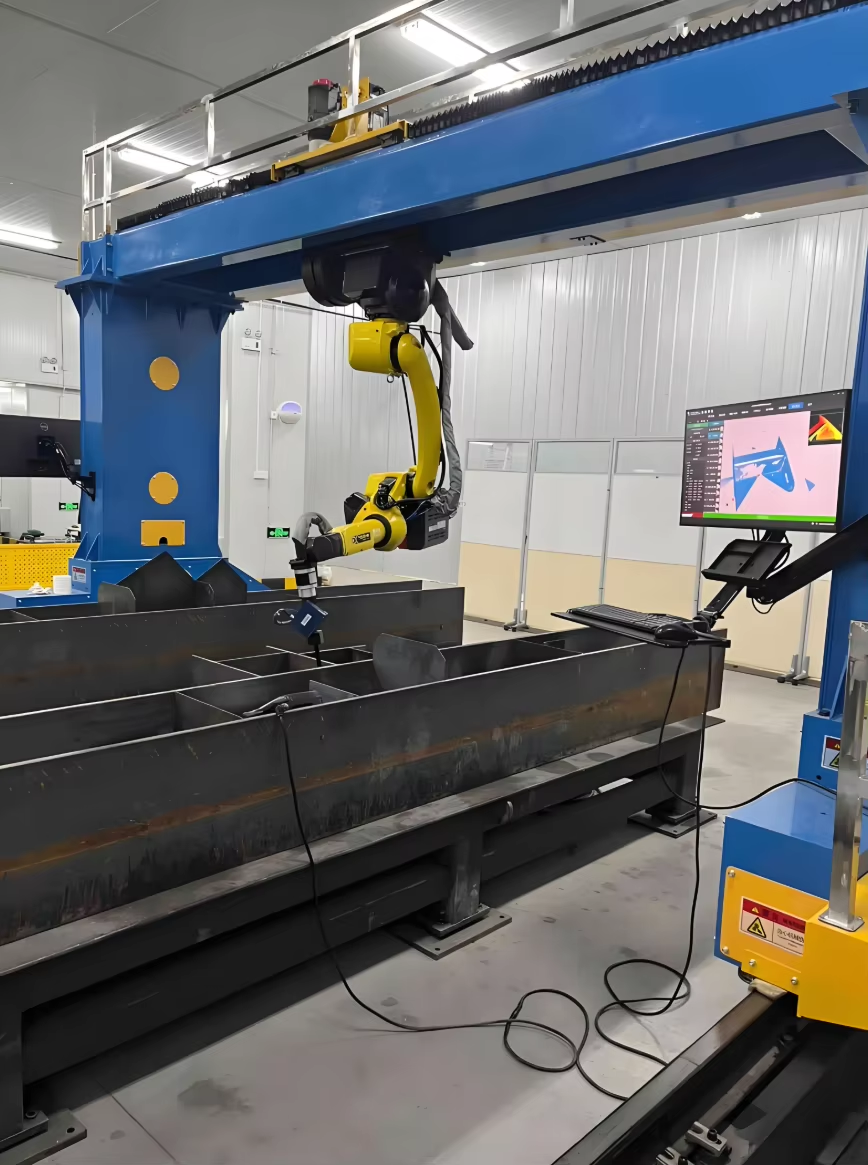
Robotic MAG systems allow for precise control over the spray transfer mode. By maintaining a constant voltage and wire feed speed, the robot ensures that the droplet transfer is consistent, minimizing spatter and the subsequent need for post-weld grinding. In a manual environment, maintaining a consistent torch angle around the circumference of a large vessel is ergonomically impossible. The robotic arm, however, maintains the optimal work angle and travel angle throughout the 360-degree rotation, ensuring uniform bead profile and penetration depth. This repeatability is essential for passing rigorous non-destructive testing (NDT) such as ultrasonic or radiographic inspections, which are standard in maritime construction.
Offline Programming: Eliminating Production Downtime
Offline Programming is the primary driver of ROI for robotic systems in shipyards. Historically, robots were seen as unsuitable for Shipbuilding because the time required to “teach” the robot a path exceeded the time it took to weld the joint manually. OLP changes this calculation by utilizing the ship’s CAD data to generate welding paths automatically.
The software accounts for the geometry of the hull, the specific groove design (V-groove, J-groove, or U-groove), and the physical constraints of the robotic cell. Engineers can perform reachability studies and collision detection before the first arc is struck. Furthermore, OLP systems can integrate “Search and Track” functions. Since large shipyard sections often have fit-up tolerances that vary by several millimeters, the Automatic Girth Seam Welder uses touch-sensing or through-arc seam tracking to adjust the pre-programmed path in real-time. This synergy between digital planning and physical sensing ensures that the weld is always placed in the center of the joint, regardless of minor deviations in the workpiece assembly.
Maintenance Protocols for High-Duty Cycle Robotics
To maintain a high Mean Time Between Failure (MTBF), a rigorous preventative maintenance schedule is mandatory. Robotic MAG systems are high-duty cycle machines, often operating at 80% to 90% arc-on time. This places significant thermal stress on the welding torch and the wire delivery system.
Daily maintenance focus must be directed at the “front-end” consumables: the contact tip, the gas nozzle, and the diffuser. In high-amperage MAG welding, contact tip wear is the leading cause of arc instability and “burn-back.” Automated torch cleaning stations, or “reamers,” should be integrated into the cell to automatically clear spatter and apply anti-spatter liquid during the inter-pass intervals. Beyond the torch, the wire liners must be replaced at regular intervals based on the volume of wire consumed. A clogged liner introduces friction, leading to wire slippage and inconsistent weld beads. From an industrial engineering perspective, these maintenance tasks are not “downtime” but rather scheduled “micro-interventions” that prevent the catastrophic failure of a 50-meter girth seam weld.
Labor ROI and Economic Impact
The economic justification for an Automatic Girth Seam Welder is found in the “deposition rate per hour” and the “cost per kilogram of weld metal.” A manual welder typically operates at a duty cycle of 30% to 40% due to the need for breaks, repositioning, and helmet adjustments. A robotic system effectively doubles this duty cycle.
When analyzing labor ROI, it is a misconception to view robotics as a simple replacement for human labor. Instead, it is a force multiplier. One skilled operator can supervise two or three robotic girth seam cells. The ROI is further bolstered by the reduction in “rework.” In shipbuilding, the cost of gouging out a defective weld and re-welding it is roughly four times the cost of the initial weld. By providing a repeatable, MAG welding process controlled by OLP, the shipyard virtually eliminates the variability that leads to defects like porosity, slag inclusions, or lack of fusion.
Safety and Human Factors
Finally, the implementation of robotic girth seam welding removes human operators from hazardous environments. Welding large hull sections often involves working at heights, in confined spaces, or in positions that cause long-term musculoskeletal strain. By delegating the physical execution to a Robotic Welding system, the human worker transitions into a “Technician” or “System Operator” role, focusing on quality assurance and process optimization rather than enduring the physical hardships of the shipyard floor. This shift not only improves safety metrics but also addresses the chronic shortage of high-level manual welders in the maritime industry.
Conclusion
The integration of an Automatic Girth Seam Welder with Offline Programming is a strategic necessity for modern shipyards. By focusing on the technical precision of the MAG process, maintaining strict consumable management, and leveraging OLP to maximize arc-on time, facilities can achieve a throughput level that far exceeds traditional methods. The result is a more durable vessel, a safer workplace, and a significantly improved bottom line through the reduction of labor variance and rework costs.






