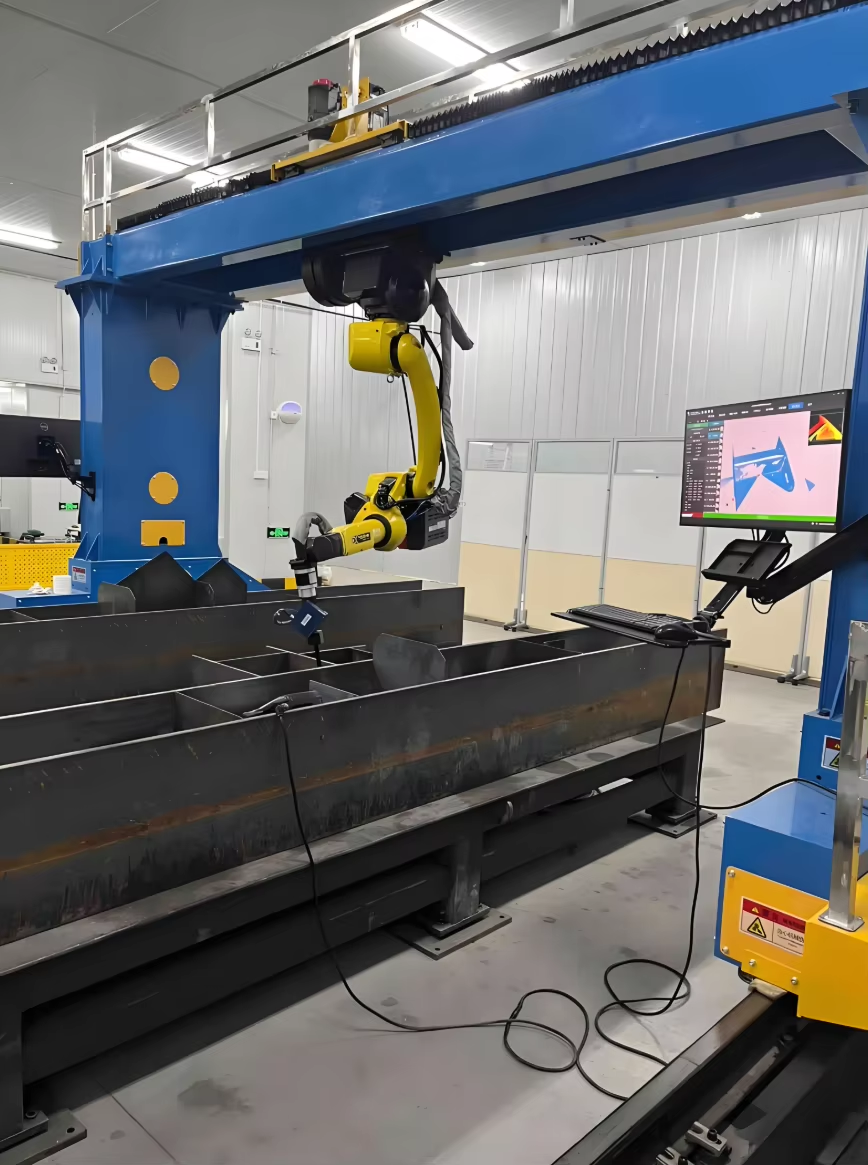
Automatic Girth Seam Welder with Narrow Gap welding for LNG Projects

In this article
- Optimizing LNG Infrastructure with Automatic Girth Seam Welding
- The Mechanics of Narrow Gap MAG Welding
- MAG Process Parameters in Robotic Systems
- Heat Input and Metallurgical Integrity
- Robotic Integration and System Architecture
- Automated Tracking and Sensing
- Precision and Repeatability
- Maintenance Protocols for High-Uptime Welding Systems
- Wire Delivery System Maintenance
- Torch and Contact Tip Management
- Carriage and Track Calibration
- Economic Analysis and Labor ROI
- Direct Labor Cost Reduction
- The Impact of Defect Rates on ROI
Optimizing LNG Infrastructure with Automatic Girth Seam Welding
The global demand for Liquefied Natural Gas (LNG) has necessitated the construction of massive storage tanks, often featuring thick-walled nickel alloy or stainless steel plates. In industrial engineering, the primary bottleneck in tank farm construction remains the horizontal circumferential welds, commonly known as girth seams. Traditional manual welding or standard mechanized processes often struggle with deposition consistency and heat input control. The introduction of the Automatic Girth Seam Welder using narrow gap MAG technology represents a paradigm shift in throughput and structural integrity.
The Mechanics of Narrow Gap MAG Welding
In the context of LNG projects, narrow gap welding refers to a technique where the groove angle is significantly reduced, often to less than 10 degrees, or even a parallel-sided preparation. This geometry minimizes the total volume of the weld joint, which directly correlates to a reduction in the number of passes required.
MAG Process Parameters in Robotic Systems
Metal Active Gas (MAG) welding is the preferred process for these robotic systems due to its high deposition rate and ability to be easily automated. In a narrow gap configuration, the robotic carriage must maintain precise wire positioning. Even a millimeter of deviation can lead to sidewall lack of fusion. The robotic system utilizes oscillating torch movements or specialized wave-form control to ensure that the arc reaches the root and sidewalls effectively.
Heat Input and Metallurgical Integrity
For cryogenic applications, maintaining the toughness of the heat-affected zone (HAZ) is critical. Robotic MAG systems allow for precise control over the voltage, current, and travel speed. By utilizing a narrow gap welding approach, the total heat input per unit length of the weld is often lower than traditional multi-pass wide-groove welding, despite the higher deposition per pass. This control is essential for preventing grain coarsening in the base metal, ensuring the tank can withstand the thermal stresses of LNG storage.
Robotic Integration and System Architecture
The transition from semi-automatic to fully robotic girth welding involves a sophisticated hardware stack. These systems typically consist of a self-propelled carriage that rides on a track mounted to the tank wall.
Automated Tracking and Sensing
Unlike manual welders who rely on visual feedback, the robotic girth welder employs laser-based or tactile seam tracking. However, the core of the robotic advantage lies in the integration of real-time monitoring of electrical parameters. In an LNG project, environmental factors like wind can disrupt gas shielding. Advanced robotic controllers can adjust parameters on the fly or pause the operation if they detect an anomaly in the arc stability, thereby preventing defects before they are buried under subsequent layers.
Precision and Repeatability
The primary mechanical advantage of robotic MAG welding is repeatability. A human welder, regardless of skill level, faces physical fatigue when managing a 360-degree weld on a tank that may be 80 meters in diameter. Robots do not suffer from “end-of-shift” quality degradation. This consistency ensures that the ultrasonic or radiographic testing (RT) failure rate remains near zero, which is a critical KPI for industrial engineers managing project timelines.
Maintenance Protocols for High-Uptime Welding Systems
To maintain the ROI of an automated system, a rigorous preventive maintenance (PM) schedule is mandatory. Robotic systems in the field face harsh environments, including dust, humidity, and metallic particles.
Wire Delivery System Maintenance
The wire feed unit is the heart of the MAG process. Maintenance engineers must prioritize the inspection of drive rolls and liners. In narrow gap applications, any friction in the liner can cause “bird-nesting” or inconsistent wire delivery, leading to arc instability. Liners should be replaced based on the total weight of wire consumed rather than waiting for a failure.
Torch and Contact Tip Management
In narrow gap configurations, the torch often extends deep into the groove. This proximity increases the risk of spatter buildup on the gas nozzle and contact tip. Automated reaming stations or manual cleaning intervals every four hours are recommended. Furthermore, the contact tip must be inspected for “keyholing,” where the wire wears an oval shape into the tip, leading to poor electrical contact and erratic arc behavior.
Carriage and Track Calibration
The rail system upon which the automatic girth seam welder travels must be perfectly concentric to the tank shell. Maintenance teams must perform weekly checks on the track integrity and the drive motor’s encoder accuracy. A deviation in travel speed by even 5% can alter the weld bead morphology enough to cause a rejectable defect under stringent LNG codes.
Economic Analysis and Labor ROI
From an Industrial Engineering perspective, the justification for robotic girth welding is rooted in the Total Cost of Ownership (TCO) and the Return on Investment (ROI) regarding labor.
Direct Labor Cost Reduction
A single robotic girth welding system can often replace three to five manual welding teams. While the initial capital expenditure (CAPEX) is high, the reduction in man-hours per meter of weld is substantial. In many LNG projects located in remote regions, the cost of mobilizing, housing, and insuring highly skilled manual welders is a significant portion of the budget. Robots require fewer operators, and those operators do not need the same level of manual dexterity as a 6G-certified welder, though they do require technical training in system management.
The Impact of Defect Rates on ROI
In LNG tank construction, the cost of a weld repair is roughly ten times the cost of the initial weld. This includes the cost of grinding out the defect, re-welding, and re-performing NDT (Non-Destructive Testing). Robotic systems typically achieve a first-pass yield of over 98%. When calculating labor ROI, engineers must factor in the “shadow labor” of repair teams that are no longer needed when automation is deployed.
Throughput and Project Timelines
Time is money in large-scale energy projects. An automatic girth welder can operate at a higher duty cycle than a human. While a manual welder might have a duty cycle (arc-on time) of 30-40% due to repositioning and breaks, a robotic carriage can achieve a duty cycle of 70-80%. This acceleration of the critical path in the project schedule allows for earlier commissioning of the LNG facility, providing a massive financial incentive that far outweighs the machine’s purchase price.
Conclusion
The deployment of automatic girth seam welders with narrow gap MAG technology is an operational necessity for modern LNG projects. By focusing on the precision of robotic systems, maintaining them through disciplined engineering protocols, and leveraging the massive ROI provided by reduced labor costs and defect rates, firms can ensure both the structural safety and the economic viability of global energy infrastructure. The shift from manual craftsmanship to robotic precision is not merely a technological upgrade; it is a fundamental requirement for the scale of today’s industrial demands.