Automatic Girth Seam Welder with Laser Seam Tracking for Construction Machinery

In this article
Optimizing Circular Joint Integrity in Heavy Equipment Fabrication
In the production of construction machinery, the structural reliability of cylindrical components—such as hydraulic cylinders, track rollers, and drive axles—is non-negotiable. These components are subjected to extreme cyclic loading and high-pressure environments. Traditionally, manual welding of these girth seams presented challenges in consistency, particularly regarding penetration depth and overlap synchronization. The integration of an Automatic Girth Seam Welder solves these mechanical discrepancies by providing a controlled environment for the MAG welding process.
From an industrial engineering perspective, the shift to automated girth welding is not merely a hardware upgrade but a fundamental process optimization. The Metal Active Gas (MAG) process, typically utilizing an 80/20 Argon/CO2 shielding gas mix, is favored in this sector for its deep penetration and high deposition rates. However, manual application often leads to “arc-off” time during workpiece repositioning. An automated girth welder utilizes a synchronized headstock and tailstock assembly to rotate the workpiece at a constant surface feet per minute (SFPM), ensuring a uniform bead profile that meets AWS (American Welding Society) standards for heavy machinery.
The Role of Laser Seam Tracking in Robotic MAG Welding
Precision in girth welding is frequently compromised by upstream manufacturing tolerances. Even minor deviations in fit-up, tack welding, or thermal distortion during the first pass can lead to catastrophic weld failure if the torch path remains fixed. This is where Laser Seam Tracking becomes critical. Unlike fixed-sequence robotics, a tracker-equipped system uses a triangulation sensor to scan the joint geometry in real-time, milliseconds ahead of the arc.
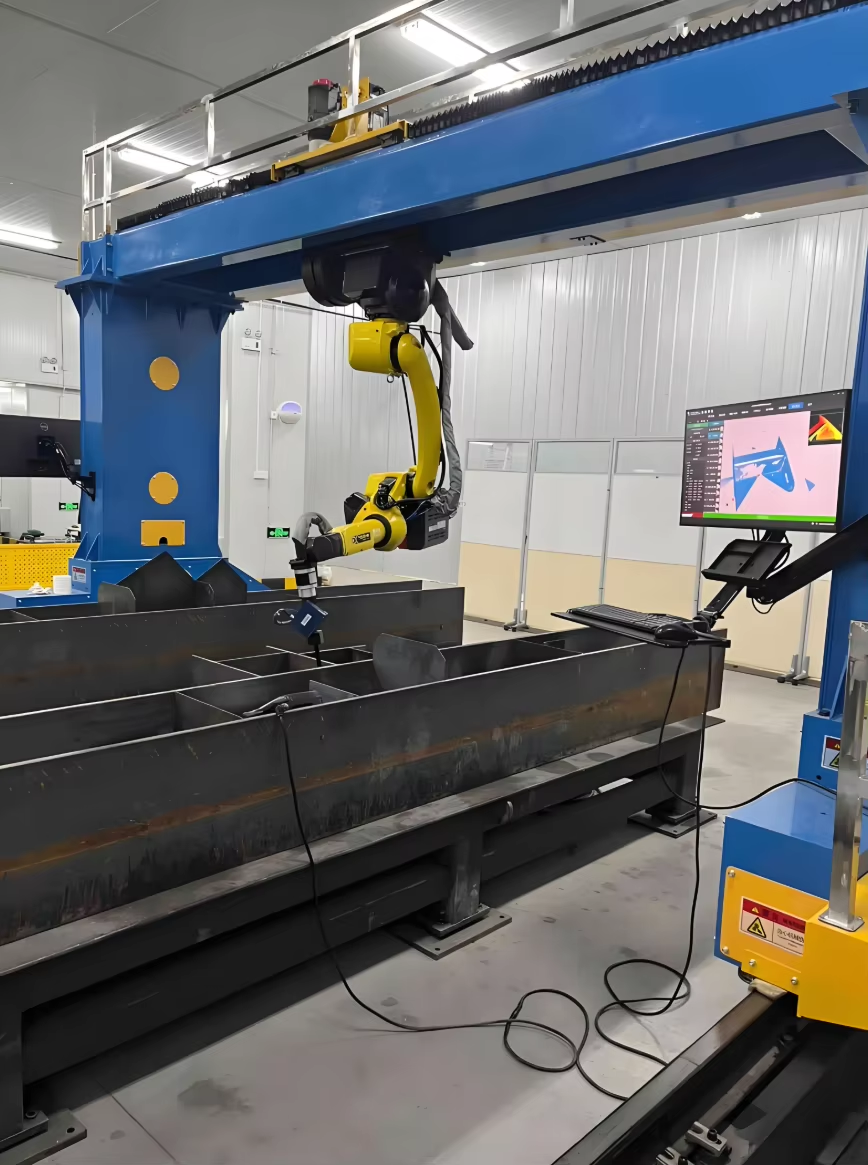
for Construction Machinery components, which often feature large diameters and heavy wall thicknesses, the laser sensor detects the center of the V-groove or J-prep and adjusts the robotic arm’s X, Y, and Z axes. This compensates for eccentricity in the rotation or slight warping of the cylinder. By maintaining the electrode in the optimal position relative to the joint root, the system eliminates the “missed seam” syndrome common in blind automation. This real-time correction is essential for achieving 100% penetration on safety-critical structural welds.
Labor ROI and Throughput Analysis
The primary driver for the adoption of robotic girth seam welding is the quantifiable Labor ROI. In a manual welding environment, a skilled welder’s “arc-on” time rarely exceeds 30% of a shift due to part handling, setup, and fatigue. In contrast, an automated girth seam welder operates at an arc-on efficiency of 75% to 85%. This represents a nearly threefold increase in throughput per man-hour.
Direct Labor Savings
Automation allows for a “one-to-many” operator ratio. A single operator, who does not need the high-level manual dexterity of a certified welder but rather the technical proficiency of a system technician, can manage two or even three welding cells simultaneously. This reduces the direct labor cost per unit significantly. Furthermore, the reduction in rework—often the hidden cost of manual production—contributes to a faster payback period, typically localized between 14 to 24 months depending on shift volume.
Training and Skill Transition
Implementing an Automatic Girth Seam Welder shifts the labor requirement from high-stress manual labor to process management. This transition mitigates the impact of the global shortage of certified welders. Training focuses on sensor calibration, parameter optimization (wire feed speed, voltage, and travel speed), and preventive maintenance rather than the physical stamina required for out-of-position manual welding.
Maintenance Protocols for High-Uptime Environments
To maintain the ROI of a Robotic Welding cell, a rigorous preventative maintenance (PM) schedule is mandatory. Industrial engineers must account for the wear-and-tear associated with high-duty cycle MAG welding. The maintenance of these systems is categorized into three primary areas: the torch consumables, the wire delivery system, and the laser sensor optics.
Consumable Management
Contact tips and gas nozzles are the most frequent points of failure. In an automated setup, an automated torch cleaning station (reamer) should be integrated into the cycle. Every few parts, the robot maneuvers the torch to the station to remove spatter and apply anti-spatter spray. This extends the life of the contact tip and ensures consistent gas coverage, preventing porosity in the girth seam.
Wire Feed Consistency
The delivery of the welding wire from the bulk drum to the drive rolls must be friction-free. Any hesitation in the wire feed will cause arc instability, which even the most advanced laser seam tracker cannot correct. Maintenance teams must inspect liners and drive rolls weekly to ensure that the wire does not shave or bird-nest, which would lead to expensive downtime.
Sensor Protection
The laser seam tracking sensor is an optical instrument operating inches away from an industrial arc. It is protected by a pressurized air knife and a sacrificial clear lens. The PM schedule must include the daily inspection of these lenses. A clouded lens leads to “signal noise,” causing the robot to jitter or lose the path. Standardized cleaning procedures ensure the tracking accuracy remains within the required +/- 0.1mm tolerance.
Quality Assurance and Data Logging
A significant advantage of robotic welding in construction machinery is the ability to perform digital quality audits. Modern automated girth welders log every parameter of every weld. If a component fails in the field, engineers can pull the “birth certificate” of that specific girth seam to review the voltage, amperage, gas flow, and tracking data recorded during its manufacture.
This data-driven approach allows for continuous process improvement. If the laser tracker consistently detects a 2mm offset in a certain batch of cylinders, the industrial engineer can trace the issue back to the upstream machining or tacking station. This closed-loop feedback is impossible with manual welding, where variables are subject to human inconsistency.
Strategic Implementation Summary
The integration of an Automatic Girth Seam Welder with Laser Seam Tracking represents a critical evolution for construction equipment manufacturers. By focusing on the MAG welding process and rigorous maintenance of robotic assets, facilities can overcome the limitations of manual labor. The Labor ROI is realized not just through speed, but through the elimination of scrap, the reduction of secondary grinding operations, and the ability to maintain peak production rates across multiple shifts without degradation in weld quality. For the industrial engineer, the goal is clear: transform welding from a variable-dependent craft into a highly predictable, data-backed manufacturing process.






