Automatic Girth Seam Welder with Arc Voltage Control for Wind Tower fabrication

In this article
- Optimizing Wind Tower Fabrication: The Role of Automatic Girth Seam Welders
- The Technical Necessity of Arc Voltage Control (AVC)
- Robotic MAG Welding Efficiency
- Labor ROI and Man-Hour Reallocation
- Maintenance Protocols for High-Duty Cycle Systems
- Quality Assurance and Data Integration
- Conclusion on Industrial Scalability
Optimizing Wind Tower Fabrication: The Role of Automatic Girth Seam Welders
In the heavy fabrication sector, specifically wind tower production, the circumferential joining of large-diameter sections represents a critical bottleneck. These structures, often exceeding four meters in diameter, require deep penetration and impeccable bead aesthetics to withstand the cyclical loading of offshore and onshore environments. An Automatic Girth Seam Welder utilizing Metal Active Gas (MAG) technology provides the throughput necessary to meet aggressive production schedules while maintaining the structural integrity required by international standards such as AWS D1.1.
The shift from traditional submerged arc welding (SAW) to advanced robotic MAG systems in specific girth seam applications allows for better control over heat-affected zones (HAZ) and reduces the massive flux handling requirements typical of SAW. This transition is underpinned by the integration of Arc Voltage Control (AVC), a technology that compensates for the physical imperfections inherent in large-scale industrial workpieces.
The Technical Necessity of Arc Voltage Control (AVC)
Wind tower sections are rarely perfectly cylindrical. During the rolling and tacking process, slight ovality or surface irregularities are inevitable. For a fixed-head robotic system, these variations in the distance between the contact tip and the workpiece—known as the stick-out distance—can lead to fluctuations in current and penetration depth.
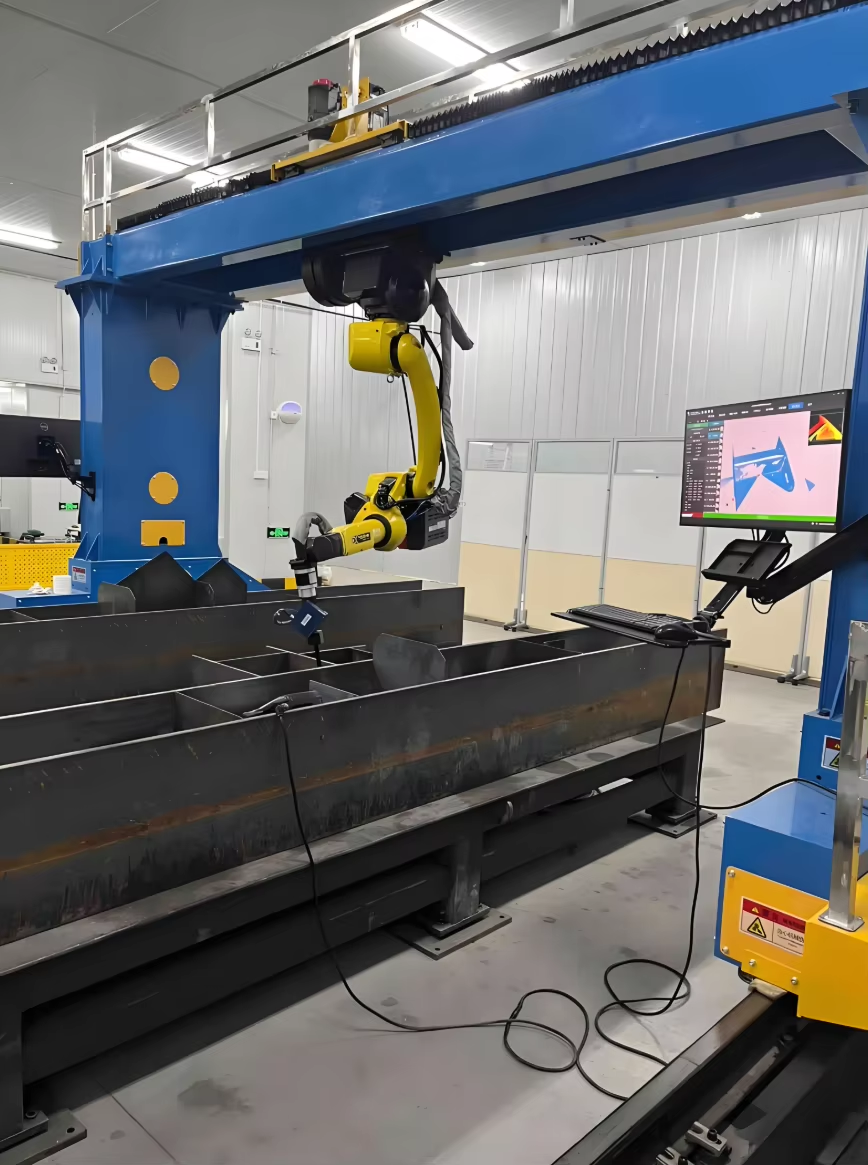
Arc Voltage Control functions as a real-time feedback loop. The system continuously monitors the voltage across the arc; if the distance between the torch and the metal increases, the voltage rises. The AVC logic immediately signals a motorized vertical slide to lower the torch, maintaining a constant arc length. This precision is vital for wind towers, where a 2mm variance in torch height can lead to a lack of fusion or excessive spatter, necessitating costly grinding and rework. By automating this adjustment, the industrial engineer ensures that the weld profile remains uniform across the entire 360-degree circumference.
Robotic MAG Welding Efficiency
The implementation of Metal Active Gas (MAG) welding within a robotic framework offers distinct advantages in deposition efficiency and multi-pass management. Unlike manual welding, where operator fatigue leads to inconsistent travel speeds, a robotic girth welder maintains a programmed centimeter-per-minute rate with mathematical precision.
In wind tower fabrication, filling a deep J-prep or V-prep groove requires multiple passes. A robotic system can be programmed to oscillate the torch in specific patterns (weaving) to ensure side-wall fusion while managing the heat input. This level of control prevents the grain coarsening in the base metal that often occurs with slower, high-heat manual processes. Furthermore, the use of pulsed-MAG waveforms reduces spatter, which directly translates to fewer man-hours spent on post-weld cleanup.
Labor ROI and Man-Hour Reallocation
From an industrial engineering perspective, the Return on Investment (ROI) for an Automatic Girth Seam Welder is calculated not just through speed, but through the reduction of “non-value-added” time. In manual welding setups, a significant portion of a welder’s shift is spent on repositioning, adjusting cable management, and taking breaks necessitated by the harsh environment inside or adjacent to large steel shells.
A robotic cell allows a single operator to oversee multiple welding heads. While the robot executes the girth seam, the operator can prepare the next section or perform quality inspections on completed joints. This “multi-machine interface” strategy reduces the labor cost per tower section by an estimated 40% to 60%. When factoring in the scarcity of high-skill welders capable of maintaining consistent quality on 12-hour shifts, the robot acts as a force multiplier, stabilizing the production floor’s output regardless of labor market volatility.
Maintenance Protocols for High-Duty Cycle Systems
To maintain the ROI calculated during the procurement phase, a rigorous preventative maintenance (PM) schedule must be enforced. Robotic MAG systems in wind tower facilities often operate at a duty cycle exceeding 80%. This places extreme stress on the wire delivery system and the torch consumables.
Consumable Management
The contact tip is the most frequent point of failure. Over time, the wire erodes the internal diameter of the tip (keyholing), which causes arc instability. Industrial engineers should implement a “cycles-to-failure” replacement program rather than waiting for weld defects to appear. Similarly, the use of automated torch cleaning stations—which ream the nozzle, spray anti-spatter liquid, and trim the wire—can extend the life of consumables by 30% and ensure reliable arc starts.
Liner and Drive Roll Integrity
Feeding several meters of welding wire from a bulk drum to the robotic head requires a low-friction path. Any buildup of copper flaking or dust within the liner leads to “bird-nesting” at the drive rolls. Monthly pneumatic purging of the liners and semi-annual replacement of the drive rolls are mandatory to prevent unplanned downtime. In a wind tower facility, one hour of downtime on the girth seam station can delay the entire assembly line, costing thousands of dollars in lost throughput.
Quality Assurance and Data Integration
Modern automatic girth welders serve as data collection points. Every weld performed is a data set containing voltage, current, travel speed, and gas flow rates. This Robotic Welding data can be integrated into the factory’s ERP system to provide a digital twin of the tower’s fabrication history.
If a non-destructive testing (NDT) report indicates a porosity issue at a specific coordinate, the engineer can review the arc data for that exact timestamp. This allows for root cause analysis—determining if the issue was a gas shielding surge or a dip in voltage—thereby preventing systemic errors in future builds. This level of traceability is often a contractual requirement for offshore wind projects, where the cost of field failure is astronomical.
Conclusion on Industrial Scalability
The integration of Automatic Girth Seam Welders with AVC represents the pinnacle of heavy-duty fabrication logic. By removing the variability of human intervention and replacing it with the consistency of sensor-driven robotics, wind tower manufacturers can achieve a level of OEE (Overall Equipment Effectiveness) that was previously unattainable.
The transition requires an initial investment in both hardware and technician training, but the long-term benefits—reduced scrap rates, lower labor overhead, and superior weld quality—position the facility as a competitive leader in the renewable energy infrastructure market. The focus remains on the arc: keeping it stable, keeping it consistent, and keeping the wire feeding until the tower is complete.
[END]






