Intelligent Robotic Welder with Zero-tailing technology for Wind Tower fabrication

In this article
Technical Implementation of Intelligent Robotic Welding in Wind Tower Production
The fabrication of wind turbine towers necessitates the highest standards of structural integrity and repeatability. As tower heights increase to capture more consistent wind at higher altitudes, the thickness of the steel sections—often exceeding 50mm—demands a robust welding strategy. The transition from manual or semi-automated processes to an Intelligent Robotic Welder represents a strategic pivot toward precision engineering. This system utilizes advanced sensors and real-time data processing to manage the complexities of multi-pass Metal Active Gas (MAG) welding on large-diameter cylindrical sections.
In this industrial context, the focus is strictly on the welding phase, where thermal management and deposition rates dictate the production timeline. By implementing robotic systems, manufacturers can maintain a continuous arc-on time that far exceeds manual capabilities, ensuring that the heat-affected zone (HAZ) remains within specified metallurgical limits while achieving deep penetration in longitudinal and circumferential seams.
Optimizing the MAG Process for Large-Scale Fabrications
Metal Active Gas (MAG) welding is the preferred method for Wind Tower fabrication due to its high deposition rates and adaptability to various plate thicknesses. When integrated into an intelligent robotic cell, the MAG process is enhanced through synergic control systems. These systems automatically adjust voltage and wire feed speed in response to minute changes in the arc length or joint geometry. For wind towers, where the fit-up of massive rolled plates may not always be perfect, the robot’s ability to perform real-time seam tracking is critical.
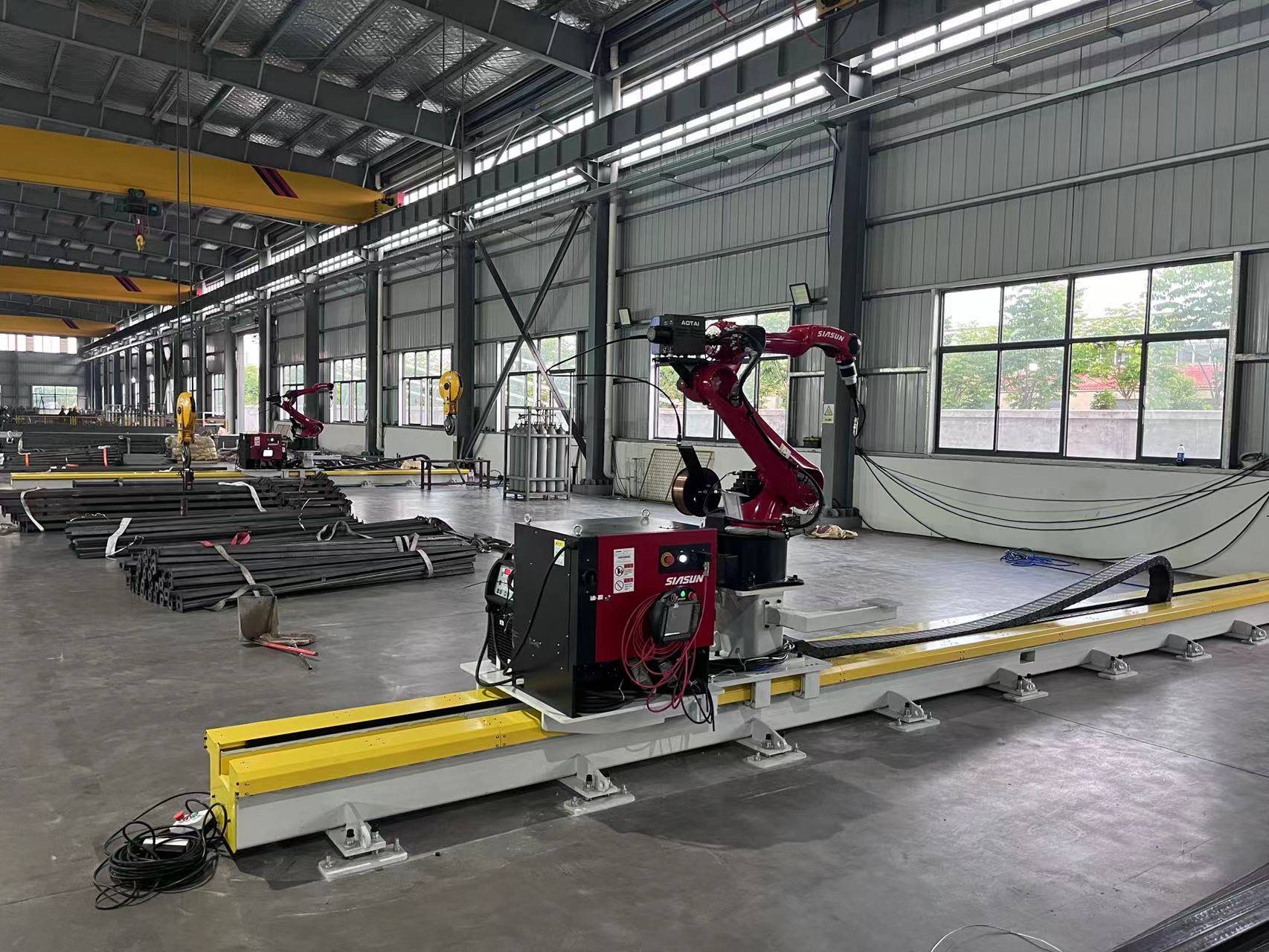
The robotic system employs arc sensing or tactile sensors to follow the weld groove, compensating for any deviations in the workpiece. This ensures that the weld bead is placed accurately within the root or subsequent fill passes. The intelligent controller manages the oscillation parameters and travel speed to maintain a consistent puddle, which is vital for preventing slag inclusions or porosity in the thick-walled sections characteristic of offshore and onshore towers.
The Mechanics of Zero-tailing Technology
One of the most significant advancements in welding efficiency is the introduction of Zero-tailing technology. In traditional robotic welding, the start and stop points of a weld often result in “tails” or excess wire remnants and crater defects. These irregularities require manual intervention, such as grinding or re-welding, which breaks the automated cycle and introduces potential points of failure. Zero-tailing technology addresses this by optimizing the wire-end profile and the crater-filling sequence at the conclusion of each weld pass.
From an industrial engineering perspective, zero-tailing involves a high-speed wire retraction and controlled burn-back during the arc-extinguishing phase. This leaves the wire tip in a perfect spherical state, ready for the next strike without the need for mechanical clipping. In wind tower fabrication, where circumferential welds can be several meters in length, the ability to stop and restart the arc seamlessly across different sectors of the tower section significantly reduces the total cycle time. It eliminates the non-value-added time associated with cleaning the torch tip or manually dressing the weld start/stop zones.
Maintenance Protocols and System Reliability
The reliability of an automated welding cell is contingent upon a rigorous maintenance schedule. Because wind tower production often runs on 24/7 cycles, any unplanned downtime at the welding station creates a bottleneck for the entire assembly line. The Metal Active Gas (MAG) robotic setup includes integrated maintenance stations that perform automated torch cleaning, anti-spatter injection, and wire cutting.
Predictive maintenance is facilitated by the intelligent controller, which monitors the current draw of the wire drive motor and the temperature of the cooling system. An increase in motor friction often signals the need to replace the wire liner or the contact tip before a failure occurs. In wind tower welding, contact tip wear is accelerated due to the high currents and long arc-on times. Intelligent systems track the cumulative wire throughput and prompt the operator to perform “quick-change” maintenance during natural breaks in the production sequence, ensuring that the arc stability is never compromised by worn consumables.
Labor ROI and Economic Impact
The transition to robotic welding is frequently driven by the need to optimize Labor ROI. The global shortage of certified high-pressure welders capable of working on heavy-gauge steel makes human capital both expensive and scarce. A robotic system does not replace the welder; rather, it elevates the welder to the role of a Robotic Operator or Systems Technician. One technician can oversee two or three robotic cells, effectively tripling the output per labor hour.
Return on Investment is calculated not just through increased speed, but through the drastic reduction in rework. In manual wind tower welding, the repair rate for X-ray or ultrasonic testing failures can be as high as 5-10% depending on the environment. Robotic systems, with their consistent travel speeds and precise parameter control, typically reduce repair rates to less than 1%. When considering the cost of gouging out a defective weld in a 40mm thick plate and re-welding it, the savings from high first-pass yield are substantial. Over a 36-month period, the reduction in filler metal waste and the elimination of manual grinding hours often cover the capital expenditure of the robotic system.
System Integration and Data-Driven Quality Control
Modern intelligent welders are equipped with data logging capabilities that satisfy the stringent documentation requirements of the energy sector. Every millimeter of the weld is monitored, and parameters such as heat input (kJ/mm) are recorded. This digital twin of the welding process allows industrial engineers to analyze the production data to find further efficiencies. For instance, analyzing the data might reveal that a specific batch of shielding gas or wire is causing more spatter, allowing for immediate corrective action with the supplier.
Furthermore, the integration of these robots into the factory’s ERP system ensures that material flow is synchronized. As the robotic welder completes a section of a wind tower, the downstream logistics—such as sandblasting or painting—can be signaled automatically. This creates a lean manufacturing environment where the welding station acts as the heartbeat of the production facility.
Concluding Technical Summary
The application of intelligent robotic welding with Zero-tailing technology represents the current peak of efficiency for wind tower fabrication. By focusing on the mechanical precision of the MAG process and the reduction of consumable waste, manufacturers can meet the aggressive delivery schedules required by the global energy transition. The shift from manual labor to automated, sensor-driven systems provides the dual benefit of enhanced metallurgical quality and a robust, measurable return on investment. As the wind industry moves toward even larger turbine designs, these automated systems will be the only viable means of maintaining the required scale and structural integrity.






