Intelligent Robotic Welder with Zero-tailing technology for Construction Machinery

In this article
The Evolution of Heavy-Duty Fabrication in Construction Machinery
The construction machinery industry—encompassing the production of excavators, loaders, and cranes—demands structural integrity that can withstand extreme cyclic loading and harsh environmental conditions. Historically, the fabrication of thick-plate components relied heavily on manual Metal Active Gas (MAG) welding. However, the inherent variability of manual labor introduces inconsistencies in penetration depth and bead morphology. The transition to an Intelligent Robotic Welder represents a shift toward deterministic manufacturing where precision is governed by algorithmic control rather than human fatigue.
Robotic integration in this sector is not merely about speed; it is about the management of heat input and the repeatability of multi-pass welds. Heavy sections often require complex groove geometries that must be filled with surgical precision to avoid slag inclusions or lack of fusion. An automated system provides the constant travel speed and wire feed rate necessary to ensure the metallurgical properties of the weld joint meet rigorous ISO standards for heavy machinery.
Understanding Zero-Tailing Technology in MAG Welding
One of the primary inefficiencies in high-volume welding operations is wire waste and the time lost during arc-start failures. Zero-tailing technology addresses these bottlenecks by optimizing the wire-end conditioning process. In conventional robotic setups, a small “tail” of wire often remains or deforms at the contact tip after the arc is extinguished, leading to inconsistent re-strikes or excess spatter during the subsequent cycle.
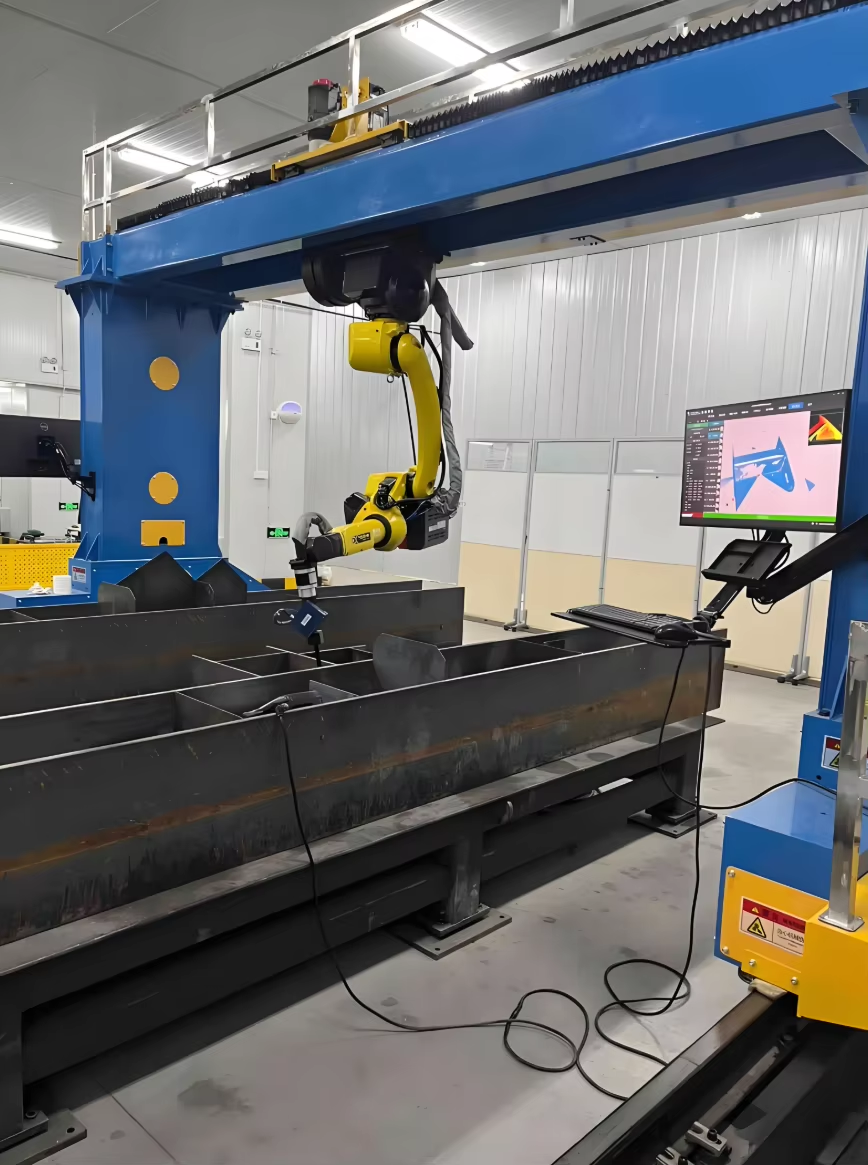
Zero-tailing systems utilize precise motor control to retract or “clip” the wire electronically or mechanically at the exact millisecond the weld ends. By ensuring the wire tip is perfectly formed for the next arc ignition, the system eliminates the need for manual wire trimming. In the context of construction machinery—where a single chassis may require hundreds of short stitch welds—the cumulative savings in wire material and the reduction in cycle interruptions significantly impact the bottom line. This technology ensures that every centimeter of filler metal is deposited into the joint, rather than ending up on the shop floor as scrap.
The Technical Superiority of MAG Welding in Automation
Metal Active Gas (MAG) welding remains the industry standard for construction equipment due to its high deposition rates and deep penetration capabilities. When integrated with an Intelligent Robotic Welder, the MAG process is enhanced through pulsing parameters that minimize spatter even when using 100% CO2 or Argon/CO2 blends. The robot’s controller can adjust welding parameters in real-time to compensate for slight variations in joint fit-up, a common challenge when dealing with large-scale heavy steel plates.
Advanced power sources paired with robotic arms allow for “Spray Transfer” modes that are difficult for manual welders to maintain over long durations. This results in a cleaner weld finish and a significant reduction in post-weld cleaning. For thick-walled components like excavator booms, the robot can execute multi-layered welds with optimized cooling intervals, ensuring that the Heat Affected Zone (HAZ) does not compromise the base metal’s tensile strength.
Maintenance Protocols for Robotic Welding Cells
To maintain a high uptime percentage, an industrial engineer must prioritize a preventive maintenance (PM) schedule for the robotic cell. The harsh environment of a welding shop—characterized by metallic dust and electromagnetic interference—requires robust protection for the robot’s sensors and joints. Key maintenance focus areas include:
Contact Tip and Liner Integrity
The contact tip is the primary point of electrical transfer. Even minor wear can cause arc instability. Automated torch cleaning stations, which include reaming and anti-spatter injection, should be programmed to run every few cycles. Liners must be checked for friction buildup, as any drag in the wire delivery system will negate the benefits of zero-tailing precision.
Calibration of the Tool Center Point (TCP)
In heavy machinery welding, the robot often operates in tight spaces or follows long, contoured paths. Regular TCP calibration ensures that the wire is always positioned correctly within the joint. If the TCP shifts by even a millimeter due to a minor collision or thermal expansion, the integrity of the weld is compromised. High-end systems utilize laser-based or touch-sensing calibration to verify the torch geometry without operator intervention.
Calculating Industrial ROI and Labor Reallocation
The transition to automated welding is often scrutinized through the lens of Industrial ROI. When evaluating the acquisition of a robotic system, the calculation must extend beyond simple hourly wage comparisons. In construction machinery fabrication, the ROI is driven by three primary factors: throughput, consumable efficiency, and quality-related costs.
Labor ROI is realized by moving skilled welders from repetitive, ergonomically taxing tasks to higher-value roles such as robotic cell programming, weld procedure specification (WPS) development, and quality assurance. A single robotic operator can oversee multiple cells, effectively tripling the output per man-hour. Furthermore, the reduction in rework—which is exceptionally costly in heavy-plate welding due to the volume of material that must be ground out—provides a direct boost to the internal rate of return.
When zero-tailing technology is factored in, the ROI calculation includes a 3% to 5% reduction in total wire consumption. While this may seem marginal, in a facility consuming tons of welding wire annually, the cost savings often cover the annual maintenance budget of the robot itself. Moreover, the reduction in arc-start failures leads to an increase in “Arc-on Time,” the most critical KPI for any welding department.
Overcoming Implementation Challenges
Integrating an intelligent welder into a legacy production line requires careful planning of the material flow. Construction machinery components are heavy and require precise jigging and fixtures. If the workpiece is not positioned accurately, the robot’s efficiency is wasted. Therefore, the use of heavy-duty positioners coordinated with the robot’s movement is essential. These positioners allow the robot to maintain a “downhand” welding position (1F or 1G), which is the most efficient orientation for maximizing deposition rates and ensuring weld quality.
Software integration also plays a vital role. Modern robotic systems use offline programming (OLP) to simulate welding paths before the first bead is ever struck. This minimizes downtime during product changeovers and allows engineers to identify potential collisions between the torch and complex workpiece geometries. By validating the process in a virtual environment, the physical cell remains productive, further shortening the payback period of the investment.
Strategic Conclusion for Industrial Operations
The implementation of an Intelligent Robotic Welder with Zero-tailing technology is no longer an optional upgrade for Construction Machinery manufacturers; it is a strategic necessity. By eliminating the variables associated with manual MAG welding and significantly reducing material waste through precise wire management, firms can achieve a level of operational excellence that manual processes cannot match. The focus on maintenance and data-driven ROI ensures that the technology remains a long-term asset, driving both quality and profitability in a competitive global market.






