Engineering Precision: The Rise of Intelligent Robotic Welder Systems
The fabrication of oil and gas storage tanks demands structural integrity that can withstand extreme hydrostatic pressures and environmental stressors. Traditionally, this sector relied heavily on manual labor, which introduced variables in weld consistency and material wastage. The introduction of the Intelligent Robotic Welder has fundamentally shifted the baseline for quality and throughput. These systems are not merely programmed arms; they are integrated platforms utilizing advanced sensors and real-time data processing to adapt to the minor deviations found in large-scale plate fit-ups.
In the context of tank farm construction, where vertical and horizontal seams extend for hundreds of meters, the robotic system provides a level of repeatability that human operators cannot match over a twelve-hour shift. By utilizing high-speed processors and tactile or through-arc sensing, the robot maintains a constant arc length and torch angle, ensuring that the Heat Affected Zone (HAZ) remains within the strict parameters defined by API 650 standards.
Zero-Tailing Technology: Material Efficiency in MAG Welding
One of the most significant advancements in modern automated welding is Zero-tailing technology. In standard robotic MAG (Metal Active Gas) welding, the “tail” refers to the excess welding wire that is often wasted during the start and end of a weld cycle, or the overlap required to ensure fusion at the tie-in points. In large-diameter oil tanks, where thousands of starts and stops occur, this waste accumulates into significant material costs.
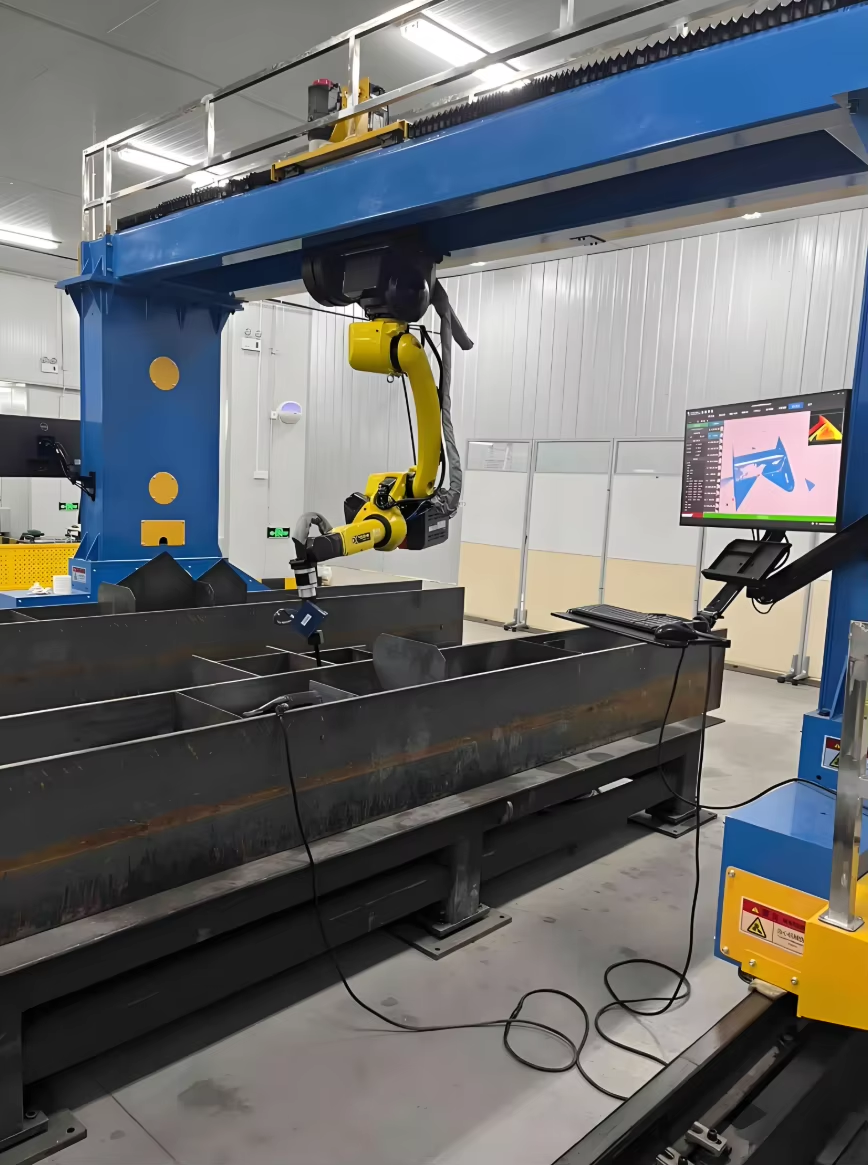
Technical Mechanism of Zero-Tailing
Zero-tailing works through a synchronized control of the wire feeder and the power source’s waveform. As the robot approaches the end of a programmed seam, the system executes a precise “retract” motion or a controlled burn-back that eliminates the formation of a wire stub. This ensures that the crater is filled perfectly without leaving an protrusion that requires secondary grinding. From an industrial engineering perspective, this reduces the “cycle time per joint” by eliminating post-weld cleanup and reducing the consumption of filler metal by up to 12% across a full project lifecycle.
Impact on Weld Integrity
Beyond material savings, this technology improves the metallurgical properties of the tie-in. By controlling the arc extinguishing parameters, the system prevents the formation of “pipes” or crater cracks, which are common failure points in high-pressure vessels. The MAG welding process, when governed by zero-tailing algorithms, produces a flatter, more consistent bead profile that transitions smoothly into the base metal, reducing stress concentration factors.
Labor ROI and Economic Throughput
The financial justification for adopting intelligent robotics in the oil and gas sector is driven by the labor ROI calculation. The energy industry faces a chronic shortage of certified high-pressure welders. A robotic system allows a single technician to oversee two or three welding cells, effectively tripling the output per man-hour.
Quantitative ROI Metrics
When evaluating the return on investment, we look at the Operating Factor (OF). A manual welder typically has an OF of 20% to 30%, accounting for breaks, fatigue, and setup. A robotic system, conversely, operates at an OF of 75% to 85%. For a standard 50,000-barrel tank, the reduction in man-hours can exceed 40%, allowing for faster commission times and lower overhead. Furthermore, the reduction in rework—which can cost up to five times the original weld cost—provides a hidden but substantial boost to the bottom line.
Skill Shift and Retention
The shift to robotics does not eliminate the need for skilled personnel but rather redefines the role. The “welder” becomes a “robotics technician,” focusing on path optimization and quality assurance. This shift improves workplace safety by removing the operator from the immediate vicinity of welding fumes and intense UV radiation, which in turn reduces long-term liability and insurance premiums for the contractor.
Maintenance Protocols for Robotic MAG Systems
To maintain the high-duty cycles required for oil tank fabrication, a rigorous preventive maintenance (PM) schedule is non-negotiable. Unlike manual equipment, a robotic cell is a precision instrument where minor misalignments result in catastrophic failures across long seams.
Daily and Weekly Inspections
The primary focus of maintenance in a robotic MAG setup is the wire delivery system and the torch neck. Spatter buildup in the gas nozzle can disrupt the laminar flow of shielding gas, leading to porosity. Automated nozzle cleaning stations are essential; they ream the nozzle and apply anti-spatter liquid at programmed intervals. Additionally, the contact tip must be inspected for “key-holing,” where the wire wears an oval shape into the tip, causing arc instability and wandering.
Calibration and Component Longevity
The robotic arm’s 6-axis calibration must be verified monthly using a Tool Center Point (TCP) check. Any deviation in the TCP will render the through-arc sensing inaccurate, leading to off-center welds. Cables and liners also represent critical wear items. Using high-quality, low-friction liners reduces the load on the wire drive motor, ensuring the constant wire feed speed necessary for the zero-tailing algorithms to function correctly.
Strategic Implementation in Tank Farms
Implementing an Intelligent Robotic Welder in the field presents unique challenges compared to a factory floor. Portability and weatherproofing are essential. Most modern systems for the oil and gas industry are designed as modular “track-mounted” units that can be moved along the circumference of the tank.
The integration of cloud-based monitoring allows engineers to track weld quality and wire consumption in real-time from a remote office. This data-driven approach allows for “predictive maintenance,” where the system alerts the team to a potential part failure before it causes downtime. By treating the welding process as a controlled industrial process rather than a manual craft, companies can achieve the scale and safety required for the next generation of energy infrastructure.
Conclusion
The adoption of intelligent Robotic Welding with zero-tailing capabilities represents a logical evolution for the oil and gas industry. By focusing on the optimization of the MAG process, maximizing labor ROI through high duty cycles, and adhering to strict maintenance regimes, fabrication firms can ensure the highest standards of tank integrity while maintaining a competitive edge in an increasingly cost-sensitive global market.
-

LT240S tube laser cutting machine
-
LT120S tube laser cutting machine
-
Sale

Tank Fillet Welding Machine
Original price was: $1,000.00.$900.00Current price is: $900.00. -
Sale

MAK100 tube laser cutting machine
Original price was: $5,500.00.$5,000.00Current price is: $5,000.00. -

portable plasma air cutting machine
$1,200.00 -

2in1 fiber laser cutting machine
-

Air cooling Laser welding machine
-

HF h beam laser cutting machine
-

LT240 laser cutting machine
-

Laser welding machine
-

Cobotic Welding Station
-

Gantry welding robot solution
-

Tracked Wheeled AGV Welding robot
-

LFH6020 Fiber laser cutting machine
-
LFP6020
-

robotic welidng machine
Advanced Fiber Laser Tube Processing Technology
Our CNC Fiber Laser Tube Cutting systems revolutionize metal fabrication by integrating high-precision cutting, punching, and profiling into a single automated workflow. Designed for versatility, this technology handles a wide array of profiles including Round, Square, Rectangular, and Oval tubes, as well as complex L-shaped and U-shaped channels.
- Precision Punching: High-speed hole punching with micron-level accuracy, eliminating the need for mechanical drilling or die-stamping.
- Complex Profiling: Advanced 3D pathing allows for intricate interlocking joints and specialized notch cuts, ideal for structural frames.
- High Material Efficiency: Intelligent nesting software minimizes scrap, reducing raw material costs across large production runs.
- Clean Finish: Delivers oxide-free, burr-free edges that require zero secondary grinding before welding.

Seamlessly processing multiple profiles with consistent precision.
Global Delivery & Logistics



From our high-tech manufacturing facility directly to your global site. PCL WeldCut ensures secure packaging, professional handling, and reliable international logistics to safeguard your equipment throughout the entire journey.
