Strategic Implementation of MAG Welding Automation in Tank Construction
The fabrication of large-scale storage tanks for the Oil & Gas sector demands a synthesis of structural integrity and operational speed. Conventional manual welding methods often struggle with consistency when managing long longitudinal and circumferential seams. The transition toward MAG welding automation represents a fundamental shift in industrial engineering strategy, moving away from variable human output toward localized, repeatable precision. This transition is not merely about speed; it is about the management of thermal input and the standardization of weld bead geometry across thousands of linear meters.
The Engineering Logic Behind Zero-Tailing Technology
In standard Robotic Welding configurations, the “tail” refers to the excess wire or the suboptimal weld crater formed at the termination of a weld bead. Zero-tailing technology utilizes advanced wire-retraction algorithms and synchronized power source control to eliminate these defects. In the context of oil tank fabrication, where plate thicknesses can exceed 30mm, the presence of tails or craters necessitates extensive manual grinding and secondary repair passes. By automating the end-of-weld sequence, the system ensures a flush finish that meets API 650 standards without human intervention.
The technical mechanism involves a high-speed processor communicating with the wire drive system. As the robot approaches the end of a programmed path, the power source modulates the current while the drive motor executes a precise pull-back. This prevents the welding wire from sticking to the molten pool and eliminates the “stub” typically left behind. For an industrial facility, this translates to a 15% reduction in consumable waste and a 20% reduction in post-weld processing time.
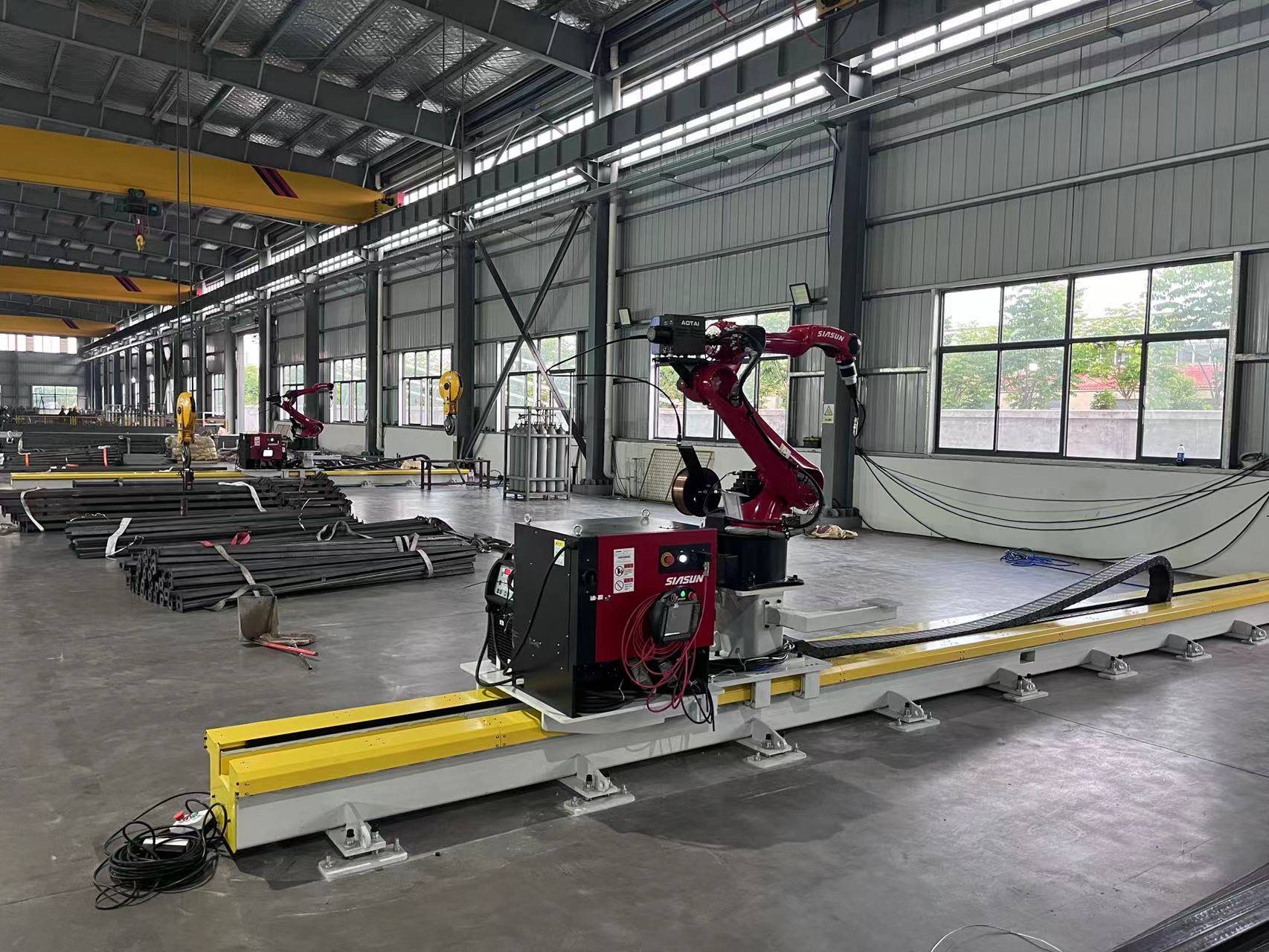
Optimizing MAG Processes for High-Pressure Environments
Metal Active Gas (MAG) welding is the preferred process for tank fabrication due to its high deposition rates and deep penetration characteristics. However, its effectiveness is highly dependent on gas shielding stability and wire feed consistency. Intelligent Robotic Welders integrate seam tracking sensors that adjust the torch position in real-time, compensating for plate warping or fit-up irregularities that occur during the assembly of large-diameter tanks.
Thermal Management and Shielding Gas Dynamics
Managing the heat-affected zone (HAZ) is critical when working with high-tensile steels used in pressure vessels. Robotic systems allow for precise control over travel speed and oscillation patterns, ensuring that the thermal input remains within the calibrated range. This level of control is impossible to maintain manually over an eight-hour shift. Furthermore, the integration of automated gas flow regulators ensures that the shielding gas—typically a mixture of Argon and CO2—is optimized for the specific arc characteristics, preventing porosity and slag inclusions.
Labor ROI and Economic Impact Analysis
The primary driver for adopting intelligent robotic welders is the escalating shortage of certified high-pressure welders. The Labor ROI in fabrication is realized not just through the displacement of manual hours, but through the exponential increase in “arc-on” time. While a manual welder might maintain an arc-on efficiency of 30-40% due to fatigue and repositioning, a robotic gantry or crawler system can exceed 80% efficiency.
When calculating ROI, industrial engineers must consider the “Cost of Quality.” A single failed radiographic test (RT) on a tank seam can cost thousands of dollars in excavation, re-welding, and project delays. Robotic systems, by providing a digitized record of every weld parameter (voltage, amperage, travel speed), offer a “first-time-right” rate that significantly lowers the total cost of ownership. Over a standard 3-year depreciation cycle, the reduction in rework alone often covers the capital expenditure of the robotic unit.
Maintenance Protocols for Sustained Duty Cycles
To maintain the precision required for zero-tailing performance, a rigorous preventive maintenance schedule is mandatory. Unlike manual torches, robotic MAG torches are subject to higher duty cycles, which accelerates the wear of contact tips and gas nozzles.
Consumable Management and Torch Calibration
1. Contact Tip Replacement: High-amperage MAG welding causes orifice enlargement in contact tips, leading to arc instability. Automated systems should include a tip-change counter based on wire throughput.
2. Liner Cleaning: Periodic purging of the wire liner prevents the buildup of copper flaking and dust, which are the primary causes of feed motor strain.
3. TCP (Tool Center Point) Verification: Robotic accuracy is dependent on the torch geometry. Automatic TCP calibration stations should be used at the start of every shift to ensure the robot’s “zero” hasn’t drifted due to minor collisions or thermal expansion.
Integration with Digital Quality Assurance
Modern robotic welders serve as data nodes. Every centimeter of a weld on an Oil & Gas tank is mapped and stored. This data is invaluable for compliance with international safety codes. If a defect is discovered during NDT (Non-Destructive Testing), the engineer can review the data log for that specific coordinate to identify if there was a fluctuation in gas pressure or a voltage spike. This level of traceability is the hallmark of Industry 4.0 in heavy fabrication.
The elimination of the human factor in path following means that the weld profile is perfectly uniform. This uniformity is essential for the subsequent application of anti-corrosive coatings. A smooth, machine-welded surface requires less surface preparation (sandblasting) and ensures a more consistent coating thickness, which is the final line of defense against tank corrosion in harsh environments.
Conclusion on Engineering Efficiency
The deployment of intelligent robotic welders with zero-tailing capabilities is a strategic necessity for modern tank farms and refinery projects. By focusing on the refinement of the MAG process, maximizing labor ROI through duty cycle improvements, and adhering to strict maintenance schedules, firms can achieve a level of structural integrity and economic efficiency that manual processes cannot replicate. The shift to automation is not merely a technical upgrade; it is an evolution of the manufacturing workflow that prioritizes data-driven quality and waste reduction.
-

LT240S tube laser cutting machine
-
LT120S tube laser cutting machine
-
Sale

Tank Fillet Welding Machine
Original price was: $1,000.00.$900.00Current price is: $900.00. -
Sale

MAK100 tube laser cutting machine
Original price was: $5,500.00.$5,000.00Current price is: $5,000.00. -

portable plasma air cutting machine
$1,200.00 -

2in1 fiber laser cutting machine
-

Air cooling Laser welding machine
-

HF h beam laser cutting machine
-

LT240 laser cutting machine
-

Laser welding machine
-

Cobotic Welding Station
-

Gantry welding robot solution
-

Tracked Wheeled AGV Welding robot
-

LFH6020 Fiber laser cutting machine
-
LFP6020
-

robotic welidng machine
Advanced Fiber Laser Tube Processing Technology
Our CNC Fiber Laser Tube Cutting systems revolutionize metal fabrication by integrating high-precision cutting, punching, and profiling into a single automated workflow. Designed for versatility, this technology handles a wide array of profiles including Round, Square, Rectangular, and Oval tubes, as well as complex L-shaped and U-shaped channels.
- Precision Punching: High-speed hole punching with micron-level accuracy, eliminating the need for mechanical drilling or die-stamping.
- Complex Profiling: Advanced 3D pathing allows for intricate interlocking joints and specialized notch cuts, ideal for structural frames.
- High Material Efficiency: Intelligent nesting software minimizes scrap, reducing raw material costs across large production runs.
- Clean Finish: Delivers oxide-free, burr-free edges that require zero secondary grinding before welding.

Seamlessly processing multiple profiles with consistent precision.
Global Delivery & Logistics



From our high-tech manufacturing facility directly to your global site. PCL WeldCut ensures secure packaging, professional handling, and reliable international logistics to safeguard your equipment throughout the entire journey.
