Optimizing Heavy Construction Machinery Fabrication with Intelligent Robotics
The manufacturing of construction machinery—ranging from excavator booms to bulldozer frames—presents unique challenges for traditional automation. These components are characterized by large dimensions, thick-plate carbon steel, and significant fit-up variations. Standard “teach-and-repeat” robotic programming often fails in this environment because thermal expansion during the welding process and incoming material tolerances lead to seam displacement. To address this, the industry has shifted toward the Intelligent Robotic Welder equipped with advanced perception layers.
By utilizing 3D vision for localization and real-time seam tracking, the robotic cell transitions from a rigid execution tool to an adaptive system. This transition is critical for high-integrity structural welds where penetration depth and bead geometry must meet strict ISO and AWS standards. The focus of this technical deployment is the optimization of the Metal Active Gas (MAG) process, ensuring that the robotic trajectory aligns perfectly with the actual physical joint rather than the theoretical CAD model.
3D Vision Positioning: The Technical Foundation
The integration of 3D Vision positioning allows the robot to identify the starting point and orientation of a workpiece without the need for expensive, high-precision hydraulic fixtures. In construction machinery, parts are often tack-welded manually, leading to variations of several millimeters. A 3D structured light sensor or a laser profile scanner mounted on the robot’s faceplate captures a point cloud of the joint geometry before the arc is ignited.
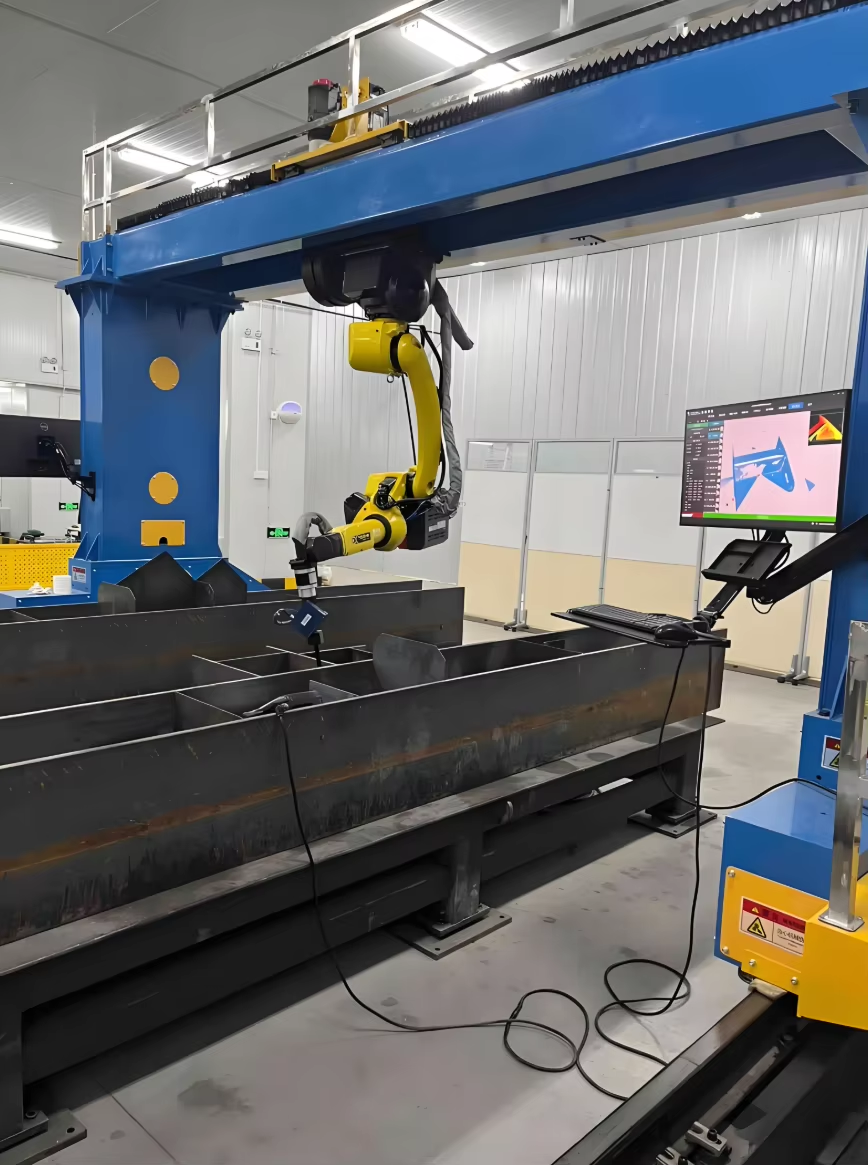
The system’s software processes this spatial data to calculate the exact gap width and groove angle. This is particularly vital for multi-pass welding on thick plates (15mm to 40mm). The vision system informs the robot’s controller to adjust welding parameters—such as wire feed speed, travel speed, and weave width—on the fly to compensate for a wider or narrower gap. This closed-loop feedback loop eliminates the most common cause of defects in heavy fabrication: inconsistent root penetration and slag inclusions due to poor fit-up.
Metal Active Gas (MAG) Welding Parameters for Heavy Structures
In the context of heavy machinery, Metal Active Gas (MAG) welding is the preferred process due to its high deposition rate and deep penetration capabilities. Typically, a mixture of 80% Argon and 20% CO2 is utilized to stabilize the arc while providing the necessary heat for thick-section fusion. The robotic system must manage high-current spray transfer modes to ensure structural integrity.
Industrial engineers must calibrate the “synergic lines” within the power source to match the specific wire diameters—usually 1.2mm or 1.6mm—used in these applications. The robotic controller manages the torch angle (push vs. pull) dynamically. In multi-layer welding, the robot utilizes the 3D vision data to determine the number of filler passes required. If the vision system detects a volume deviation in the groove, the path planning algorithm automatically inserts an additional filling bead. This level of autonomy ensures that the final capping pass is consistent, reducing the need for post-weld grinding and visual inspection.
Labor ROI and Economic Viability
The primary driver for adopting intelligent robotics in heavy machinery is the Labor ROI. The global shortage of certified structural welders has driven labor costs upward while reducing the availability of skilled personnel capable of enduring the harsh environments of heavy fabrication shops. A single Robotic Welding cell, managed by one technician, can often replace the output of three to four manual welders.
The return on investment is calculated not just by the reduction in hourly labor costs, but by the drastic decrease in “non-value-added” time. Manual welders spend a significant portion of their shift positioning themselves, changing consumables, and cleaning spatter. A robotic system maintains a duty cycle (arc-on time) of 70-85%, compared to approximately 20-30% for manual welding. Furthermore, the reduction in rework—a cost that typically triples the original cost of the weld—provides a direct boost to the bottom line. By ensuring the weld is correct on the first pass through vision-guided accuracy, manufacturers can achieve payback on capital expenditure within 18 to 24 months in high-volume environments.
Maintenance Protocols for High-Uptime Systems
Reliability is the cornerstone of industrial engineering. An intelligent robotic welder is a complex assembly of mechanical, optical, and electrical components that requires a rigorous maintenance schedule to prevent unplanned downtime. Maintenance is categorized into three primary zones: the welding torch, the vision sensor, and the robotic arm itself.
Torch and Consumable Management
MAG welding generates significant spatter. The robotic cell must include an automatic torch cleaning station (reamer). Every few cycles, the robot should automatically visit the station to clean the gas nozzle, spray anti-spatter fluid, and trim the welding wire to a precise “stick-out” length. Contact tips and gas diffusers must be replaced based on wire throughput metrics (e.g., every 500kg of wire) rather than waiting for failure, as worn tips lead to arc instability and “wandering” TCP (Tool Center Point).
Vision System Calibration
The 3D vision sensor is the “eyes” of the system and is susceptible to the harsh welding environment. While these sensors are typically housed in protective, air-cooled, and shielded enclosures, the optical window must be checked daily for dust or soot accumulation. Periodic calibration using a “checkerboard” or “calibration pin” is required to ensure the offset between the sensor’s coordinate system and the robot’s tool center point remains accurate to within 0.1mm. Failure to maintain this calibration results in the robot misidentifying the seam location, negating the benefits of the technology.
Mechanical and Electrical Integrity
The wire drive system must be inspected for tension and roller wear. Inconsistent wire feeding is a leading cause of porosity and arc outages. Additionally, the high-current earth cables and the robot’s internal cabling (harnesses) must be inspected for fatigue, especially in high-axis-movement applications. Preventative lubrication of the robot’s reducers and checking for backlash in the axes ensures that the precision required for 3D path following is preserved over the 10-15 year lifespan of the equipment.
Conclusion: Technical Superiority through Integration
The implementation of an intelligent robotic MAG welder in construction machinery fabrication represents a shift from reactive to proactive manufacturing. By utilizing 3D vision to compensate for real-world variables, engineers can guarantee a level of repeatability and quality that is physically impossible for manual operators to sustain over long shifts. The combination of high deposition MAG processes, adaptive vision-guided path planning, and disciplined maintenance creates a production environment where quality is built-in, not inspected-in. for Construction Machinery OEMs, this technology is no longer an optional upgrade but a fundamental requirement for maintaining global competitiveness and operational resilience.
-

LT240S tube laser cutting machine
-
LT120S tube laser cutting machine
-
Sale

Tank Fillet Welding Machine
Original price was: $1,000.00.$900.00Current price is: $900.00. -
Sale

MAK100 tube laser cutting machine
Original price was: $5,500.00.$5,000.00Current price is: $5,000.00. -

portable plasma air cutting machine
$1,200.00 -

2in1 fiber laser cutting machine
-

Air cooling Laser welding machine
-

HF h beam laser cutting machine
-

LT240 laser cutting machine
-

Laser welding machine
-

Cobotic Welding Station
-

Gantry welding robot solution
-

Tracked Wheeled AGV Welding robot
-

LFH6020 Fiber laser cutting machine
-
LFP6020
-

robotic welidng machine
Advanced Fiber Laser Tube Processing Technology
Our CNC Fiber Laser Tube Cutting systems revolutionize metal fabrication by integrating high-precision cutting, punching, and profiling into a single automated workflow. Designed for versatility, this technology handles a wide array of profiles including Round, Square, Rectangular, and Oval tubes, as well as complex L-shaped and U-shaped channels.
- Precision Punching: High-speed hole punching with micron-level accuracy, eliminating the need for mechanical drilling or die-stamping.
- Complex Profiling: Advanced 3D pathing allows for intricate interlocking joints and specialized notch cuts, ideal for structural frames.
- High Material Efficiency: Intelligent nesting software minimizes scrap, reducing raw material costs across large production runs.
- Clean Finish: Delivers oxide-free, burr-free edges that require zero secondary grinding before welding.

Seamlessly processing multiple profiles with consistent precision.
Global Delivery & Logistics



From our high-tech manufacturing facility directly to your global site. PCL WeldCut ensures secure packaging, professional handling, and reliable international logistics to safeguard your equipment throughout the entire journey.
