Precision MAG Welding in Heavy Machinery Fabrication
The manufacturing of construction machinery—ranging from excavator booms to crane chassis—requires deep penetration welds capable of withstanding extreme cyclic loading. Traditional manual Metal Active Gas (MAG) welding faces significant challenges in this domain, primarily due to the physical fatigue of operators and the inherent variability in human performance over long shifts. Implementing an Intelligent Robotic Welder allows for consistent heat input and travel speeds, which are critical for maintaining the metallurgical properties of high-strength low-alloy (HSLA) steels.
In the MAG process, the selection of shielding gas (typically an Argon/CO2 mix) and wire chemistry must be precisely synchronized with the robot’s motion parameters. Automated systems utilize synergic power sources that adjust voltage and wire feed speed in real-time. This synchronization ensures that the arc remains stable even when the distance between the contact tip and the work piece varies slightly. For heavy machinery, where plate thicknesses often exceed 20mm, multi-pass welding strategies are programmed to ensure full root penetration and a defect-free cap layer.
Overcoming Fit-up Tolerances with Laser Seam Tracking
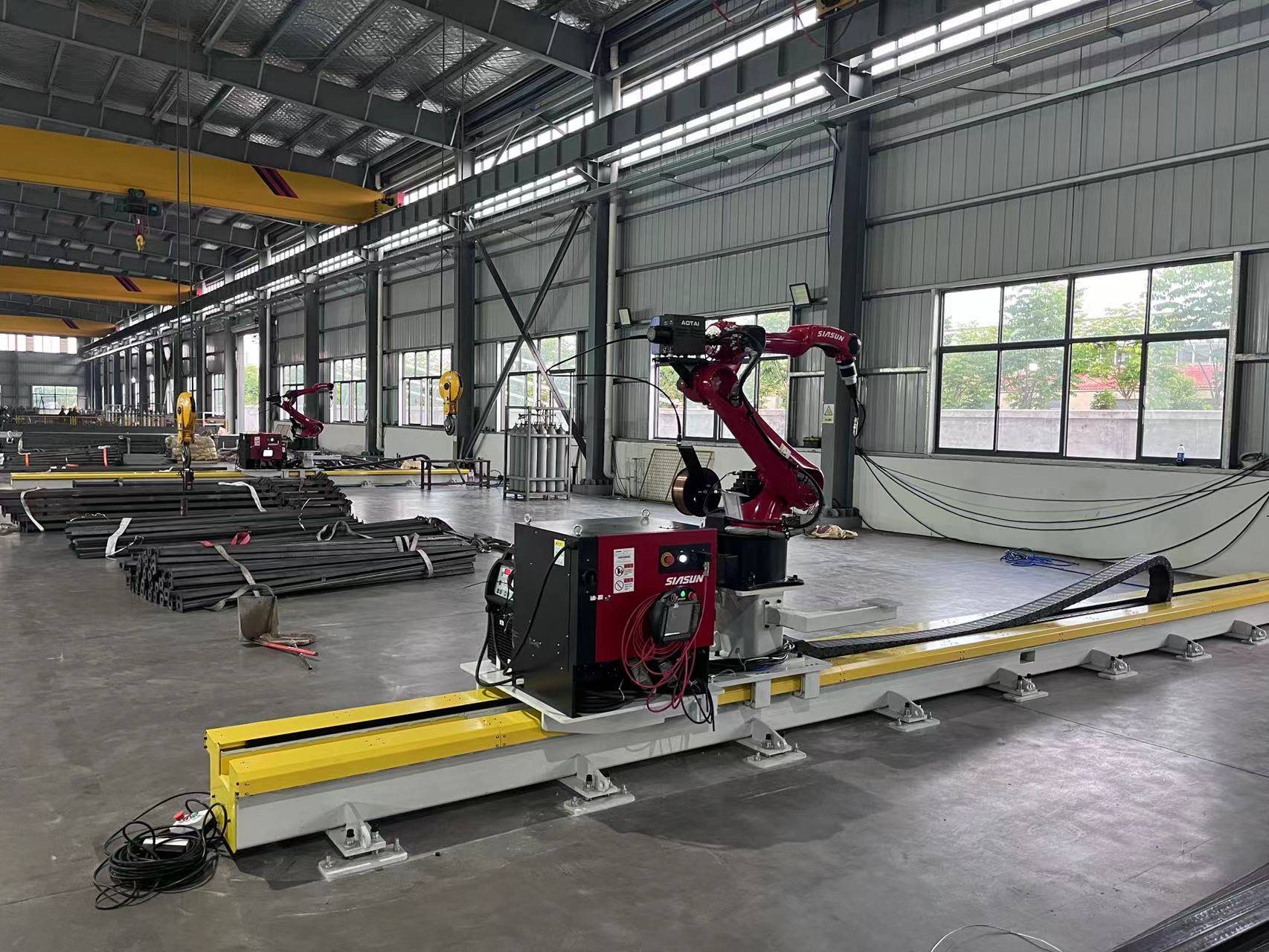
One of the primary obstacles in Robotic Welding for large-scale construction components is the inconsistency of fit-up. Large plates often exhibit thermal distortion from previous processing stages or slight inaccuracies in tack welding. An Intelligent Robotic Welder utilizes Laser Seam Tracking to solve this geometric variability. Unlike “touch sensing,” which requires the robot to stop and find the start point, laser tracking operates in real-time, ahead of the welding arc.
The Mechanics of Real-Time Correction
The laser sensor projects a line across the weld joint, capturing the profile of the groove. The system’s controller processes this data to identify the center of the joint and the cross-sectional area. If the gap widens, the robot can automatically slow its travel speed or increase its weave amplitude to fill the volume correctly. This capability is essential for Construction Machinery, where a 1mm deviation in a 5-meter weldment can lead to structural failure if not addressed during the deposition process. By eliminating the need for perfect fixturing, manufacturers reduce the overhead costs associated with high-precision jigs.
Maintenance Protocols for High-Duty Cycle Systems
To achieve an OEE (Overall Equipment Effectiveness) rating above 85%, a rigorous maintenance schedule for the robotic welding cell is mandatory. Industrial engineers must categorize maintenance into three streams: consumable management, torch calibration, and system-wide preventative checks.
Consumable Optimization
The contact tip, nozzle, and gas diffuser are the most frequent points of failure. In high-amperage MAG welding, spatter accumulation can obstruct gas flow, leading to porosity. Automated torch cleaning stations (reamers) should be programmed to cycle every 30 to 60 minutes of arc-on time. This process includes wire cutting to ensure a consistent stick-out length for the next arc ignition, and the application of anti-spatter fluid to prolong nozzle life.
Predictive Liner Replacement
The wire conduit or “liner” is often overlooked. Friction within the liner can lead to “bird-nesting” at the wire feeder or inconsistent arc stability. Monitoring the motor current of the wire feeder serves as a predictive maintenance tool; an increase in current indicates rising friction, signaling that a liner change is required before a catastrophic stoppage occurs.
Quantifying Labor ROI and Throughput Gains
The transition to automated welding is driven by the Return on Investment (ROI), particularly in regions facing a shortage of certified high-pressure welders. Calculating the ROI for an Intelligent Robotic Welder involves more than just comparing hourly wages; it requires an analysis of total weld deposition rates and the elimination of post-weld rework.
Deposition Efficiency and Arc-On Time
A manual welder typically maintains an arc-on time of 20% to 30% due to the need for breaks, repositioning, and slag removal. A robotic system can achieve arc-on times exceeding 75%. In heavy fabrication, where weld volumes are massive, this translates to a 3x to 4x increase in throughput per shift. Furthermore, because the Laser Seam Tracking ensures the weld is placed correctly the first time, the cost of carbon arc gouging and re-welding—common in manual shops—is virtually eliminated.
Labor Redirection
ROI is also realized through labor upskilling. Instead of employing five manual welders for repetitive longitudinal seams, a plant can employ one robotic technician to oversee two or three cells. The remaining labor force can be redirected to complex tacking operations or final assembly, where human dexterity and decision-making provide higher value. This shift reduces the “cost per meter” of weldment significantly over a 24-month amortization period.
Quality Assurance and Structural Integrity
In the construction machinery industry, weld failure can lead to significant liability and field repair costs. Robotic MAG welding provides a digital footprint for every joint. Modern controllers can log parameters such as current, voltage, and gas flow rates for every centimeter of the weld. This data logging creates a “birth certificate” for the component, ensuring compliance with international standards like AWS D1.1 or ISO 5817.
Addressing Thermal Distortion
Intelligent systems can sequence welds to balance heat input across large frames. By jump-welding or utilizing specific back-step patterns programmed into the robot’s logic, the engineer can minimize the “banana effect” in long telescopic booms. This level of thermal management is nearly impossible to coordinate across multiple manual welders working on the same part simultaneously.
Engineering Strategy for Implementation
Successful deployment of an Intelligent Robotic Welder requires a bottom-up engineering approach. It begins with the standardization of joint preparations and extends to the digital integration of the welding cell into the factory’s ERP system. For construction machinery, the focus must remain on the robustness of the Laser Seam Tracking system to handle the dusty, high-heat environment of a fabrication shop. When maintained correctly, these systems provide a sustainable competitive advantage through superior weld quality, predictable production timelines, and a significant reduction in the total cost of manufacturing.
-


LT240S tube laser cutting machine
-
LT120S tube laser cutting machine
-
Sale

Tank Fillet Welding Machine
Original price was: $1,000.00.$900.00Current price is: $900.00. -
Sale

MAK100 tube laser cutting machine
Original price was: $5,500.00.$5,000.00Current price is: $5,000.00. -

portable plasma air cutting machine
$1,200.00 -

2in1 fiber laser cutting machine
-

Air cooling Laser welding machine
-

HF h beam laser cutting machine
-

LT240 laser cutting machine
-

Laser welding machine
-


Cobotic Welding Station
-

Gantry welding robot solution
-

Tracked Wheeled AGV Welding robot
-

LFH6020 Fiber laser cutting machine
-
LFP6020
-

robotic welidng machine
Advanced Fiber Laser Tube Processing Technology
Our CNC Fiber Laser Tube Cutting systems revolutionize metal fabrication by integrating high-precision cutting, punching, and profiling into a single automated workflow. Designed for versatility, this technology handles a wide array of profiles including Round, Square, Rectangular, and Oval tubes, as well as complex L-shaped and U-shaped channels.
- Precision Punching: High-speed hole punching with micron-level accuracy, eliminating the need for mechanical drilling or die-stamping.
- Complex Profiling: Advanced 3D pathing allows for intricate interlocking joints and specialized notch cuts, ideal for structural frames.
- High Material Efficiency: Intelligent nesting software minimizes scrap, reducing raw material costs across large production runs.
- Clean Finish: Delivers oxide-free, burr-free edges that require zero secondary grinding before welding.

Seamlessly processing multiple profiles with consistent precision.
Global Delivery & Logistics



From our high-tech manufacturing facility directly to your global site. PCL WeldCut ensures secure packaging, professional handling, and reliable international logistics to safeguard your equipment throughout the entire journey.
