Optimizing Pressure Vessel Fabrication with Intelligent Robotic Welding
In the heavy industrial sector, the fabrication of pressure vessels demands a level of precision and structural integrity that exceeds standard structural steel requirements. Traditionally, this industry relied heavily on manual MAG welding (Metal Active Gas) processes, which are susceptible to human error, fatigue-induced defects, and inconsistent penetration. The introduction of the Intelligent Robotic Welder equipped with Laser Seam Tracking marks a shift toward data-driven manufacturing. These systems address the inherent variability in large-scale plate rolling and fit-up, ensuring that every bead meets rigorous ASME (American Society of Mechanical Engineers) standards.
The Role of Laser Seam Tracking in Heavy-Wall Applications
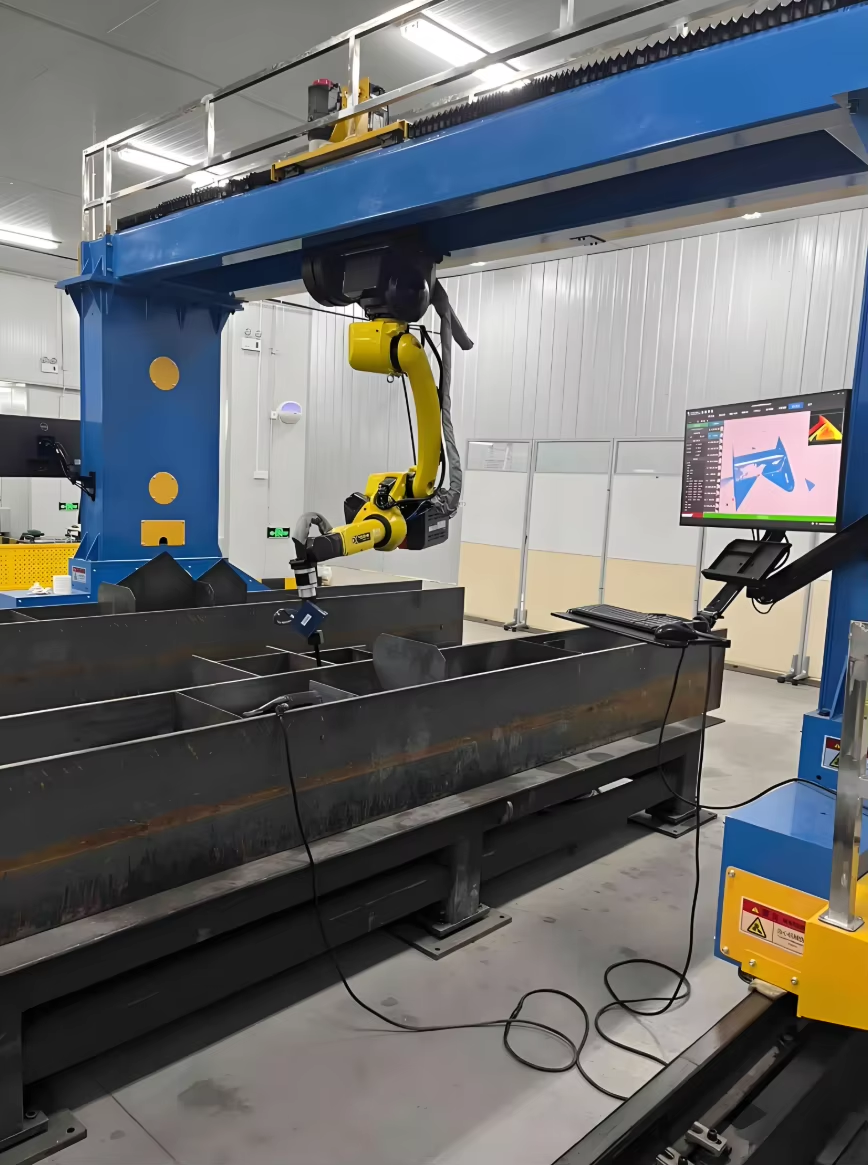
Pressure vessels often involve thick-walled cylinders and hemispherical heads. During the fit-up phase, slight deviations in the groove geometry are inevitable. Without real-time adjustment, a fixed-path robot would fail to account for these gaps, leading to lack of fusion or excessive reinforcement. Laser Seam Tracking utilizes a triangulation sensor mounted ahead of the welding torch. This sensor scans the joint profile in real-time, feeding positional data back to the robot controller. The system adjusts the torch coordinates and welding parameters—such as wire feed speed and travel speed—to compensate for variations in root gap or misalignment.
This “closed-loop” feedback system is critical for multi-pass welding. As layers of weld metal are deposited, thermal expansion can shift the joint’s original position. The intelligent tracker identifies these shifts, ensuring the arc remains centered in the groove, which significantly reduces the need for post-weld rework or expensive grinding operations.
MAG Welding Efficiency and Parametric Control
The choice of MAG welding for Pressure Vessels is driven by high deposition rates and deep penetration capabilities. In an automated cell, the robotic system can maintain a duty cycle of 85-90%, compared to the 30-40% typical of manual operators. This efficiency is achieved through the use of high-amperage power sources and optimized shielding gas mixtures (typically Argon and CO2). The intelligent controller manages the transition between dip transfer and spray transfer modes based on the material thickness and welding position.
For industrial engineers, the primary metric is “pounds of weld metal deposited per hour.” A robotic system can consistently deliver 10-12 lbs/hr in spray transfer mode, ensuring that long longitudinal and circumferential seams are completed in a fraction of the time required by manual methods. Furthermore, the stability of the robotic arm eliminates “arc wander,” which is a primary cause of porosity and slag inclusions in manual processes.
Maintenance Protocols for High-Availability Robotic Cells
To maintain the ROI of an automated welding system, a rigorous preventative maintenance (PM) schedule is mandatory. Unlike manual equipment, robotic cells have high-duty cycles that accelerate the wear of consumables. The following areas require engineering oversight:
Contact Tip and Diffuser Life Cycles
The contact tip is the most frequent point of failure. Micro-arcing within the tip can cause wire feeding fluctuations. Modern robotic torches include automatic “tip changers” or “reamer stations.” Every few cycles, the robot moves to a cleaning station where a mechanical reamer removes spatter and applies anti-spatter fluid, extending the life of the nozzle and ensuring gas flow remains laminar.
Wire Delivery Systems
The friction in the wire liner can lead to “bird-nesting” at the drive rolls. For pressure vessel welding, where wire reels can reach 600 lbs (bulk packs), the use of high-quality, low-friction liners and digital wire feeders is essential. Monitoring the motor torque on the wire feeder can serve as a predictive maintenance indicator; an increase in torque usually suggests a clogged liner or a worn drive roll.
Calibration of the Laser Sensor
The Laser Seam Tracking unit is exposed to high levels of UV radiation and weld spatter. Maintenance includes the regular replacement of protective cover slides and the verification of the sensor’s “zero point” relative to the torch’s Tool Center Point (TCP). Calibration ensures that the data being fed to the robot’s motion controller remains accurate to within sub-millimeter tolerances.
Labor ROI and Economic Impact Analysis
The economic justification for an Intelligent Robotic Welder goes beyond simple labor replacement. In the current industrial landscape, there is a chronic shortage of certified high-pressure welders. Robotic automation allows a single technician to oversee two or three welding cells, effectively tripling the output per man-hour.
Quantitative Savings
When calculating ROI, industrial engineers must look at the “Total Cost of Quality.” Manual welding on Pressure Vessels often results in a 3-5% repair rate based on X-ray or ultrasonic testing. Robotic systems, once optimized, typically reduce this repair rate to less than 0.5%. Considering that a single repair on a thick-walled vessel can cost thousands of dollars in labor, consumables, and lost throughput, the quality savings alone can pay for the robotic system within 18-24 months.
Skill Set Transition
Instead of manual dexterity, the labor force shifts toward “Robot Operators” and “Weld Technicians.” Training existing welders to program and maintain the robot improves employee retention and reduces the physical strain associated with welding inside cramped vessels or in high-heat environments. This shift reduces worker’s compensation claims and long-term health liabilities related to fume inhalation and ergonomic stress.
Throughput and Scaling Production
Integrating Laser Seam Tracking enables the facility to scale production without a linear increase in headcount. For circumferential seams, the robot can be integrated with a heavy-duty positioner (rotators). The controller synchronizes the rotation speed with the robot’s travel speed, maintaining a constant surface velocity. This synchronization is nearly impossible to maintain manually over an 8-hour shift. The result is a standardized production timeline, allowing project managers to predict delivery dates with high accuracy—a critical factor in the oil, gas, and nuclear power industries.
Final Technical Considerations
Transitioning to an Intelligent Robotic Welder requires a holistic approach to the production line. Upstream processes, such as plate rolling and beveling, must be consistent to allow the Laser Seam Tracking system to function within its optimal window. While the technology is robust, it serves as an enhancer for a well-designed manufacturing process rather than a fix for poor material preparation. For the industrial engineer, the focus remains on the stability of the process, the reliability of the hardware, and the continuous monitoring of weld data to ensure 100% compliance with safety codes.
-

LT240S tube laser cutting machine
-
LT120S tube laser cutting machine
-
Sale

Tank Fillet Welding Machine
Original price was: $1,000.00.$900.00Current price is: $900.00. -
Sale

MAK100 tube laser cutting machine
Original price was: $5,500.00.$5,000.00Current price is: $5,000.00. -

portable plasma air cutting machine
$1,200.00 -

2in1 fiber laser cutting machine
-

Air cooling Laser welding machine
-

HF h beam laser cutting machine
-

LT240 laser cutting machine
-

Laser welding machine
-

Cobotic Welding Station
-

Gantry welding robot solution
-

Tracked Wheeled AGV Welding robot
-

LFH6020 Fiber laser cutting machine
-
LFP6020
-

robotic welidng machine
Advanced Fiber Laser Tube Processing Technology
Our CNC Fiber Laser Tube Cutting systems revolutionize metal fabrication by integrating high-precision cutting, punching, and profiling into a single automated workflow. Designed for versatility, this technology handles a wide array of profiles including Round, Square, Rectangular, and Oval tubes, as well as complex L-shaped and U-shaped channels.
- Precision Punching: High-speed hole punching with micron-level accuracy, eliminating the need for mechanical drilling or die-stamping.
- Complex Profiling: Advanced 3D pathing allows for intricate interlocking joints and specialized notch cuts, ideal for structural frames.
- High Material Efficiency: Intelligent nesting software minimizes scrap, reducing raw material costs across large production runs.
- Clean Finish: Delivers oxide-free, burr-free edges that require zero secondary grinding before welding.

Seamlessly processing multiple profiles with consistent precision.
Global Delivery & Logistics



From our high-tech manufacturing facility directly to your global site. PCL WeldCut ensures secure packaging, professional handling, and reliable international logistics to safeguard your equipment throughout the entire journey.
