Optimizing Field Construction: The Role of Mechanized Tank Fillet Welding
In the fabrication of large-scale pressure vessels and atmospheric storage tanks, the fillet weld serves as a critical structural junction, particularly at the shell-to-bottom and shell-to-roof connections. Industrial engineers prioritize the transition from manual to mechanized welding processes to mitigate the risks associated with human fatigue and environmental variables. The tank fillet welding machine represents a specialized solution designed to navigate the unique geometry of circular and rectangular vessels with high repeatability.
Field construction presents challenges that shop environments do not. Wind, humidity, and minor plate misalignments can compromise the integrity of a weld. A mechanized approach using a magnetic crawler provides the necessary stability by adhering directly to the workpiece. This eliminates the need for expensive scaffolding or temporary guide rails, streamlining the mobilization phase of the welding operation. By focusing on mechanical reliability and arc stability, manufacturers can achieve X-ray quality welds in a fraction of the time required for manual Stick or MIG processes.
The Mechanics of Magnetic Crawler Systems in Tank Fabrication
The foundation of a reliable tank welding machine is its drive system. Unlike stationary systems, a magnetic crawler utilizes high-strength permanent magnets or electromagnets to maintain a constant force against the vertical or horizontal plate surface. This adhesion is critical when performing horizontal-vertical (2F) fillet welds, where gravity tends to pull the welding torch away from the joint interface.
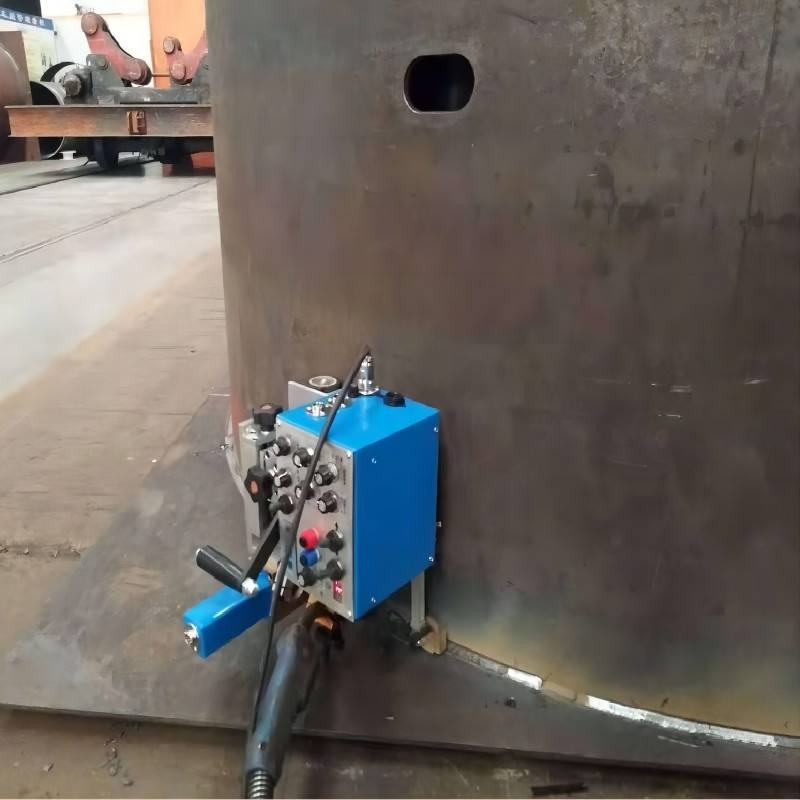
From an engineering standpoint, the traction system must provide smooth, jitter-free movement. Any pulsation in the drive motor translates directly into the weld ripple pattern, potentially causing stress concentrators. Modern machines utilize four-wheel drive systems with heat-resistant silicone or specialized rubber tires that provide grip while maintaining the magnetic gap. This ensures that the magnetic crawler can traverse over minor surface rust, mill scale, or tack welds without losing its trajectory or velocity consistency.
Arc Voltage Control (AVC) for Precision Fillet Geometry
One of the most significant advancements in field-deployable welding technology is the integration of Arc Voltage Control. In any arc welding process, the distance between the electrode and the molten pool is directly proportional to the arc voltage. During the fabrication of large pressure vessels, plates are rarely perfectly flat. Distortion from previous weld passes or slight deviations in plate rolling can create a fluctuating gap between the torch and the fillet joint.
The AVC system functions as a closed-loop feedback mechanism. It continuously monitors the voltage across the arc and compares it to a pre-set value determined by the welding procedure specification (WPS). If the distance between the torch and the plate increases, the voltage rises; the AVC motor immediately adjusts the torch position downward to restore the target voltage. This real-time correction ensures consistent fusion penetration and a uniform leg length, which are essential for meeting the stringent requirements of ASME Section VIII or API 650 standards.
Maintaining Duty Cycle and Thermal Management
Manual welding is limited by the operator’s ability to withstand heat and maintain a steady hand. In contrast, mechanized systems are designed for high duty cycles. When performing long-circumference welds on a 50-meter diameter tank, the machine can operate continuously for hours. This requires a robust thermal management strategy for the crawler’s internal components. Heat shields and cooling fins are integrated into the chassis to protect the drive motors and the AVC actuators from the intense radiant heat of the arc.
By maintaining a consistent travel speed and arc length, the heat input is regulated across the entire circumference. This predictability is vital for managing the Heat Affected Zone (HAZ). Excessive heat input in pressure vessel fabrication can lead to grain coarsening and reduced notch toughness, while insufficient heat leads to lack of fusion. The mechanized control offered by AVC ensures that the heat input remains within the calculated engineering limits, preserving the metallurgical properties of the parent metal.
Operational Efficiency and Labor Optimization
The implementation of mechanized fillet welding drastically changes the labor dynamic on a construction site. A single operator can oversee two or more machines, effectively doubling or tripling the output per man-hour. The operator’s role shifts from the physical execution of the weld to the monitoring of parameters and the management of consumables. This reduction in physical strain leads to fewer errors toward the end of a shift, which is where most manual welding defects occur.
Furthermore, the setup time for these machines is minimal. Because the crawler is self-guiding via the fillet joint or a magnetic track, the time spent on alignment is significantly reduced. In the context of industrial engineering, this translates to a reduction in the “non-value-added” time of the fabrication cycle. The reliability of the Arc Voltage Control also reduces the repair rate. In pressure vessel work, the cost of gouging out a defective weld and re-welding is often five to ten times the cost of the initial weld. Avoiding these repairs is the primary driver for the ROI of mechanized systems.
Consistency in Multi-Pass Fillet Welds
For thick-walled vessels, a single-pass fillet weld is often insufficient to meet structural requirements. Multi-pass welding introduces the risk of slag inclusion and inter-pass defects. Mechanized crawlers allow for precise indexing of the torch position for each subsequent pass. The AVC ensures that even as the joint profile changes with each layer of deposited metal, the arc remains at the optimal height.
This level of control allows for the use of larger diameter wires and higher current densities, which increases deposition rates. For example, moving from a manual 1.2mm wire to a mechanized 1.6mm or 2.0mm flux-cored wire can increase the deposition rate by over 50%. When multiplied by the thousands of meters of welding required for a large tank farm project, the schedule compression is substantial.
Conclusion: The Engineering Standard for Modern Infrastructure
The transition to tank fillet welding machines with integrated Arc Voltage Control is not merely a matter of convenience; it is an engineering necessity for modern high-integrity projects. By leveraging the physical stability of a magnetic crawler and the electronic precision of AVC, fabricators can guarantee results that manual processes cannot match. These systems provide a data-driven approach to welding, where parameters are locked in, and the mechanical system executes the design with surgical precision.
As the demand for pressure vessel fabrication grows in the energy and chemical sectors, the reliance on these mechanized solutions will continue to expand. The focus remains on achieving the highest quality standards while optimizing the economic efficiency of field construction. By removing the variables of human error and environmental interference, mechanized fillet welding ensures that the structural integrity of our global infrastructure is maintained through superior process control.
-


LT240S tube laser cutting machine
-
LT120S tube laser cutting machine
-
Sale

Tank Fillet Welding Machine
Original price was: $1,000.00.$900.00Current price is: $900.00. -
Sale

MAK100 tube laser cutting machine
Original price was: $5,500.00.$5,000.00Current price is: $5,000.00. -

portable plasma air cutting machine
$1,200.00 -

2in1 fiber laser cutting machine
-

Air cooling Laser welding machine
-

HF h beam laser cutting machine
-

LT240 laser cutting machine
-

Laser welding machine
-


Cobotic Welding Station
-

Gantry welding robot solution
-

Tracked Wheeled AGV Welding robot
-

LFH6020 Fiber laser cutting machine
-
LFP6020
-

robotic welidng machine
