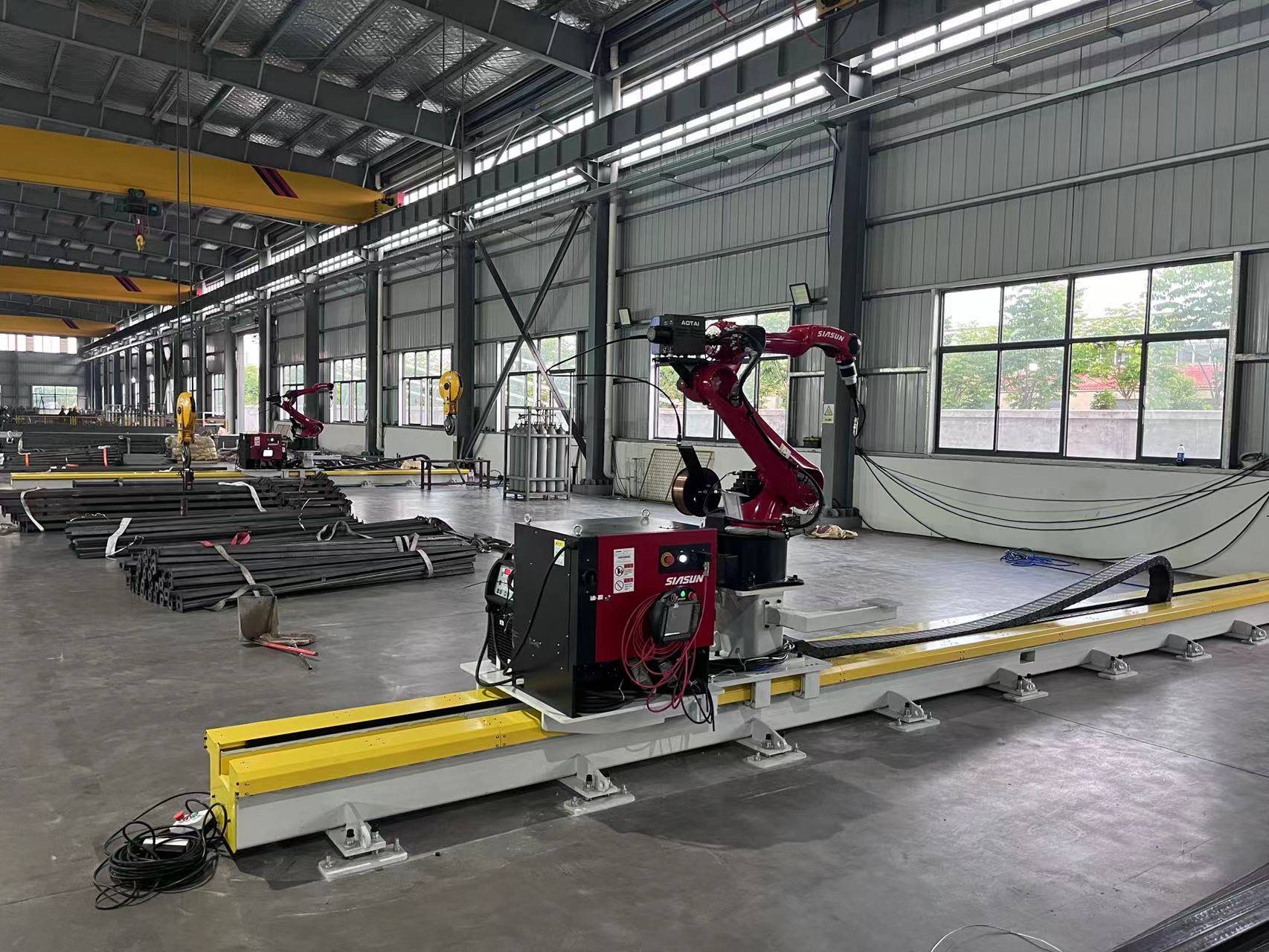
Advanced 7-axis robotic solution for heavy-duty steel structure fabrication.
| Accuracy | ±0.05mm |
| Travel Rail | 9M / 12M Standard |
| Vision System | 3D Laser Scanning |
✓ CE CERTIFIED
✓ 24-MONTH WARRANTY
The Robotic Welding Robot is a high-precision, 7-axis automation system specifically engineered for the modern steel structure industry. By integrating advanced 3D vision with industrial-grade robotics, it enables a seamless “teaching-free” digital workflow.
Core Technical Advantages
- AI-Powered Path Planning: 3D laser scanning identifies seams and calculates trajectories automatically, eliminating manual coding.
- BIM/CAD Integration: Seamless data linking with Tekla and Solidworks for direct 3D-to-Weld conversion.
- Expanded Working Envelope: Features a 2000mm arm span and customizable 9M/12M travel rails.
- Industrial Reliability: ±0.05mm repeatability ensures consistent weld quality for 24/7 heavy-duty operations.
Technical Specifications
| Robot Model | Robotic 7-Axis |
| Positioning Accuracy | ±0.05mm |
| Travel Rail Length | 9M / 12M (Customizable) |
| Vision Sensor | High-Precision 3D Laser |
| Control Protocol | EtherCAT Bus Servo |
PCL Support & Quality Assurance
2-Year Global Warranty | CE/ISO Certified | 24/7 Technical Engineering Support
PCL GROUP Intelligent Equipment CO.,LTD
Advanced Programming: OLP vs. Teaching-Free System
For large-scale gantry welding, manual "point-to-point" teaching is inefficient. PCL offers two cutting-edge solutions to minimize downtime and maximize precision. Understanding the difference is key to choosing the right automation level for your factory.
Off-line Programming (OLP)
OLP allows engineers to create welding paths in a 3D virtual environment using CAD data (STEP/IGES).
- Zero Downtime: Program the next job on a PC while the robot is still welding.
- Collision Detection: Simulates the gantry movement to prevent accidents in a virtual space.
- Best For: Complex workpieces with high repeat rates and detailed weld joints.
Teaching-Free Welding System
Uses 3D laser scanning or vision sensors to "see" the workpiece and generate paths automatically without any CAD data.
- Instant Setup: No manual coding or 3D modeling required; just scan and weld.
- High Flexibility: Ideal for "One-off" parts where every workpiece is slightly different.
- Real-time Adaptation: Automatically compensates for thermal distortion and fit-up gaps.
- Best For: Custom fabrication, repairs, and low-volume/high-mix production.
| Feature | Off-line Programming (OLP) | Teaching-Free System |
|---|---|---|
| Input Required | CAD 3D Models | 3D Laser Scanning |
| Programming Time | Minutes to Hours (Off-site) | Seconds (On-site) |
| Ideal Production | Mass Production / Batch Work | Custom / Single Unit Work |
Related products










Watch Related Videos
Frequently Asked Questions
Q1: What is the maximum workpiece size a gantry robot can handle?
The primary advantage of a gantry system is its scalability. Unlike fixed-base robots, the gantry rail length can be extended from 6 meters to over 30 meters. We customize the X, Y, and Z travel strokes based on your specific components, such as trailer chassis or large pressure vessels.
Q2: How does the robot handle material deviations or heat deformation?
For large workpieces, we recommend integrating Laser Seam Tracking or Arc Sensors. These technologies allow the robot to detect the actual weld joint position in real-time and adjust the torch path automatically, compensating for thermal distortion or fit-up tolerances.
Q3: Which robot brands are compatible with the PCL Gantry System?
Our gantry structures are highly flexible and can be integrated with leading international brands including Fanuc, ABB, Yaskawa, and KUKA, as well as our proprietary PCL robotic arms. We provide the full integration including the synchronized 7th or 8th external axes.
Q4: Is it difficult to program a gantry robot for complex large structures?
Not at all. We offer Off-line Programming (OLP) software. This allows your engineers to simulate the welding process and generate code on a PC using CAD data, significantly reducing machine downtime and preventing potential collisions before the physical welding starts.
Q5: Can one gantry system manage multiple welding stations?
Yes. A common configuration is a dual-station setup. While the robot is welding at Station A, operators can safely load or unload workpieces at Station B. This maximizes the robot's "Arc-on Time" and ensures continuous production flow.
Clients Review
Steve Tech Workshop –
Highly recommend for any professional construction workshop. Precision is top-notch.
Chris Garcia Group –
Excellent cut quality on 20mm stainless steel. The edges are clean and burr-free.
Mark Tech Manufacturing –
Excellent cut quality on 5mm stainless steel. The edges are clean and burr-free.
James Rodriguez Workshop –
Been using this for 200 hours now. Still running like a beast. Very reliable.
James Tech | Production Manager –
The nesting software is very intuitive. Saved us a lot of alloy waste.
Jacob Machine Workshop –
Highly recommend for any professional construction workshop. Precision is top-notch.
Jeffrey Anderson Ltd. –
Been using this for 3 months now. Still running like a beast. Very reliable.