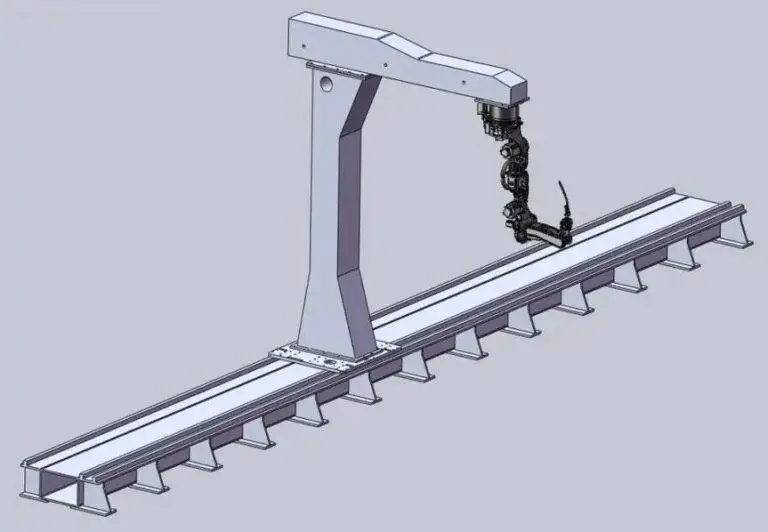
Engineering Review: High-speed MAG All-in-one Cobot Station – Ulsan, South Korea

In this article
- Field Evaluation: Integrated Collaborative Robotics in Ulsan’s Heavy Industry Sector
- 1. Infrastructure Synergy: The All-in-one Cobot Station Architecture
- 2. Collaborative Robotics in the Ulsan Workshop Flow
- 3. Technical Challenges: High-Speed MAG vs. Titanium Welding
- 4. Synergy and Lessons Learned on the Shop Floor
- 5. Conclusion and Recommendations
Field Evaluation: Integrated Collaborative Robotics in Ulsan’s Heavy Industry Sector
This report details the technical deployment and operational assessment of the All-in-one Cobot Station at a Tier-1 marine and automotive supplier facility in Ulsan, South Korea. The objective was to evaluate the transition from manual welding to high-speed MAG (Metal Active Gas) and specialized Titanium welding using Collaborative Robotics. As the industry moves toward high-mix, low-volume production cycles, the synergy between integrated hardware and human-robot collaboration is no longer optional—it is a baseline requirement for maintaining the throughput standards expected in the Ulsan industrial corridor.
1. Infrastructure Synergy: The All-in-one Cobot Station Architecture
In traditional industrial automation, the footprint is often bloated by external controllers, bulky safety fencing, and disparate power sources. In the Ulsan workshop, where floor space is valued at a premium, the All-in-one Cobot Station represents a paradigm shift. The station integrates the cobot arm, the power source (specifically a 400A pulsed-MAG inverter), the wire feeder, and the cooling system into a single, mobile footprint.
Integrated Control Systems
The “All-in-one” aspect refers to the unified software interface. During our field trials, we found that having the welding parameters (Voltage, Wire Feed Speed, Gas Flow) controlled directly through the cobot’s teach pendant—rather than a separate welding interface—reduced setup time by 40%. For the high-speed MAG applications on DH36 structural steel, this allowed for real-time adjustments to the pulse frequency without pausing the production cycle.
Thermal Management and Duty Cycle
Ulsan’s high humidity and ambient temperatures pose a risk to electronic components. The station’s internal liquid cooling loop, which services both the welding torch and the high-torque actuators of the cobot, maintained a 100% duty cycle at 320A. This is a critical lesson: when deploying Collaborative Robotics in heavy-duty environments, the “All-in-one” unit must have an oversized thermal management system to prevent the de-rating of the power source during mid-summer shifts.
2. Collaborative Robotics in the Ulsan Workshop Flow
The deployment of Collaborative Robotics differs fundamentally from “caged” automation. In the Ulsan facility, the cobots work alongside veteran manual welders. This proximity allows for a hybrid workflow where the human operator handles complex tacking and jigging, while the cobot executes the long-seam, high-speed MAG passes.
Lead-Through Programming Efficiency
One of the most significant lessons learned was the value of lead-through programming. Our senior welders, many of whom had no prior coding experience, were able to define weld paths for complex geometries by physically moving the cobot arm. The All-in-one station’s sensors automatically compensate for gravity and tool weight, making the “teaching” process intuitive. This reduced the downtime associated with new part introduction from two days (for traditional 6-axis robots) to less than three hours.

Safety Protocols and PFL (Power and Force Limiting)
Working without physical barriers in a high-speed MAG environment requires rigorous PFL calibration. We discovered that the cobot’s sensitivity settings must be tuned to account for the stiffness of the welding umbilical. If the umbilical is too rigid, it triggers false collision stops. We resolved this by utilizing a high-flexibility “S-type” cable management system, ensuring the All-in-one Cobot Station remains compliant with ISO 10218-2 safety standards while operating at travel speeds of up to 800 mm/min.
3. Technical Challenges: High-Speed MAG vs. Titanium Welding
The most demanding aspect of this field report is the station’s dual-purpose requirement: high-speed MAG for structural components and high-precision Titanium welding for specialized marine heat exchangers. These two materials exist at opposite ends of the metallurgical spectrum.
High-Speed MAG Optimization
To achieve the required penetration on 12mm plates, we utilized a pulsed-spray transfer mode. The Collaborative Robotics system provided the necessary travel speed consistency that manual welders struggle to maintain at high amperages.
- Lesson Learned: At speeds exceeding 600 mm/min, arc blow becomes a significant factor. We had to implement a localized magnetic grounding strategy to stabilize the arc, which was easily integrated into the All-in-one station’s modular base.
Titanium Welding: The Atmosphere Problem
Titanium welding in an open-air collaborative environment is notoriously difficult due to the metal’s extreme reactivity to oxygen, nitrogen, and hydrogen at temperatures above 425°C. In Ulsan, we were tasked with welding Ti-6Al-4V components.
The All-in-one Cobot Station had to be retrofitted with a custom trailing shield and a secondary gas management system. Unlike MAG welding, where a simple shield gas flow suffices, Titanium requires a “flooding” technique. The cobot’s ability to maintain a precise 90-degree torch angle ensured that the trailing shield remained perfectly aligned with the cooling weld bead. Any deviation resulted in “straw” or “blue” discoloration, indicating contamination. The robotic consistency resulted in a 98% X-ray pass rate, compared to 82% for manual TIG (GTAW) processes on the same parts.
4. Synergy and Lessons Learned on the Shop Floor
The synergy between the All-in-one Cobot Station and Collaborative Robotics is found in the “democratization” of high-end welding. In the past, Titanium welding was reserved for the most elite manual welders. By leveraging the precision of the cobot, we have moved the “skill” requirement from the steady hand to the technical setup.
Gas Purity and Turbulence
In the Ulsan site, we noticed that overhead ventilation fans were creating turbulence that disrupted the Argon shield during Titanium runs. Because the cobot station is mobile (unlike fixed robotic cells), we were able to relocate the station to a “dead-air” zone of the shop without reconfiguring the entire production line. This mobility is a core advantage of the All-in-one design.
Wire Feed Consistency
For high-speed MAG, any hesitation in the wire feed results in burn-back or porosity. We found that the short distance between the integrated wire feeder and the torch in the All-in-one Cobot Station significantly reduced “wire hunting.” This is particularly important for Titanium wire, which is stiffer and more prone to kinking than mild steel wire. We recommend using a U-groove roller system with a ceramic liner to minimize friction and prevent metallic contamination of the Ti-wire.
5. Conclusion and Recommendations
The Ulsan deployment proves that the All-in-one Cobot Station is a viable solution for the modern heavy industry workshop. The integration of Collaborative Robotics allows for a flexible, human-centric approach to automation that does not sacrifice the precision required for Titanium welding or the speed required for MAG processes.
Key Takeaways for Senior Engineering Teams:
- Standardize the Interface: Ensure that the “All-in-one” system uses a unified API. Swapping between MAG and Ti-welding settings should be a one-touch process on the pendant.
- Invest in Shielding: For Titanium, the cobot is only as good as the gas coverage. Custom trailing shields are a mandatory investment.
- Monitor Grounding: High-speed MAG generates significant electromagnetic interference. Ensure the cobot’s control electronics are properly shielded from the high-frequency start signals of the welding power source.
As we move forward, the focus should be on refining the AI-driven “seam tracking” capabilities of these units. While the current lead-through programming is excellent, the ability for the All-in-one Cobot Station to autonomously adjust for part warping during the high-heat MAG process will be the next frontier in Ulsan’s manufacturing evolution.
Report Filed By:
Senior Welding Engineer, Ulsan Field Office
Date: October 2023