Engineering Review: Multi-pass Welding All-in-one Cobot Station – Melbourne, Australia
In this article
- Field Report: Deployment of Multi-pass Collaborative Robotics for Heavy-Gauge Copper Welding
- 1.0 Site Overview and Objectives
- 2.0 The Synergy of the All-in-one Cobot Station and Collaborative Robotics
- 3.0 Technical Challenges: Copper Components Welding
- 4.0 Lessons Learned: Field Observations
- 5.0 Productivity Metrics: Manual vs. Cobot
- 6.0 Safety and Compliance in the Australian Context
- 7.0 Final Recommendations
- 8.0 Conclusion
Field Report: Deployment of Multi-pass Collaborative Robotics for Heavy-Gauge Copper Welding
1.0 Site Overview and Objectives
The following report details the technical commissioning and operational performance of an All-in-one Cobot Station at a high-capacity fabrication facility in Melbourne, Australia. The primary objective was the transition from manual GTAW (Gas Tungsten Arc Welding) to automated GMAW (Gas Metal Arc Welding) for thick-section Copper Components welding.
In the Melbourne industrial landscape—specifically within the renewable energy and power distribution sectors—there is an increasing demand for high-purity copper busbars and heat exchangers. The challenge lies in copper’s extreme thermal conductivity, which necessitates high heat inputs and precise interpass temperature management. This deployment sought to leverage Collaborative Robotics to maintain consistent torch angles and travel speeds that are humanly impossible to sustain over long-duration multi-pass sequences.
2.0 The Synergy of the All-in-one Cobot Station and Collaborative Robotics
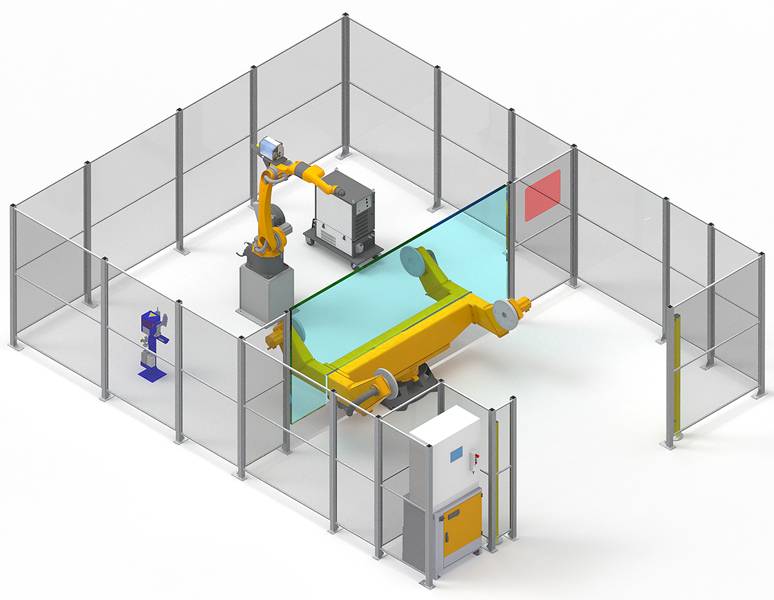
In a traditional industrial robotics setup, the footprint is massive, requiring light curtains, physical fencing, and dedicated PLC integration. In the compact workshops of Melbourne’s suburbs, spatial efficiency is critical. The All-in-one Cobot Station bridges this gap by integrating the robotic arm, power source, wire feeder, and a specialized welding table into a single, mobile footprint.
2.1 Collaborative Robotics in a Live Workshop
The “Collaborative” aspect of Collaborative Robotics is often misunderstood as merely “safe to touch.” In this field application, the synergy was found in the “Lead-Through Programming” capability. Our senior welders, who possess decades of intuitive knowledge regarding weld pool behavior, were able to physically move the cobot arm to define the path for the initial root pass. This allows the welder to remain the “brain” of the operation while the cobot acts as the “steady hand.”
2.2 Integrated Control Systems
The All-in-one Cobot Station utilized a unified software interface. This meant that the pulse-on-pulse parameters, gas pre-flow, and the multi-pass offset logic were all controlled from a single pendant. For Copper Components welding, where voltage drops can occur rapidly due to heat-induced resistance changes, having the power source and the robot controller in a tight digital feedback loop was essential for real-time arc compensation.
3.0 Technical Challenges: Copper Components Welding
Copper is a notoriously difficult material for automation. Its thermal conductivity is approximately 10 to 30 times greater than that of carbon steel. During this field test in Melbourne, we were working with 12mm oxygen-free electronic (OFE) copper plates.
3.1 The Multi-pass Strategy
Manual welding of these components often results in “cold laps” at the start and “burn-through” at the end as the workpiece saturates with heat. To combat this, we programmed a 5-pass sequence:
- Pass 1 (Root): High current (280A) with a slow travel speed to ensure penetration despite the massive heat sink of the base metal.
- Pass 2-3 (Fill): Utilized a programmed weave pattern. Here, Collaborative Robotics outperformed manual intervention by maintaining a consistent 1.5mm oscillation width to tie in the toes of the weld.
- Pass 4-5 (Cap): Reduced current (210A) to manage the cumulative heat and prevent excessive grain growth in the Heat Affected Zone (HAZ).
3.2 Shielding Gas and Porosity
In the Melbourne workshop environment, humidity can fluctuate, impacting gas purity at the nozzle. We utilized a 75% Helium / 25% Argon mix. The All-in-one Cobot Station was equipped with a high-flow gas lens and a secondary trailing shield. The cobot’s ability to maintain a constant Contact Tip to Work Distance (CTWD) of 15mm (+/- 0.2mm) was the deciding factor in achieving X-ray quality welds with zero porosity.
4.0 Lessons Learned: Field Observations
4.1 Thermal Saturation and Path Offsetting
One major lesson learned was the necessity of “Dynamic Path Offsets.” As the Copper Components welding progressed, the physical plate expanded by nearly 1.2mm over a 500mm run. A standard industrial robot would have stayed on its rigid coordinate path, leading to an off-center bead. By using the touch-sensing capabilities inherent in our Collaborative Robotics system, the cobot performed a “quick touch” at the start of each pass to recalibrate its zero point. This accounted for the thermal expansion of the copper.
4.2 Wire Feed Consistency
Copper wire is soft. High-speed feeding through a long torch cable often leads to “bird-nesting.” The All-in-one Cobot Station we deployed used a localized wire feeder mounted directly on the cobot’s third axis. This reduced the liner length to 1.5 meters, significantly decreasing friction and ensuring the pulse-on-pulse delivery remained rhythmic. If the wire delivery is even slightly inconsistent, the copper weld pool—which is very fluid—will collapse.
4.3 The “Human-in-the-Loop” Requirement
Despite the automation, we found that the most successful runs occurred when the welder used the collaborative nature of the robot to pause the sequence for interpass cleaning. Copper oxides form rapidly. The All-in-one Cobot Station was programmed with “Wait for Input” commands between Pass 2 and 3, allowing the operator to wire-brush the surface without powering down the entire safety system. This is where Collaborative Robotics truly shines compared to caged automation.
5.0 Productivity Metrics: Manual vs. Cobot
Over a two-week period in the Melbourne facility, we tracked the following data:
- Arc-on Time: Increased by 45%. The cobot does not require breaks and does not suffer from “arc glare” fatigue.
- Post-Weld Grinding: Reduced by 60%. The precision of the weave patterns in the All-in-one Cobot Station produced a ripple profile that met aesthetic standards for architectural copper work without secondary finishing.
- Consumable Waste: Reduced by 15% due to optimized gas pre-flow and post-flow settings locked into the robotic job files.
6.0 Safety and Compliance in the Australian Context
Compliance with AS/NZS 1554.6 (Welding stainless steels and non-ferrous metals) was a mandatory requirement for this project. The All-in-one Cobot Station provided a digital log of every weld—voltage, current, and travel speed. This “Digital Birth Certificate” for each copper component is becoming a standard requirement for Melbourne-based infrastructure projects.
Furthermore, the integration of high-vacuum smoke extraction directly into the cobot’s torch head addressed the OHS concerns regarding copper oxide fumes, which are significantly more hazardous than standard steel welding particulates. The Collaborative Robotics setup allowed the extractor to stay perfectly positioned 10mm from the arc, a feat rarely achieved by manual welders who often find the extraction hoses cumbersome.
7.0 Final Recommendations
For firms looking to implement Copper Components welding automation, the All-in-one Cobot Station is the recommended entry point. However, the following must be addressed during setup:
- Pre-heat Management: Even with high-amperage cobot settings, a localized 200°C pre-heat is recommended for copper sections exceeding 10mm to ensure proper wetting at the start of the bead.
- Jigging: Use stainless steel or ceramic-coated clamps. Standard steel clamps will suck too much heat out of the copper, leading to localized cold-cracking.
- Software Updates: Ensure the cobot’s firmware is optimized for “Arc Sense.” This allows the robot to adjust its height based on the arc voltage, which is a lifesaver when welding materials with high thermal expansion rates like copper.
8.0 Conclusion
The Melbourne field trial successfully demonstrated that the integration of Collaborative Robotics into an All-in-one Cobot Station provides the necessary control for complex Copper Components welding. The synergy between the operator’s metallurgical knowledge and the robot’s mechanical repeatability has solved the consistency issues that have plagued the local power distribution manufacturing sector for years. We recommend a full-scale rollout of these stations across the production floor to replace aging manual GTAW stations.
Report Prepared By:
Senior Welding Engineer
Melbourne Field Office







