Engineering Review: Robotic MIG Cobot Welding Machine – Bangkok, Thailand
In this article
- Field Engineering Report: Implementation of Collaborative Robotics in Stainless Steel Fabrication
- 1. Introduction and Regional Context
- 2. The Synergy of the Cobot Welding Machine and Collaborative Robotics
- 3. Technical Analysis: Stainless Steel Welding Challenges
- 4. Deployment Observations: The “Bangkok Workshop” Variables
- 5. Lessons Learned and Engineering Best Practices
- 6. Quantitative Performance Metrics
- 7. Conclusion
Field Engineering Report: Implementation of Collaborative Robotics in Stainless Steel Fabrication
1. Introduction and Regional Context
This report details the technical deployment and performance evaluation of a MIG Cobot Welding Machine within a high-output manufacturing facility located in the Bang Na district of Bangkok, Thailand. The primary objective was to transition a portion of the manual MIG line—specifically targeting 300-series stainless steel components—to an automated framework leveraging collaborative robotics.
The manufacturing landscape in Bangkok is currently facing a dual challenge: a critical shortage of Tier-1 certified welders and a tropical climate that accelerates operator fatigue, leading to inconsistency in manual weld beads. By integrating a Cobot Welding Machine, we aimed to stabilize cycle times and improve the aesthetic and structural quality of stainless steel welding operations, which are notoriously sensitive to heat input and travel speed variations.
2. The Synergy of the Cobot Welding Machine and Collaborative Robotics
In the field, we distinguish between the “welding power source” and the “robotic integrator.” However, the success of this project relied on the seamless synergy between the Cobot Welding Machine (the hardware/power supply) and the philosophy of collaborative robotics (the software, safety sensors, and human-machine interface).
2.1 Hardware Integration
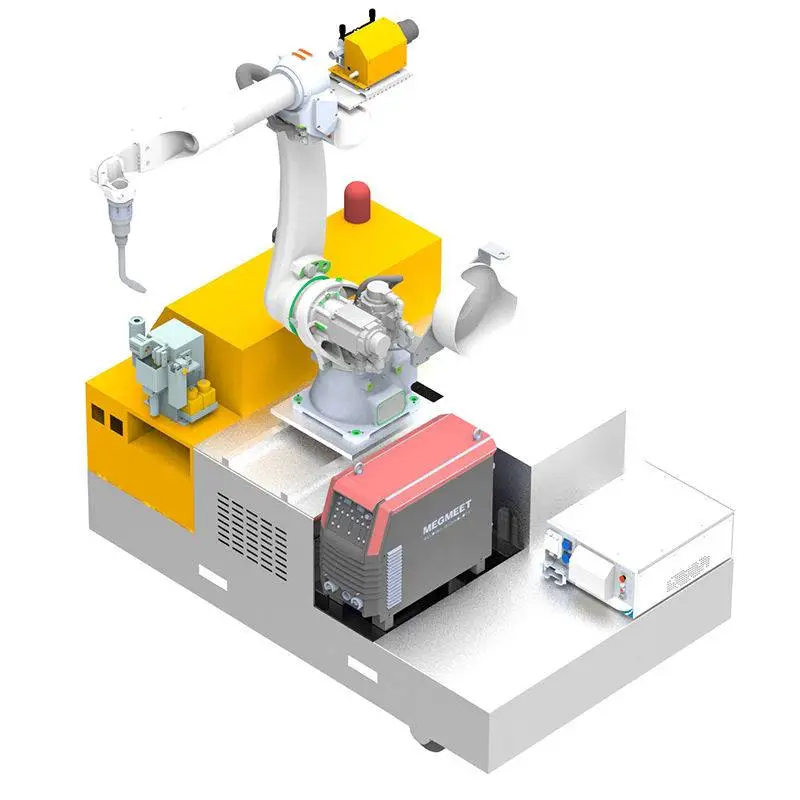
The system utilized a 6-axis collaborative arm integrated with a high-performance pulse-MIG power source. Unlike traditional industrial robots, these collaborative systems do not require heavy floor-bolted fencing. In the cramped quarters of a typical Bangkok urban workshop, this footprint reduction is vital. The “collaborative” aspect allowed our senior welders to stand bedside the machine, using “lead-through teaching” to define complex weld paths on curved stainless steel surfaces without writing a single line of G-code.
2.2 Adaptive Parameters
The Cobot Welding Machine was calibrated to communicate via a dedicated Fieldbus protocol. This allowed the robotic controller to adjust wire feed speed and voltage dynamically based on the arm’s TCP (Tool Center Point) speed. In stainless steel welding, maintaining a constant heat input is the difference between a pass and a scrap piece due to burn-through or excessive warping.
3. Technical Analysis: Stainless Steel Welding Challenges
Stainless steel welding using MIG (GMAW) processes presents unique metallurgical challenges, particularly in the humid environment of Central Thailand. Our focus was on SUS304 and SUS316L grades, commonly used in the food processing equipment manufactured on-site.
3.1 Heat Management and Distortion
Stainless steel has a lower thermal conductivity and a higher coefficient of thermal expansion than carbon steel. Manual operators in our Bangkok facility often struggled with “bowing” on 3mm plates. By utilizing collaborative robotics, we implemented a “stitch welding” sequence that distributed heat more evenly across the workpiece. The cobot’s ability to maintain a precise 2.5mm arc length ensured that the Heat Affected Zone (HAZ) remained narrow, preserving the corrosion resistance of the material.
3.2 Shielding Gas Integrity in Tropical Environments
Humidity in Bangkok often exceeds 80%, which can lead to hydrogen porosity in welds if gas coverage is interrupted. We upgraded the Cobot Welding Machine with a specialized gas-lens nozzle and increased the flow rate of the Ar+He+CO2 trimix. The cobot’s consistent torch angle (maintained at a strict 15-degree push) ensured that the gas envelope was never compromised, a feat difficult for manual welders to maintain over an 8-hour shift in 35°C heat.
4. Deployment Observations: The “Bangkok Workshop” Variables
Implementing collaborative robotics in Thailand requires accounting for local infrastructure. We encountered several variables that necessitated on-site engineering workarounds:
4.1 Power Stability
Voltage fluctuations in the industrial zones of Samut Prakan can disrupt sensitive robotic controllers. We installed an industrial-grade UPS and power conditioner between the primary grid and the Cobot Welding Machine to prevent mid-cycle stops, which cause “cold laps” in stainless steel welding.
4.2 Spatter Control and Wire Feeding
For stainless MIG, we utilized a pulsed-spray transfer mode. The cobot’s mounting bracket had to be stiffened to compensate for the high-frequency vibrations of the pulse. We also found that 308LSi wire, while providing excellent wetting, required a Teflon liner in the cobot’s torch lead to prevent bird-nesting—a common issue when the robotic arm performs tight-radius maneuvers.
5. Lessons Learned and Engineering Best Practices
After three months of operation, several “hard-won” lessons have surfaced regarding the use of a Cobot Welding Machine in a high-mix, low-volume stainless shop.
5.1 The Fallacy of “Plug and Play”
While collaborative robotics manufacturers market these machines as “ready out of the box,” the reality of stainless steel welding requires deep metallurgical knowledge. A cobot will repeat a bad weld perfectly 1,000 times. Our senior engineers spent the first two weeks optimizing “crater fill” parameters. Without a proper slope-down routine, stainless steel welds often develop “star cracks” at the termination point. We programmed the cobot to perform a 0.5-second dwell at the end of each segment to mitigate this.
5.2 Fixturing is Paramount
In manual welding, the operator compensates for poor fit-up. Collaborative robotics cannot “see” a 1mm gap unless expensive vision systems are integrated. We had to redesign our jigging systems in the Bangkok plant to ensure tolerances were within +/- 0.5mm. This front-end investment was offset by a 40% reduction in post-weld grinding and polishing—a major cost saver in stainless fabrication.
5.3 Operator Upskilling
The most successful element of the Bangkok deployment was the transition of our manual welders to “Cobot Technicians.” Instead of fighting the heat and UV radiation, they now manage two Cobot Welding Machine units simultaneously. This shift in collaborative robotics application hasn’t replaced the welder; it has amplified their expertise.
6. Quantitative Performance Metrics
The following data points reflect the delta between manual operations and the cobot-assisted line:
- Duty Cycle: Increased from 25% (manual) to 75% (cobot).
- Consumable Waste: 15% reduction in shielding gas due to optimized pre-flow/post-flow timings.
- Rework Rate: Dropped from 8% to less than 1.5% on SUS304 thin-gauge assemblies.
- Travel Speed: Consistent 450mm/min achieved on 2mm fillet welds, compared to a fluctuating 300-350mm/min manual average.
7. Conclusion
The integration of the Cobot Welding Machine into our Bangkok operations has proven that collaborative robotics is the most viable path forward for stainless steel welding. By removing the human variability factor while retaining human oversight, we have stabilized our production quality despite the challenging environmental conditions. Future phases will involve the implementation of “Through-Arc Seam Tracking” to further enhance the cobot’s ability to handle slight variations in part geometry.
Senior Engineer: [Field Notes / Bangkok Site]