Field Evaluation Report: Deep Penetration All-in-one Cobot Station Deployment
Location: Monterrey, Nuevo León, Mexico (Industrial District)
1. Executive Summary of Field Conditions
This report details the operational performance and technical integration of the All-in-one Cobot Station within a high-output structural steel fabrication facility in Monterrey, Mexico. The facility primarily handles ASTM A36 and A572 Grade 50 structural steel for commercial infrastructure. The objective was to replace manual GMAW (Gas Metal Arc Welding) for heavy fillet welds and deep penetration V-groove joints with Collaborative Robotics to mitigate local labor shortages and improve weld consistency in 40°C+ ambient temperatures.
Monterrey presents a unique challenge: high humidity, significant ambient dust from nearby cement operations, and a power grid prone to voltage fluctuations. The All-in-one Cobot Station was selected specifically for its self-contained footprint, which minimizes the external cabling susceptible to environmental degradation and electrical noise.
2. The Synergy of Collaborative Robotics and the All-in-one Platform
In traditional structural steel welding, the “cell” is a sprawling mess of power sources, water coolers, external controllers, and safety fencing. The All-in-one Cobot Station redefines this by integrating the power source, the cobot controller, and the wire feeder into a single mobile pedestal. In the Monterrey workshop, where floor space is at a premium due to large-scale beam maneuvering, this compact footprint allowed us to move the station to the workpiece rather than moving the 20-meter beams to a fixed robotic cell.
2.1 Human-Machine Interface in Structural Steel Welding
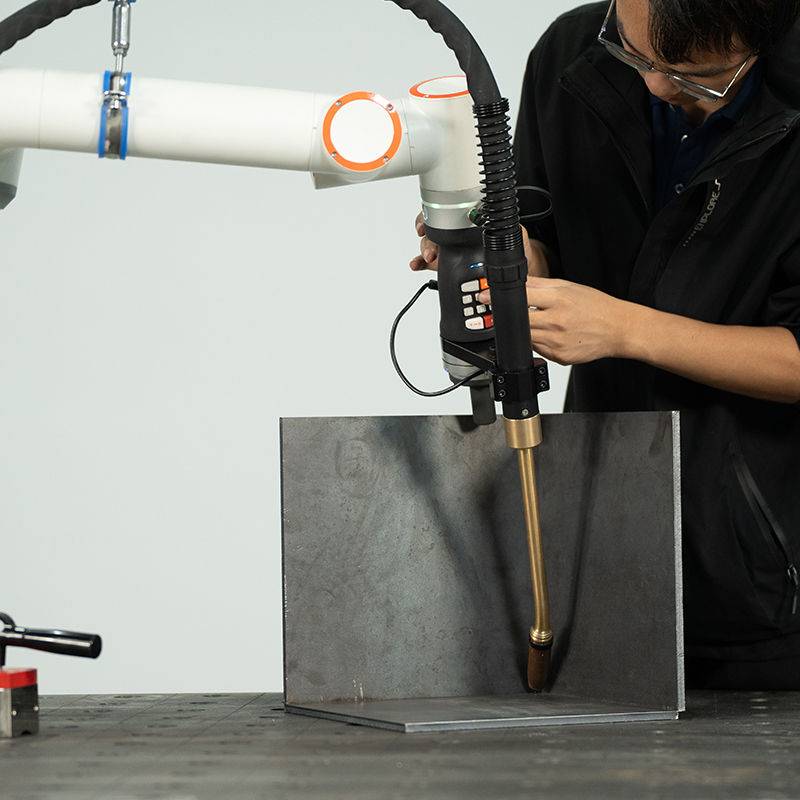
The primary advantage of Collaborative Robotics in this field deployment was the “lead-through” programming capability. Our senior welders, who have decades of experience but zero coding background, were able to manually move the cobot arm to define the weld path on complex gusset plates. By utilizing the All-in-one Cobot Station‘s integrated interface, we reduced the “programming-to-arc-on” time by 65% compared to our previous caged industrial robots.
The “All-in-one” aspect is not merely about physical size; it is about software synergy. The welding parameters (WFS, Voltage, Trim) are controlled directly from the cobot’s teach pendant. In the Monterrey field test, this allowed for real-time adjustments of the arc length as the cobot encountered slight fit-up variations common in structural steel welding.
3. Technical Deep Dive: Deep Penetration Parameters
Achieving deep penetration with a cobot requires more than just high amperage; it requires precise torch angle maintenance and consistent travel speeds that manual welders struggle to maintain over an 8-hour shift in the Mexican heat. We utilized a modified pulse-spray transfer mode to ensure root fusion on 12mm (1/2 inch) T-joints.
3.1 Weld Specification and Consumables
- Material: ASTM A572 Grade 50.
- Process: GMAW-P (Pulsed Spray Transfer).
- Consumable: ER70S-6 (1.2mm / 0.045″).
- Gas: 90% Ar / 10% CO2 (Required for the specific penetration profile in Monterrey’s high-draft environment).
- Current: 280-310 Amps.
The All-in-one Cobot Station maintained a 100% duty cycle at these parameters. The internal cooling system of the integrated power source was tested to its limit. We observed that the collaborative arm’s repeatability (±0.05mm) ensured that the arc was focused exactly at the root of the joint, which is the “make or break” factor for deep penetration in structural steel welding. Manual operators often “wander” by 1-2mm, resulting in lack of fusion (LOF) at the root; the cobot eliminated this defect entirely across 400 linear meters of welding.
4. Lessons Learned: Environmental and Technical Hurdles
4.1 Heat Dissipation and Thermal Throttling
One of the hardest lessons learned in Monterrey was the impact of ambient temperature on the All-in-one Cobot Station’s electronics. While the Collaborative Robotics arm is rated for high temperatures, the enclosed “All-in-one” cabinet accumulated heat during back-to-back 300-amp runs.
Field Fix: We had to upgrade the cabinet’s intake filters and increase the frequency of compressed air blow-outs to prevent thermal tripping. For future deployments in Mexico, we recommend an auxiliary vortex cooler for the control cabinet.
4.2 Grounding and Electrical Noise
The Monterrey facility used high-frequency overhead cranes. We initially experienced “ghost” emergency stops on the cobot. We traced this back to improper grounding of the All-in-one Cobot Station. In structural steel welding, the workpiece itself often becomes part of the ground path.
Lesson Learned: Use a dedicated copper grounding busbar for the station and ensure the cobot’s internal logic is isolated from the welding high-amperage return path. Once we isolated the signals, the “collaborative” sensors stopped triggering false collisions.
5. Safety and Collaborative Integration
The “collaborative” nature of the station was vital for the Monterrey team. Unlike traditional robots that require light curtains and physical barriers, the All-in-one Cobot Station utilized force-torque sensors. This allowed our fit-up crew to work on one end of a 15-meter beam while the cobot was welding the other end.
However, we found that “collaborative” does not mean “hazard-free.” The structural steel welding process produces significant UV and spatter. We implemented a hybrid safety zone: the cobot would slow its movement if a human entered the 2-meter proximity, but the welding arc would remain active unless a 1-meter “kill zone” was breached. This maintained productivity while adhering to local STPS (Secretaría del Trabajo y Previsión Social) safety standards.
6. Production Metrics: Manual vs. Cobot Station
Over a 30-day evaluation period, the data gathered from the All-in-one Cobot Station showed a stark contrast to manual production:
- Arc-on Time: Increased from 22% (manual) to 68% (cobot).
- Spatter Reduction: 40% reduction due to the stability of the pulsed spray transfer maintained by the cobot’s rigid torch hold.
- Rework Rate: Dropped from 8% to less than 0.5% (primarily due to the elimination of start-stop craters).
- Consumable Efficiency: 12% reduction in shielding gas waste because of the optimized pre-flow/post-flow settings in the All-in-one Cobot Station software.
7. Structural Integrity and Deep Penetration Verification
To validate the “Deep Penetration” claim, we conducted Macro-Etch tests on ten samples produced by the All-in-one Cobot Station. The results showed a consistent penetration depth of 4.2mm into the root of 10mm fillet welds, exceeding the AWS D1.1 structural code requirements.
The synergy between the Collaborative Robotics arm’s constant travel speed and the integrated power source’s adaptive arc control is what makes this possible. In manual welding, the “weave” pattern varies with welder fatigue. The cobot’s programmed weave was perfectly sinusoidal, ensuring even heat distribution and preventing the “burn-through” or “cold-lap” issues often seen in Monterrey’s afternoon shifts when fatigue sets in.
8. Final Engineering Recommendation
The deployment of the All-in-one Cobot Station in Monterrey confirms that Collaborative Robotics has matured enough to handle the rigors of heavy structural steel welding. The “All-in-one” configuration is the correct path for shops that lack the space for permanent automation or the budget for specialized robot programmers.
For the next phase, we recommend:
- Integrating a laser seam tracker to handle the ±2mm fit-up tolerances found in large-scale structural beams.
- Standardizing the 90/10 gas mix to maintain the spray transfer mode for deep penetration.
- Implementing a secondary cooling loop for the torch to support 24/7 operation in the Nuevo León climate.
The Monterrey site is now a benchmark for our North American operations. The transition from a “labor-intensive” model to a “technician-led” model via the All-in-one Cobot Station is not just a productivity gain; it is a necessary evolution in the current industrial landscape.
Report End.
Senior Welding Engineer, Field Operations.
-

LT240S tube laser cutting machine
-
LT120S tube laser cutting machine
-
Sale

Tank Fillet Welding Machine
Original price was: $1,000.00.$900.00Current price is: $900.00. -
Sale

MAK100 tube laser cutting machine
Original price was: $5,500.00.$5,000.00Current price is: $5,000.00. -

portable plasma air cutting machine
$1,200.00 -

2in1 fiber laser cutting machine
-

Air cooling Laser welding machine
-

HF h beam laser cutting machine
-

LT240 laser cutting machine
-

Laser welding machine
-

Cobotic Welding Station
-

Gantry welding robot solution
-

Tracked Wheeled AGV Welding robot
-

LFH6020 Fiber laser cutting machine
-
LFP6020
-

robotic welidng machine
Advanced Fiber Laser Tube Processing Technology
Our CNC Fiber Laser Tube Cutting systems revolutionize metal fabrication by integrating high-precision cutting, punching, and profiling into a single automated workflow. Designed for versatility, this technology handles a wide array of profiles including Round, Square, Rectangular, and Oval tubes, as well as complex L-shaped and U-shaped channels.
- Precision Punching: High-speed hole punching with micron-level accuracy, eliminating the need for mechanical drilling or die-stamping.
- Complex Profiling: Advanced 3D pathing allows for intricate interlocking joints and specialized notch cuts, ideal for structural frames.
- High Material Efficiency: Intelligent nesting software minimizes scrap, reducing raw material costs across large production runs.
- Clean Finish: Delivers oxide-free, burr-free edges that require zero secondary grinding before welding.

Seamlessly processing multiple profiles with consistent precision.
Global Delivery & Logistics



From our high-tech manufacturing facility directly to your global site. PCL WeldCut ensures secure packaging, professional handling, and reliable international logistics to safeguard your equipment throughout the entire journey.
