Fiber Laser Cutting Machine with Offline Programming for Construction Machinery
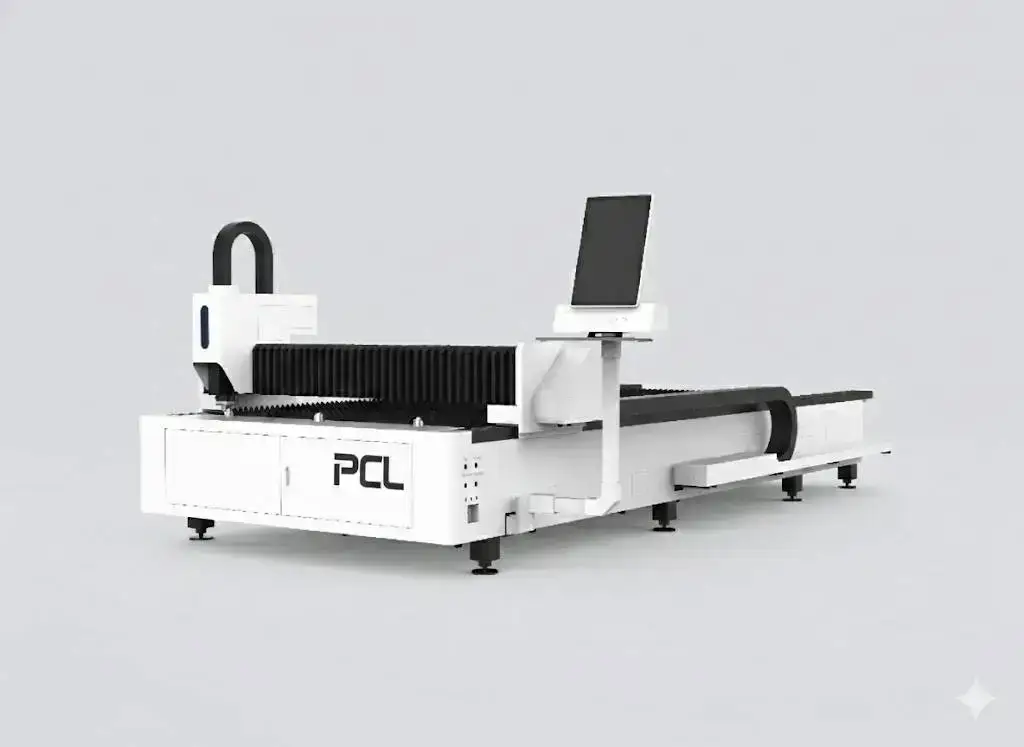
In this article
- Optimizing Construction Machinery Fabrication via Fiber Laser Systems
- Technical Superiority of Fiber Optics in Heavy Plate Processing
- Consolidated Workflow: Punching, Marking, and Cutting
- Eliminating Secondary Grinding Operations
- The Role of Offline Programming (OLP) in Production Efficiency
- Strategic Nesting and Material Utilization
- Collision Avoidance and Process Simulation
- Conclusion: Data-Driven Fabrication
Optimizing Construction Machinery Fabrication via Fiber Laser Systems
The fabrication of heavy-duty construction machinery—including excavators, cranes, and earth-moving equipment—demands a rigorous focus on structural integrity and dimensional accuracy. Traditionally, the industry relied on multi-step processes involving mechanical punching and thermal cutting, often followed by labor-intensive finishing. However, the adoption of high-wattage Fiber Laser Cutting technology has redefined these workflows. By utilizing a solid-state laser source transmitted through flexible fiber optics, manufacturers achieve a power density that allows for rapid vaporization of high-strength steel, resulting in narrow kerf widths and minimal thermal distortion.
Technical Superiority of Fiber Optics in Heavy Plate Processing
Fiber lasers operate at a wavelength of approximately 1.06 microns. This specific wavelength is highly absorbable by industrial metals, particularly the high-tensile carbon steels common in construction machinery frames. From an industrial engineering perspective, the efficiency of the fiber laser is rooted in its “wall-plug” efficiency, which significantly exceeds that of legacy CO2 systems. For the production of boom sections or chassis plates, this translates to higher feed rates and lower energy consumption per meter of cut.
The beam quality of a fiber laser remains consistent over long distances, which is critical when processing the large-format sheets (often exceeding 12 meters) required in heavy equipment manufacturing. The precision of the motion system, combined with the focused energy of the laser, ensures that holes, slots, and complex geometries are cut with a tolerance of +/- 0.1mm. This level of precision is vital for the subsequent assembly phases, where bolt-hole alignment and interlocking tabs must be perfect to ensure structural safety under dynamic loads.
Consolidated Workflow: Punching, Marking, and Cutting
One of the primary advantages of modern fiber laser centers is the ability to perform multiple operations in a single setup. In the context of Construction Machinery, a single component often requires identification numbers for traceability, pilot holes for assembly, and complex outer profiles. The fiber laser head can be modulated to perform these tasks sequentially without manual intervention.
Precision Marking for Traceability
Using low-power pulses, the laser can etch part numbers, fold lines, and QR codes directly onto the plate surface. This eliminates the need for manual stamping or inkjet marking, which are prone to error or degradation during subsequent shot-blasting processes. The permanence of laser marking ensures that every component is traceable throughout the entire lifecycle of the machine.
Integrated Hole Punching and Cutting
Instead of moving a heavy plate to a dedicated punching station, the fiber laser creates high-precision holes. Because the laser does not exert mechanical force on the material, there is no risk of plate deformation or tool wear. For thick-plate applications, specialized piercing cycles—utilizing multi-stage oxygen or nitrogen bursts—allow the laser to “punch” through material cleanly, creating a starting point for the cut that is free of slag or excessive splatter.
Eliminating Secondary Grinding Operations
In traditional thermal cutting methods, the resulting edge often features dross (hardened slag) and a significant Heat-Affected Zone (HAZ). This necessitates a secondary grinding stage to clean the edges and prepare them for assembly. Fiber laser cutting, particularly when optimized with high-pressure assist gases, produces a clean, square edge that is virtually dross-free. This “ready-to-use” edge quality is a cornerstone of Lean Manufacturing within the heavy equipment sector.
By removing the grinding station from the production flow, an industrial engineer can significantly reduce the “Work-in-Process” (WIP) inventory. The elimination of grinding also improves the safety of the shop floor by reducing airborne metallic dust and noise pollution. More importantly, it ensures that the mechanical properties of the high-strength steel remain intact, as the localized heat of the fiber laser is too brief to cause significant metallurgical changes in the surrounding material.
The Role of Offline Programming (OLP) in Production Efficiency
To fully leverage the speed of a fiber laser, the “bottleneck” must be moved from the machine controller to the engineering office. Offline Programming allows engineers to generate cutting paths, nesting layouts, and process parameters without halting the machine’s operation. This separation of “thinking” and “doing” is essential for maintaining high OEE (Overall Equipment Effectiveness) scores.
Strategic Nesting and Material Utilization
Construction machinery parts are often large and irregularly shaped. OLP software uses sophisticated algorithms to perform “true-shape nesting,” fitting parts together like a jigsaw puzzle to maximize Material Utilization. Given that material costs can represent up to 70% of the total cost of a fabricated component, even a 2% or 3% increase in nesting efficiency can result in six-figure annual savings. OLP software can also manage “remnant” tracking, ensuring that off-cuts are cataloged and used for smaller brackets or gussets in future runs.
Collision Avoidance and Process Simulation
High-speed laser heads move at rapid traverse speeds often exceeding 100 meters per minute. At these speeds, any collision with a tipped-up part can result in catastrophic damage to the laser head and significant downtime. OLP software provides a 3D simulation environment where the programmer can visualize the cutting sequence. The software automatically calculates “smart” head-up moves and avoids paths over previously cut parts, ensuring the machine runs autonomously during lights-out shifts without risk of collision.
Digital Twin Integration
Advanced OLP systems create a “Digital Twin” of the laser cutting machine. This model includes the exact kinematics, acceleration curves, and gas pressure response times of the physical equipment. By simulating the process in a virtual environment, the industrial engineer can provide highly accurate cost estimates and production timelines before the first sheet of steel is even loaded onto the shuttle table. This predictability is crucial for Just-In-Time (JIT) manufacturing schedules common in modern assembly plants.
Conclusion: Data-Driven Fabrication
The synergy between high-power fiber laser hardware and offline programming software represents the current pinnacle of plate fabrication technology for the construction machinery industry. By focusing on high-precision cutting and the elimination of secondary processes like grinding, manufacturers can drastically reduce cycle times. The transition to OLP ensures that the machine remains a productive asset rather than a programming terminal, allowing for a data-driven approach to manufacturing that emphasizes speed, accuracy, and minimum waste. As material costs and labor shortages continue to challenge the sector, the efficiency of the fiber laser remains a vital competitive advantage.






