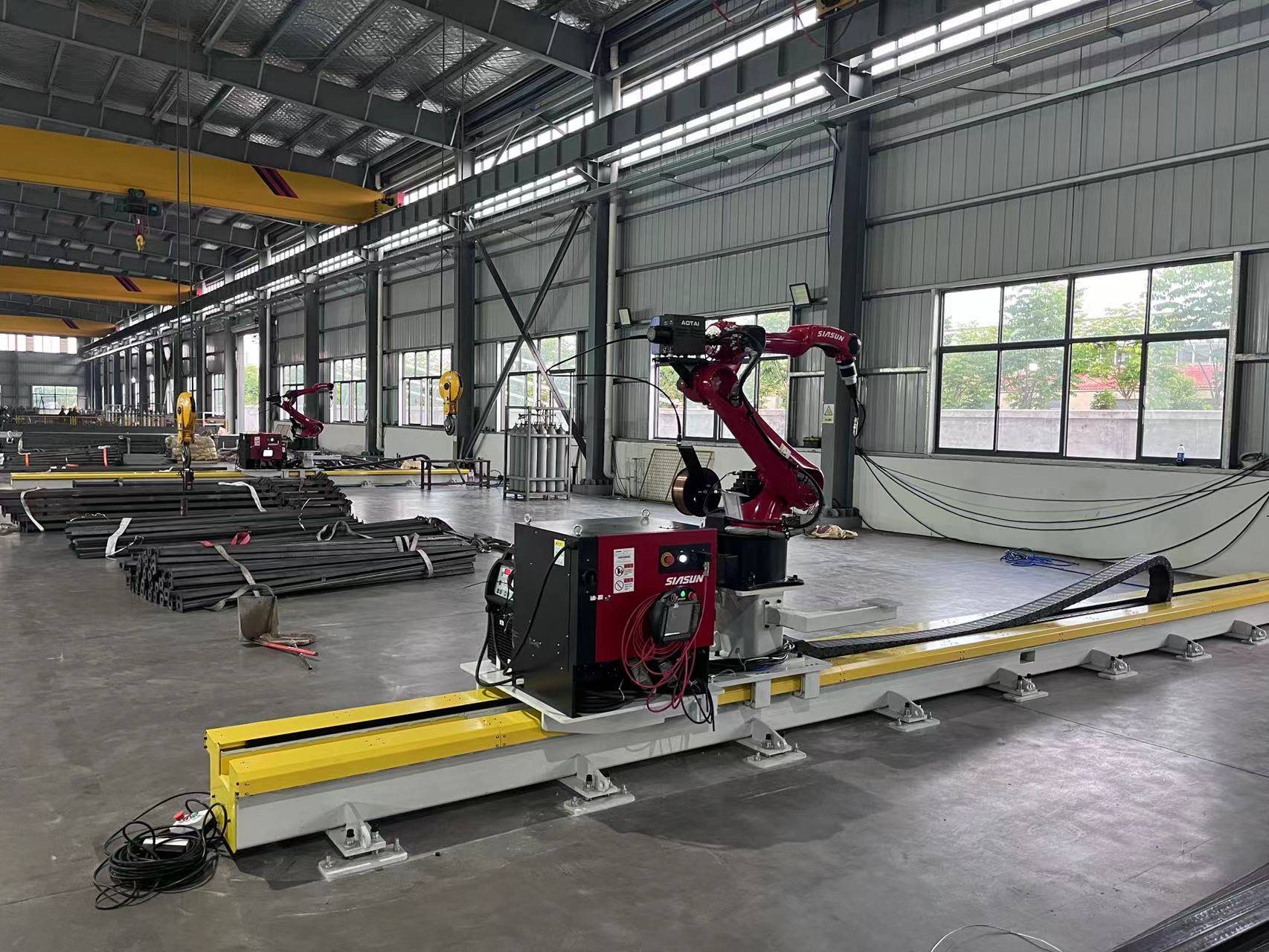
Intelligent Robotic Welder with 5-Axis Beveling for Bridge Trusses

In this article
Strategic Integration of 5-Axis Robotic MAG Systems
Bridge truss fabrication demands high-integrity structural joints capable of enduring cyclical loading and environmental stress. Traditionally, the complexity of truss geometries required highly skilled manual welders to navigate the tight angles and varying bevels inherent in heavy-duty steel connections. The introduction of the Intelligent Robotic Welder with 5-axis capabilities marks a shift from manual variability to algorithmic precision. Unlike standard 3-axis systems, the 5-axis configuration allows the torch to maintain an optimal work and travel angle even when encountering complex, multi-plane bevel geometries common in bridge chords and diagonals.
Optimizing the MAG Welding Process for Heavy Plate
The core of the robotic cell is the Metal Active Gas (MAG) process. For bridge applications, using an 80/20 Argon/CO2 shielding gas mixture is standard to balance penetration depth with spatter control. The intelligent system manages the power source through synergic pulse programs that adjust voltage and wire feed speed in real-time. This is critical for Bridge Trusses where plate thickness can vary significantly across a single span.
Deposition Rates and Arc-On Time
Industrial engineering metrics emphasize the “Arc-On” time as a primary KPI. Manual welding in heavy fabrication rarely exceeds a 30% duty cycle due to fatigue, repositioning, and slag removal. A robotic MAG system, however, can achieve an arc-on time of 75% to 85%. By utilizing 5-axis articulation, the robot can execute continuous multi-pass welds on beveled joints without stopping for manual torch repositioning. This increases the deposition rate—measured in pounds of weld metal per hour—by nearly 300% compared to manual Stick (SMAW) or semi-automatic Flux-Cored (FCAW) processes.
Adaptive Beveling and 5-Axis Articulation
The “Intelligent” component of these systems refers to Adaptive Arc Sensing. In bridge construction, fit-up tolerances are never perfect. Gaps and bevel angles may deviate from the blueprint by several millimeters. A 5-axis robotic system uses “through-the-arc” sensing or tactile probing to identify the actual groove geometry before and during the weld sequence.
Dynamic Torch Positioning
The 5th axis of the robotic wrist is the differentiator. It allows the torch to rotate around its own axis, ensuring the nozzle remains equidistant from the sidewalls of a V-groove. This prevents “undercut” and “lack of fusion” defects that typically occur at the toes of the weld. For bridge trusses, where AWS D1.5 compliance is mandatory, the ability to maintain a consistent heat-affected zone (HAZ) through precise torch manipulation is vital for passing ultrasonic and radiographic testing.
Preventative Maintenance for High-Volume Cells
From an operational standpoint, the reliability of a robotic welder is only as good as its maintenance schedule. In a high-duty cycle environment like bridge fabrication, consumables are the primary point of failure.
Daily and Weekly PM Protocols
1. Contact Tip Inspection: The contact tip is the final point of electrical transfer to the wire. Even minor wear (keyholing) can cause arc instability. In a robotic cell, tips should be replaced every 8-12 hours of arc time to prevent rework.
2. Nozzle Cleaning: Automated reamer stations must be programmed to clean the nozzle every 30-60 minutes. This prevents spatter buildup that disrupts shielding gas flow.
3. Wire Feed Liners: Every 500 lbs of wire, the liners should be blown out or replaced. Friction in the liner leads to “bird-nesting” at the drive rolls, which causes expensive downtime.
4. Calibration of the 5-Axis Wrist: Monthly checks of the Tool Center Point (TCP) ensure that the robot’s digital twin aligns with its physical reality. A deviation of even 1mm can lead to a rejected weld on a critical bridge joint.
2. Nozzle Cleaning: Automated reamer stations must be programmed to clean the nozzle every 30-60 minutes. This prevents spatter buildup that disrupts shielding gas flow.
3. Wire Feed Liners: Every 500 lbs of wire, the liners should be blown out or replaced. Friction in the liner leads to “bird-nesting” at the drive rolls, which causes expensive downtime.
4. Calibration of the 5-Axis Wrist: Monthly checks of the Tool Center Point (TCP) ensure that the robot’s digital twin aligns with its physical reality. A deviation of even 1mm can lead to a rejected weld on a critical bridge joint.
Economic Analysis and Labor ROI
The justification for a Robotic Bridge Truss welding system is found in the reduction of “Cost Per Foot” of weld. While the initial capital expenditure (CAPEX) for a 5-axis intelligent cell is high, the return on investment (ROI) is realized through three main avenues: labor reallocation, scrap reduction, and consumable efficiency.
Labor Reallocation vs. Elimination
Industrial engineers view robotic integration not as labor elimination but as labor upskilling. A single operator can manage two robotic cells simultaneously. This doubles the output per man-hour. In the context of bridge fabrication, where certified welders are increasingly scarce, the robot handles the “dull, dirty, and dangerous” long-seam welds, while the human specialist focuses on complex fit-ups and final quality inspection.
The Value of Consistency
Manual welding always involves a degree of over-welding to ensure safety margins. If a 10mm fillet is required, a manual welder might lay down 12mm to be safe. This 20% “over-weld” represents a massive waste of filler metal and shielding gas over the course of a multi-ton bridge project. An intelligent robot executes the exact 10mm leg length specified, resulting in a 15-20% reduction in Filler Metal Consumption.
Implementation Strategy for Structural Steel Facilities
Success in deploying these systems requires a phased approach. First, the facility must standardize its upstream fit-up processes. Robotics cannot compensate for gross negligence in material preparation. Second, the programming must utilize “Parametric Programming,” where the operator inputs variables (plate thickness, length) rather than writing lines of code for every new truss member.
Total Cost of Ownership (TCO) Considerations
The TCO includes power consumption, gas, wire, replacement parts, and the salary of a robotic technician. For bridge trusses, the ROI is typically achieved within 18 to 24 months, assuming a two-shift operation. The longevity of the asset, often exceeding 10 years, provides a long-term competitive advantage for government infrastructure tenders that demand both low cost and high quality-assurance documentation.
Conclusion
The transition to intelligent 5-axis robotic MAG welding is no longer optional for fabricators targeting large-scale infrastructure projects. By focusing on the precision of 5-axis torch manipulation and the data-driven efficiency of the MAG process, industrial engineers can stabilize production timelines and ensure that every truss meets the stringent safety requirements of modern bridge design. Maintenance rigor and a clear understanding of deposition ROI are the keys to transforming this technology from a capital expense into a profit engine.