Engineering Review: Water-cooled Fiber Laser Cobot – Queretaro, Mexico
In this article
- Field Engineering Report: Fiber Laser Cobot Integration
- Location: Queretaro, Mexico – Industrial Park El Marqués
- Synergy: Laser Technology and Collaborative Robotics
- The Fiber Laser Cobot Advantage
- Technical Specifications of the Fiber Source
- Application Deep Dive: Thin Metal Sheet Welding
- Overcoming Thermal Distortion
- Practical Lessons: The Queretaro Field Experience
- Water-Cooling and Humidity Management
- Shielding Gas Dynamics
- Operational Impact and ROI
- Throughput Metrics
- Safety and Skill Gap Mitigation
- Maintenance Protocols for the Queretaro Facility
Field Engineering Report: Fiber Laser Cobot Integration
Location: Queretaro, Mexico – Industrial Park El Marqués
Project Overview and Environmental Constraints
This report documents the commissioning and performance evaluation of a water-cooled 1.5kW Fiber Laser Cobot system at a Tier-2 automotive supplier facility in Queretaro. The primary objective was to transition from manual GTAW (TIG) to automated Laser Technology for the assembly of 304 stainless steel and 5052 aluminum components. Thin Metal Sheet welding (0.8mm to 1.5mm) had previously resulted in unacceptable levels of thermal distortion and post-weld rework.
The Queretaro environment presents specific challenges for high-precision laser equipment. At an altitude of approximately 1,820 meters, air density is lower, which impacts the heat exchange efficiency of traditional air-cooled systems. Consequently, we deployed a dual-circuit water-cooled unit to maintain the fiber source and the laser head at a delta-T of +/- 1°C, ensuring beam stability during 8-hour production shifts.
Synergy: Laser Technology and Collaborative Robotics
The Fiber Laser Cobot Advantage
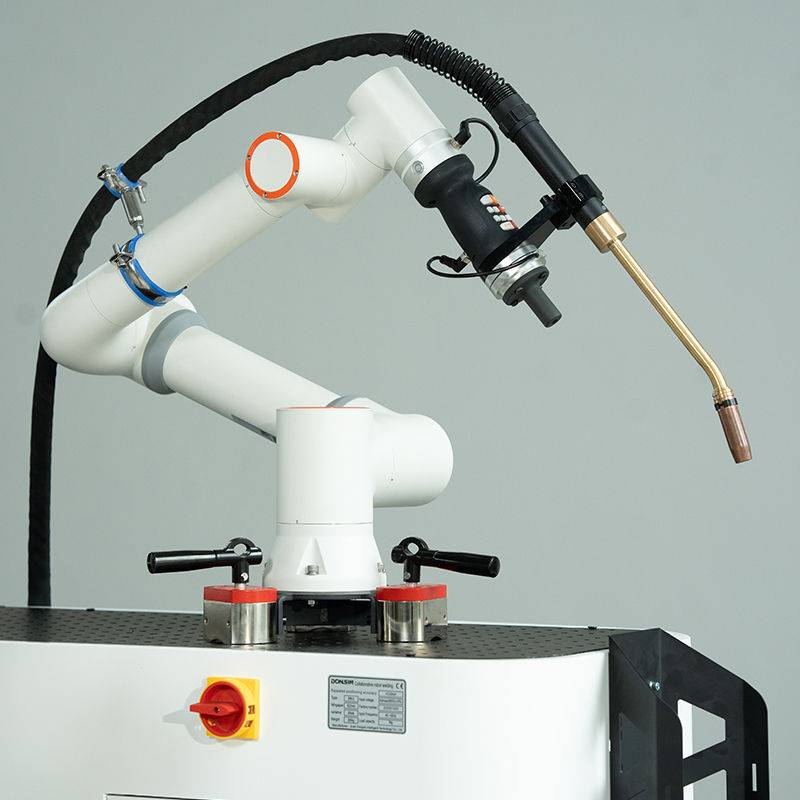
The core innovation in this deployment is the marriage of a high-brightness fiber source with a 6-axis collaborative arm. In the Queretaro workshop, the Fiber Laser Cobot replaces the rigid, expensive guarding required by traditional high-speed industrial robots with a more flexible, localized safety approach. By utilizing a “Laser-Safe” enclosure with interlocked OD7+ viewing windows, we integrated the system into an existing manual assembly line without a total floor-plan overhaul.
The technical synergy lies in the cobot’s ability to maintain a constant Stand-Off Distance (SOD). In Thin Metal Sheet welding, a variance of even 0.5mm in focal position can lead to inconsistent penetration or cutting of the substrate. The cobot’s repeatability (±0.03mm) ensures the Laser Technology operates within its optimal Rayleigh range, maintaining a consistent power density at the workpiece.
Technical Specifications of the Fiber Source
We utilized a continuous wave (CW) fiber laser with a 50μm delivery fiber. The choice of a smaller core diameter was intentional; it provides a high-energy density profile that allows for faster travel speeds (up to 80mm/s on 1.0mm stainless) while minimizing the Heat Affected Zone (HAZ). This is critical for the thin-gauge applications typical of Queretaro’s aerospace and medical device clusters.
Application Deep Dive: Thin Metal Sheet Welding
Overcoming Thermal Distortion
The primary pain point identified by the local engineering team was the “oil-canning” effect—warping of the metal sheets due to excessive heat input. Manual TIG welding requires significant dwell time to establish a puddle. In contrast, the Fiber Laser Cobot utilizes a “wobble” function. By oscillating the beam in a circular or “C” pattern at frequencies between 150Hz and 300Hz, we can bridge larger gaps (up to 0.5mm) while maintaining a high travel speed.
Wobble Parameters for 1.2mm 304 Stainless:
- Power: 1200W (Peak)
- Wobble Width: 1.5mm
- Wobble Frequency: 200Hz
- Speed: 45mm/s
- Shielding Gas: Nitrogen at 15 L/min
These parameters resulted in a weld bead that required zero post-process grinding. The reduction in total heat input preserved the structural integrity of the Thin Metal Sheet welding assembly, keeping the parts within the tight ±0.2mm dimensional tolerances required by the client.
Practical Lessons: The Queretaro Field Experience
Water-Cooling and Humidity Management
During the first week of operation, we encountered an issue with condensation on the protective lens. Queretaro’s rainy season can lead to localized humidity spikes within the plant. Because the Fiber Laser Cobot uses a water-cooled chiller, the laser head temperature was initially set too low (18°C), falling below the dew point. Lesson Learned: We adjusted the chiller setpoint to 24°C, aligning with the ambient shop temperature while still remaining well within the laser source’s operating envelope. This eliminated the condensation risk without compromising the Laser Technology‘s duty cycle.
Shielding Gas Dynamics
We found that the local supply of Argon in Queretaro occasionally varied in purity. For Thin Metal Sheet welding on aluminum, gas purity is non-negotiable to prevent porosity. We installed an inline 0.01-micron filter and a gas mixer to allow for a 5% Helium / 95% Argon blend. This small addition of Helium increased the ionization potential, leading to a more stable plasma plume and deeper, narrower penetration in the 5052 aluminum alloy.
Cobot Programming and Path Accuracy
A common mistake in cobot deployment is assuming the lead-through teaching (hand-guiding) is sufficient for laser applications. While lead-through is fine for palletizing, Laser Technology requires sub-millimeter path accuracy. In this field application, we used the cobot’s “Touch Sensing” software to recalibrate the tool center point (TCP) every 100 cycles. This accounted for any slight physical shifts in the jigging or the cobot base, ensuring the Fiber Laser Cobot stayed centered on the seam.
Operational Impact and ROI
Throughput Metrics
Prior to the installation of the Fiber Laser Cobot, the production of a single electronic enclosure (comprising 14 individual welds) took a skilled welder 12 minutes. The cobot now completes the cycle in 85 seconds. This includes the load/unload time, as the cobot allows the operator to prep the next fixture while the laser is active.
Safety and Skill Gap Mitigation
The Queretaro labor market is currently experiencing a shortage of certified TIG welders. By leveraging Laser Technology, the facility was able to upskill existing operators. The operators no longer need to master the hand-eye coordination of filler rod manipulation; instead, they manage the parameters of the Fiber Laser Cobot. This shift from “manual labor” to “technician-level oversight” has improved employee retention and reduced workplace injuries related to arc flash and repetitive motion.
Maintenance Protocols for the Queretaro Facility
Given the dust levels typical of an industrial park near semi-arid terrain, we implemented a rigorous maintenance schedule for the Fiber Laser Cobot:
- Daily: Inspection of the protective window. Any dust particles can lead to “thermal lensing,” where the window absorbs laser energy, heats up, and shifts the focus or cracks.
- Weekly: Chiller water conductivity test. We use deionized water with a specialized algaecide to prevent internal scaling within the fiber source’s cooling channels.
- Monthly: Beam alignment verification. Although the fiber is fixed, the internal optics in the wobble head can shift due to vibration.
Conclusion
The deployment of the water-cooled Fiber Laser Cobot in Queretaro demonstrates that Laser Technology is no longer confined to high-cost, static cells. For Thin Metal Sheet welding, the precision and low heat input of the fiber source, combined with the versatility of a collaborative arm, provide a clear path to scaling production without the typical distortion issues of arc welding. The project is considered a success, with a projected ROI of 14 months based on current throughput increases and the elimination of scrap parts.
Future iterations will look into integrating a seam-tracking vision system to further automate the Fiber Laser Cobot for variable-gap applications, though the current fixturing has proven sufficient for the current product mix.





