Intelligent Robotic Welder with 5-Axis Beveling for Shipbuilding

In this article
Kinematic Advantages of 5-Axis Robotic MAG Welding in Maritime Structures
In shipbuilding, the structural integrity of heavy-plate sections depends on the precision of multi-pass welds within complex joint geometries. The integration of automated shipbuilding welding systems utilizing 5-axis torch manipulation allows for superior torch positioning compared to standard 3-axis or 6-axis configurations that lack specialized kinematics for deep-groove access. By leveraging a 5-axis approach specifically for the welding head, the system maintains the optimal work angle and travel angle throughout the entire length of a curved hull section or internal bulkhead.
The primary advantage of this intelligence lies in the robot’s ability to execute complex “weave” patterns and multi-layer fills in V, U, and J-groove preparations. Traditional manual welding often suffers from inconsistent penetration at the root pass, particularly when the welder must adjust their body position. A 5-axis robotic system eliminates this human variable, ensuring that the Metal Active Gas (MAG) torch is always orthogonal to the weld pool, regardless of the hull’s curvature.
High-Deposition MAG Processes and Parameter Control
Shipbuilding requires high volumes of filler metal. Intelligent robotic systems utilize advanced 5-axis robotic MAG waveforms, such as pulsed-arc or spray-transfer modes, to maximize deposition rates while minimizing spatter. The controller dynamically adjusts wire feed speeds and voltage in real-time based on the feedback from through-arc seam tracking sensors. This ensures that even if there are slight deviations in the fit-up of heavy plates—a common occurrence in large-scale ship blocks—the robot compensates by modifying the oscillation width or travel speed.
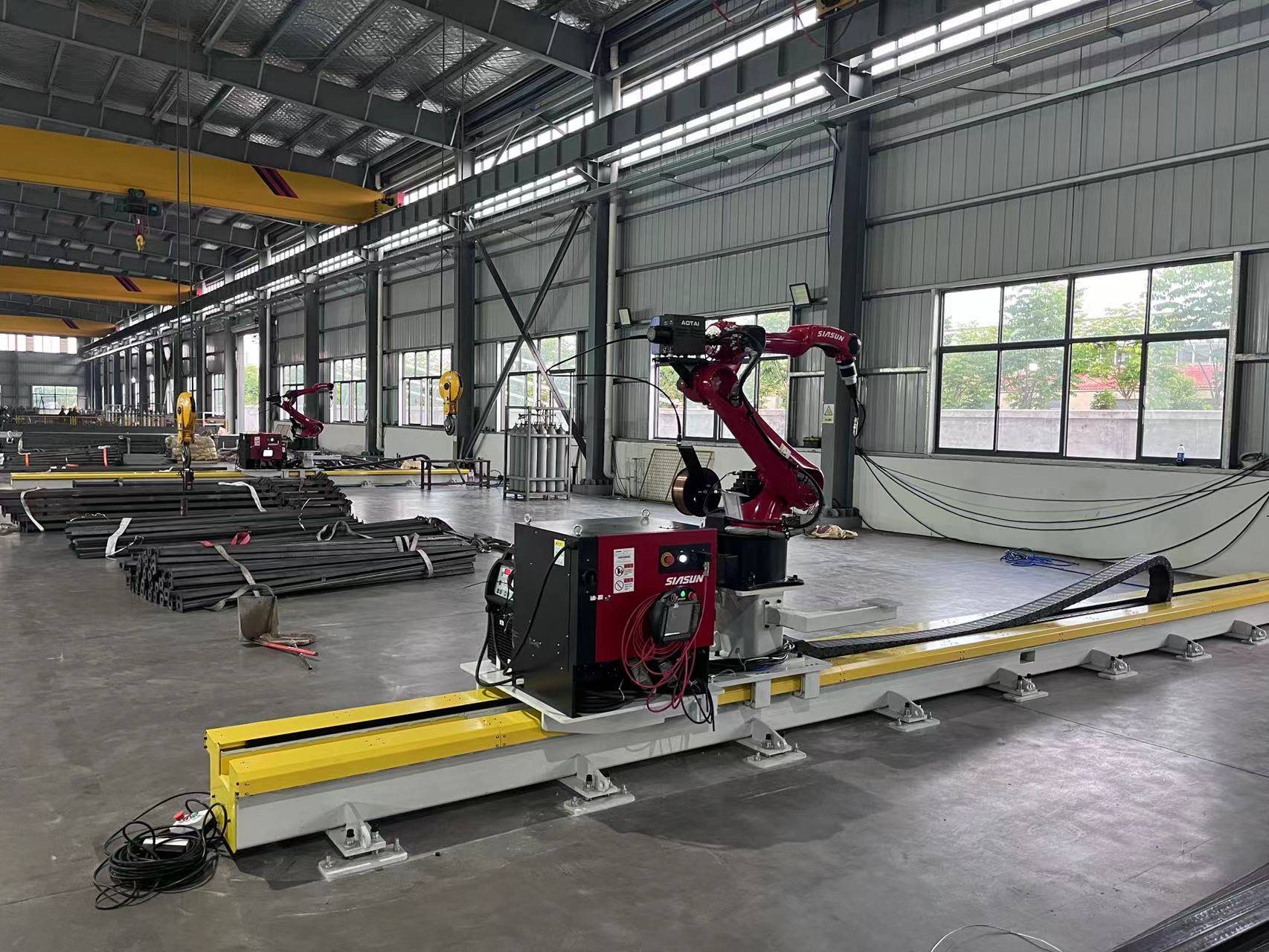
From an industrial engineering perspective, the transition to robotic MAG welding increases the “arc-on” time from a typical manual average of 20-30% to upwards of 75-85%. This massive jump in duty cycle is achieved through water-cooled torch systems that can handle continuous operation at 400-600 Amps. The consistency of the gas shield is also managed through automated flow regulators, reducing porosity risks that lead to costly rework.
Predictive Maintenance and Consumable Management
System uptime is the most critical metric in a high-throughput shipyard. Intelligent Robotic Welders are equipped with diagnostic software that monitors the health of the welding circuit. Maintenance protocols are shifted from reactive to predictive by tracking parameters such as motor current in the wire feeder and contact tip wear. An increase in friction within the liner or a micro-arcing event in the contact tip is flagged by the system before it results in a weld defect.
To maintain heavy plate weld deposition standards, automated torch cleaning stations are integrated into the work cell. At predetermined intervals—typically between major seam completions—the robot performs a mechanical reaming of the gas nozzle, applies anti-spatter compound, and performs a wire-cut to ensure a clean arc start. This level of maintenance ensures that the tool center point (TCP) remains accurate to within sub-millimeter tolerances, which is essential for maintaining the integrity of the root pass in structural welds.
Calculating Labor ROI and Throughput Scalability
The economic justification for intelligent robotic welders in shipbuilding is driven by the widening gap in skilled labor availability. A certified maritime welder represents a high overhead cost, including training, certification, and safety equipment. A single robotic operator can oversee multiple 5-axis welding cells, effectively tripling or quadrupling the output per man-hour. However, the true Robotic Welding ROI is found in the reduction of Non-Destructive Testing (NDT) failures.
Manual welding in cramped double-bottom sections or vertical-up hull joins is prone to slag inclusions or lack of fusion. Robotic systems, with their steady travel speeds and precise heat input control, produce welds that consistently pass X-ray and ultrasonic inspections. When calculating ROI, engineers must factor in the cost of “carbon arc gouging” and repairing a single failed weld, which can cost five times as much as the initial weld. By reducing the failure rate from 5% (manual) to under 0.5% (robotic), the system pays for itself within the first 12 to 18 months of operation.
Integration with Digital Twin and Offline Programming
Modern shipbuilding utilizes CAD/CAM workflows where the ship’s design is translated into welding paths via offline programming (OLP). This removes the need for “teaching” the robot on the shop floor, which would otherwise halt production. Industrial engineers can simulate the 5-axis movements to check for collisions in tight structural pockets before the first arc is struck. This digital integration allows for a seamless transition between different ship blocks, making the robotic cell versatile enough for both container ships and specialized naval vessels.
The data collected during the welding process—heat input, gas flow, and wire consumption—is logged for every centimeter of the weld. This creates a “birth certificate” for every joint, providing total traceability. In the event of a long-term structural failure, the shipyard can review the digital logs to confirm that the welding parameters stayed within the specified Welding Procedure Specification (WPS) limits, providing a layer of legal and quality assurance that is impossible to achieve with manual labor.
Technical Specifications for Maritime MAG Welding Units
To operate effectively in a shipyard environment, the robotic hardware must meet specific industrial standards. The power source should be an inverter-based multi-process welder capable of high-speed communication with the robot controller (e.g., via EtherNet/IP or DeviceNet). The 5-axis manipulator must have an IP67 rating to withstand the dust and metallic particles inherent in heavy fabrication shops. Furthermore, the wire delivery system must be capable of pulling from 500kg bulk drums to minimize the downtime associated with spool changes.
By focusing on these technical pillars—kinematic precision, parameter control, predictive maintenance, and data-driven ROI—shipyards can successfully navigate the transition to automated fabrication. The implementation of 5-axis robotic MAG welding is not merely a tool upgrade; it is a fundamental shift in maritime production engineering that ensures structural reliability and global competitiveness.






