Intelligent Robotic Welder with Zero-tailing technology for LNG Projects

In this article
- Technical Overview of Robotic MAG Welding in LNG Infrastructure
- Mechanical Implementation of Zero-Tailing Technology
- Optimization of MAG Parameters for Cryogenic Services
- Labor ROI and Economic Impact Analysis
- Maintenance Protocols for Robotic Welding Systems
- Integration within LNG Project Logistics
- Safety and Risk Mitigation
- Final Engineering Considerations
Technical Overview of Robotic MAG Welding in LNG Infrastructure
The construction of Liquefied Natural Gas (LNG) terminals and storage tanks demands unprecedented precision in structural integrity. Industrial engineers are increasingly pivoting toward Robotic Welding systems to manage the complexities of cryogenic material joining. Unlike manual operations, these intelligent systems utilize MAG welding (Metal Active Gas) to ensure deep penetration and high-quality fusion in carbon and stainless steel alloys. The primary driver for this shift is the need for consistent bead morphology and mechanical properties that can withstand thermal cycling at -162 degrees Celsius.
Mechanical Implementation of Zero-Tailing Technology
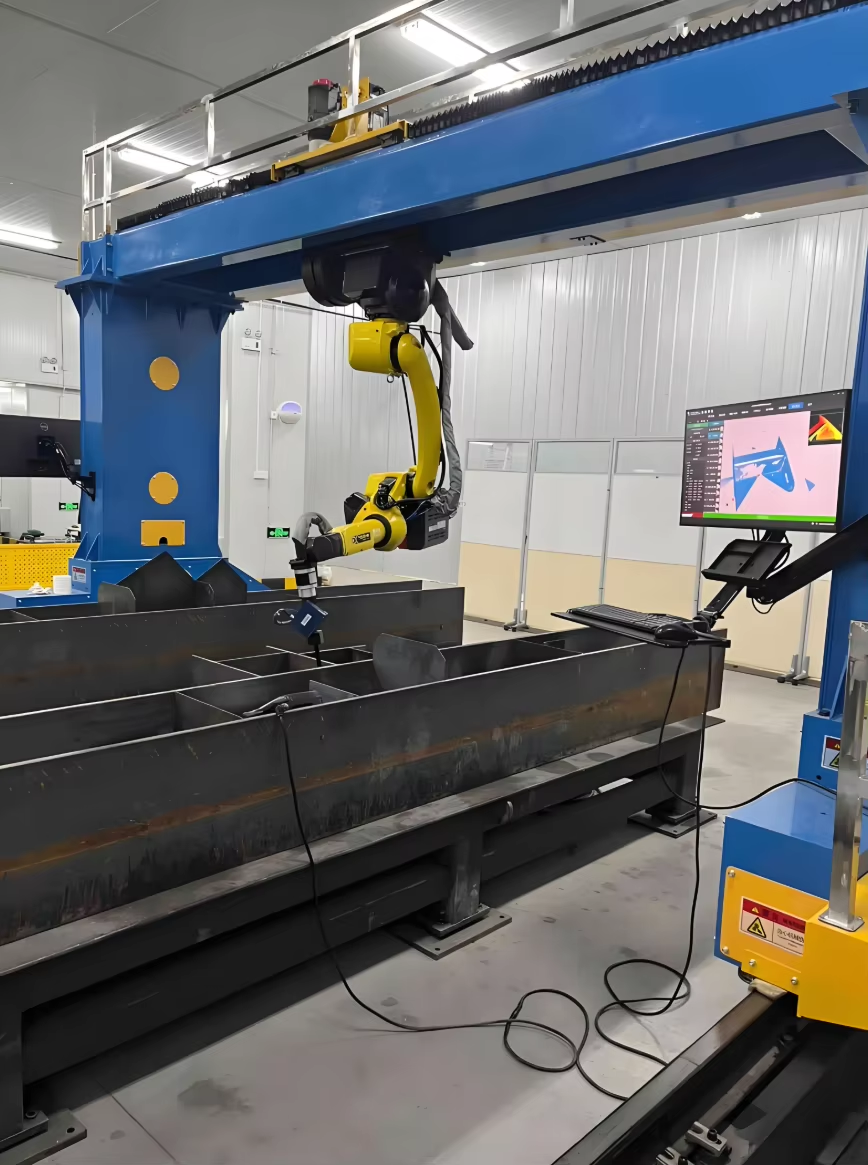
In high-volume LNG pipe spool fabrication, material waste is a significant cost factor. Zero-tailing technology refers to the advanced control of the welding wire at the termination of the arc. In traditional automated systems, “burn-back” or excess wire protrusion often results in wasted consumables and potential contamination of the next weld start. Intelligent Robotic Welders now utilize high-speed encoders and synchronized wire-feed braking to ensure the wire retracts precisely to the contact tip.
By eliminating the “tail” or the short segment of unused wire often clipped manually between cycles, the system achieves a 3-5% reduction in total consumable expenditure. More importantly, it ensures a clean restart, which is critical for the X-ray quality welds required in high-pressure gas lines. This precision reduces the necessity for post-weld grinding and ensures that the heat-affected zone (HAZ) remains within calculated engineering tolerances.
Optimization of MAG Parameters for Cryogenic Services
The Metal Active Gas process in robotic applications for LNG Projects is optimized through synergic control. The power source communicates with the robot controller to adjust wire feed speed and voltage in real-time. For LNG applications, 80/20 Argon-CO2 mixes are common, but the robotic system allows for pulsed-arc transitions that minimize spatter.
Thermal Management and Duty Cycle
A primary advantage of the robotic cell is the 100% duty cycle capability. Manual welders must manage heat buildup and physical fatigue, leading to intermittent welding. The robot maintains a constant travel speed, which stabilizes the heat input per unit length. This consistency is vital for maintaining the notch toughness of the base metal, particularly in 9% Nickel steel plates used for LNG tank inner shells.
Labor ROI and Economic Impact Analysis
The transition to intelligent robotic welding is primarily justified through a rigorous labor ROI calculation. The global shortage of certified 6G welders has driven labor costs to an inflection point where automation is no longer an option but a fiscal necessity.
| Metric | Manual Welding (Per Shift) | Robotic System (Per Shift) |
|---|---|---|
| Arc-On Time Efficiency | 35-45% | 75-85% |
| Defect Rate (Repair %) | 5-8% | <1.5% |
| Consumable Waste | High (Manual Clipping) | Near Zero (Zero-Tailing) |
| Labor Requirements | 2 Highly Skilled Welders | 1 Operator (Technician) |
The Return on Investment is realized within 14 to 22 months on large-scale LNG projects. The reduction in repair rates is the most significant contributor to ROI. In LNG tank construction, the cost of repairing a weld defect found by ultrasonic testing is approximately 10 to 15 times the cost of the initial weld. By utilizing robotic precision, the “first-time-through” rate increases, drastically reducing the logistical overhead of re-work.
Maintenance Protocols for Robotic Welding Systems
To maintain the high OEE (Overall Equipment Effectiveness) required for LNG timelines, a preventative maintenance schedule is mandatory. Unlike manual torches, robotic MAG torches are subject to higher thermal stress due to prolonged arc-on times.
Daily and Weekly Maintenance Tasks
Daily inspections focus on the wire drive rollers and the contact tip. Wear in the contact tip can lead to arc instability, which negates the benefits of the intelligent controller. Automated nozzle cleaning stations are integrated into the cell to perform “reaming” every 30-60 minutes of arc time. This prevents spatter buildup that could obstruct the shielding gas flow.
Predictive Maintenance and Sensor Integration
Advanced units now incorporate IoT sensors that monitor motor torque in the wire feeder. An increase in torque often indicates debris buildup in the liner or a tangling wire spool. By identifying these trends before a failure occurs, maintenance teams can schedule interventions during shift changes, ensuring that the critical path of the LNG project is not delayed.
Integration within LNG Project Logistics
Deploying these systems on-site at an LNG terminal requires a modular approach. Portable robotic “tractors” or track-mounted systems are used for the circumferential seams of storage tanks. These units are programmed with Zero-tailing technology to handle the long continuous welds required for tank shells.
The integration of digital twin software allows industrial engineers to simulate the welding sequence before the robot is deployed. This ensures that the robot’s arm kinematics do not conflict with the scaffolding or internal bracing of the LNG structures. By simulating the MAG process parameters, engineers can predict the deformation and shrinkage of the plates, allowing for pre-compensation in the fit-up stage.
Safety and Risk Mitigation
Robotic systems move the human operator away from the immediate vicinity of the welding arc, reducing exposure to hexavalent chromium and other hazardous fumes associated with high-alloy MAG welding. In the confined spaces often found in LNG modules, this distance is a critical safety advantage. Furthermore, the intelligent welder’s ability to detect “burn-through” or loss of shielding gas and immediately abort the process prevents catastrophic failures in pressurized components.
Final Engineering Considerations
The implementation of intelligent robotic MAG welding represents a paradigm shift in how LNG infrastructure is built. By focusing on the precision of the arc termination through zero-tailing and the consistency of the deposition rate, project managers can achieve a level of quality control that manual processes cannot match. The economic transition from a labor-heavy model to a capital-intensive, high-efficiency model is supported by the quantifiable improvements in ROI, consumable savings, and the drastic reduction in metallurgical defects. As LNG demand continues to grow, the ability to scale production through these robotic systems will be the primary differentiator for successful EPC (Engineering, Procurement, and Construction) firms.






