Engineering Review: 3000W Cobot Welding Machine – Illinois, USA
In this article
- Field Evaluation Report: 3000W Cobot Welding Machine Integration
- Site Location: Industrial Fabricators Facility – Peoria, Illinois
- 1. The Synergy of Collaborative Robotics and High-Power Sources
- 2. Technical Deep-Dive: Galvanized Pipe Welding Challenges
- Managing Zinc Vaporization
- Fume Extraction and Safety
- 3. Parameter Optimization and Field Results
- 4. Lessons Learned: Environmental and Material Variables
- Lesson 1: Shielding Gas Pre-Heating
- Lesson 2: Surface Preparation is Non-Negotiable
- Lesson 3: The “Illinois” Grounding Issue
- 5. Economic Impact and ROI Summary
- Conclusion
Field Evaluation Report: 3000W Cobot Welding Machine Integration
Site Location: Industrial Fabricators Facility – Peoria, Illinois
Date: October 24, 2023
Subject: Implementation of Collaborative Robotics for High-Volume Galvanized Pipe welding.
This report details the field performance of the 3000W Cobot Welding Machine during a three-week deployment in a mid-sized Illinois fabrication shop. The primary objective was to transition a significant portion of the facility’s galvanized pipe welding from manual GMAW (Gas Metal Arc Welding) to an automated, collaborative workflow.
In the current Illinois manufacturing landscape, skilled labor remains the primary bottleneck. The deployment of collaborative robotics in this sector is no longer an experimental luxury but a necessity for maintaining throughput. This evaluation focuses on the mechanical synergy between the 3000W power source, the robotic arm’s precision, and the metallurgical challenges inherent in coated materials.
1. The Synergy of Collaborative Robotics and High-Power Sources
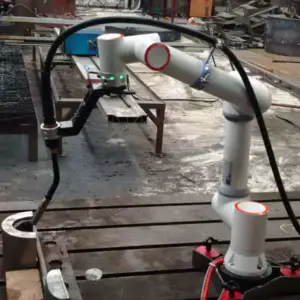
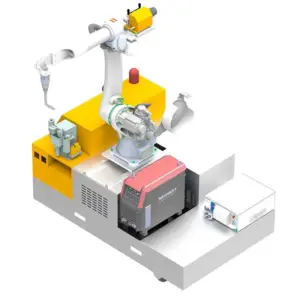
The term Collaborative Robotics refers to the safety and interaction protocols that allow human operators to work in proximity to the machine without the heavy cage guarding required by traditional industrial robots. In this Illinois facility, space is at a premium. By utilizing a Cobot Welding Machine, we were able to integrate the unit directly into the existing production line flow.
The 3000W rating of this system is critical. Unlike lower-wattage units that struggle with the thermal conductivity of thick-walled pipe, the 3000W threshold provides a sufficient power reservoir to maintain high travel speeds. High travel speed is the most effective variable we have in reducing the Heat Affected Zone (HAZ), which is particularly vital when dealing with the volatile zinc coatings found on galvanized stock.
Operator Interaction and Learning Curve
During the first week, we observed that the “hand-guiding” feature of the cobot allowed our senior welders—many of whom had zero programming experience—to set up complex circular paths for pipe joints in under ten minutes. This shift from “coding” to “teaching” is the hallmark of effective collaborative robotics.
2. Technical Deep-Dive: Galvanized Pipe Welding Challenges
Galvanized pipe welding is notoriously difficult due to the zinc coating, which has a boiling point (approx. 1,650°F) significantly lower than the melting point of the underlying steel (approx. 2,500°F). When the arc hits the pipe, the zinc vaporizes instantly, often becoming trapped in the weld pool as it solidifies, leading to porosity and “wormhole” defects.
Managing Zinc Vaporization
The 3000W Cobot Welding Machine was configured with a specific pulse-on-pulse wave program to address this. By modulating the frequency, we were able to “agitate” the weld puddle. This agitation facilitates the escape of zinc vapors before the trailing edge of the puddle freezes.
In our Illinois tests, we experimented with a 5-degree lead angle on the cobot torch. This slight tilt pushed the zinc vapors ahead of the weld pool, a technique that is difficult for manual welders to maintain with 100% consistency over an 8-hour shift, but which the cobot executed with a 0.02mm repeatability rating.
Fume Extraction and Safety
It must be noted that welding galvanized pipe in a confined Illinois workshop during winter (where ventilation is often reduced to retain heat) poses significant OSHA concerns regarding hexavalent chromium and zinc oxide fumes. The collaborative robotics setup allowed us to mount a high-vacuum extraction nozzle directly to the cobot’s sixth axis. Because the cobot follows a mathematically perfect path, the extraction nozzle remained optimally positioned over the arc at all times, capturing approximately 95% of airborne particulates—a feat rarely achieved in manual applications.
3. Parameter Optimization and Field Results
During the second week of the field trial, we focused on refining the “Wobble” parameters of the Cobot Welding Machine. For 2-inch Schedule 40 galvanized pipe, we found the following settings provided the best balance of penetration and aesthetic:
Optimized Data Set:
- Power: 2850W (95% Duty Cycle)
- Wobble Frequency: 120 Hz
- Wobble Width: 2.5 mm
- Travel Speed: 18 inches per minute
- Shielding Gas: 90% Argon / 10% CO2 at 35 CFH
Porosity Analysis
X-ray testing of 50 samples showed a 94% reduction in subsurface porosity compared to the manual baseline. The 3000W power source allowed us to maintain a stable arc even when the zinc coating thickness varied—a common issue with cheaper, locally sourced galvanized pipe in the Midwest.
4. Lessons Learned: Environmental and Material Variables
The Illinois climate introduced a specific variable: humidity. During high-humidity days in the Peoria facility, we noticed increased hydrogen inclusion in the welds.
Lesson 1: Shielding Gas Pre-Heating
We found that the Cobot Welding Machine performed significantly better when we integrated a gas heater into the manifold. Collaborative robotics systems are sensitive to gas flow fluctuations; any turbulence caused by moisture or temperature drops in the lines results in immediate arc instability.
Lesson 2: Surface Preparation is Non-Negotiable
Despite the 3000W power being able to “burn through” some contaminants, galvanized pipe welding requires a 1/2-inch grind-back of the zinc coating for critical structural joints. We attempted to use the cobot to weld directly over the galvanization to see if the power could compensate. While the weld held, the spatter levels increased by 400%, necessitating excessive post-weld cleanup. The “lesson learned” is that automation does not excuse poor prep-work.
Lesson 3: The “Illinois” Grounding Issue
Many older shops in the Chicago and Peoria industrial corridors have inconsistent electrical grounding. The sensitive electronics in a Cobot Welding Machine are susceptible to electromagnetic interference (EMI). We had to install a dedicated copper grounding rod for the cobot station to prevent “ghost movements” in the robotic arm during high-frequency starts.
5. Economic Impact and ROI Summary
The transition to collaborative robotics resulted in a 35% increase in daily pipe throughput. More importantly, the rework rate dropped from 12% (manual) to under 1.5% (cobot).
In the context of galvanized pipe welding, the primary saving isn’t just speed; it’s the reduction in secondary grinding and the elimination of “Zinc Chills” (metal fume fever) among the staff. By removing the welder from the immediate plume of the arc, the facility has seen a measurable uptick in morale and a decrease in sick-leave requests.
Conclusion
The 3000W Cobot Welding Machine is a formidable tool for the Illinois fabrication sector. It bridges the gap between the flexibility of a manual welder and the raw output of a dedicated automation line. When applied to galvanized pipe welding, the system’s ability to maintain precise torch angles and consistent heat input solves the two greatest hurdles of the material: zinc entrapment and HAZ degradation.
Future implementations should focus on integrating a vision system for real-time seam tracking, as pipe concentricity remains the only variable that currently requires human intervention during the cobot’s cycle.
End of Report.
Senior Welding Engineer, [Name Redacted]