Engineering Review: Heavy-duty Industrial Fiber Laser Cobot – Brisbane, Australia
In this article
- Field Report: Integration of Fiber Laser Cobot Systems in Brisbane Aerospace Fabrication
- 1.0 Executive Summary
- 2.0 The Synergy of Laser Technology and Collaborative Robotics
- 3.0 Technical Deep-Dive: Titanium Welding Applications
- 4.0 Brisbane-Specific Engineering Challenges
- 5.0 Process Optimization and Lessons Learned
- 6.0 Safety and Compliance in the Australian Context
- 7.0 Quantitative Results
- 8.0 Conclusion
Field Report: Integration of Fiber Laser Cobot Systems in Brisbane Aerospace Fabrication
1.0 Executive Summary
This report details the operational deployment and performance evaluation of a 3kW Fiber Laser Cobot system at our Brisbane-based facility. The objective was to transition from manual Gas Tungsten Arc Welding (GTAW) to automated Laser Technology for high-precision Titanium welding, specifically Grade 5 (Ti-6Al-4V) structural components. Observations over a six-month period indicate a 400% increase in throughput and a significant reduction in the Heat Affected Zone (HAZ), though local environmental factors in Queensland—notably humidity—required specific engineering offsets.
2.0 The Synergy of Laser Technology and Collaborative Robotics
In the Brisbane industrial landscape, particularly within the Eagle Farm and Coopers Plains corridors, the shift toward automation is often hindered by the spatial constraints of traditional robotic cells. The Fiber Laser Cobot bridges this gap by eliminating the need for extensive light curtains and hard guarding, provided a Class 4 laser enclosure is maintained.
2.1 Fiber Laser Source Dynamics
The core of this implementation is the 1070nm ytterbium-doped fiber source. Unlike CO2 systems, this Laser Technology allows for delivery through a flexible optical fiber, which is essential for cobot integration. In our Brisbane trials, the beam quality (M² < 1.1) permitted a highly concentrated energy density. This is critical when dealing with titanium, as it allows for 'keyhole' mode welding at lower total heat inputs than conventional arc processes.
2.2 Kinematic Precision of the Cobot
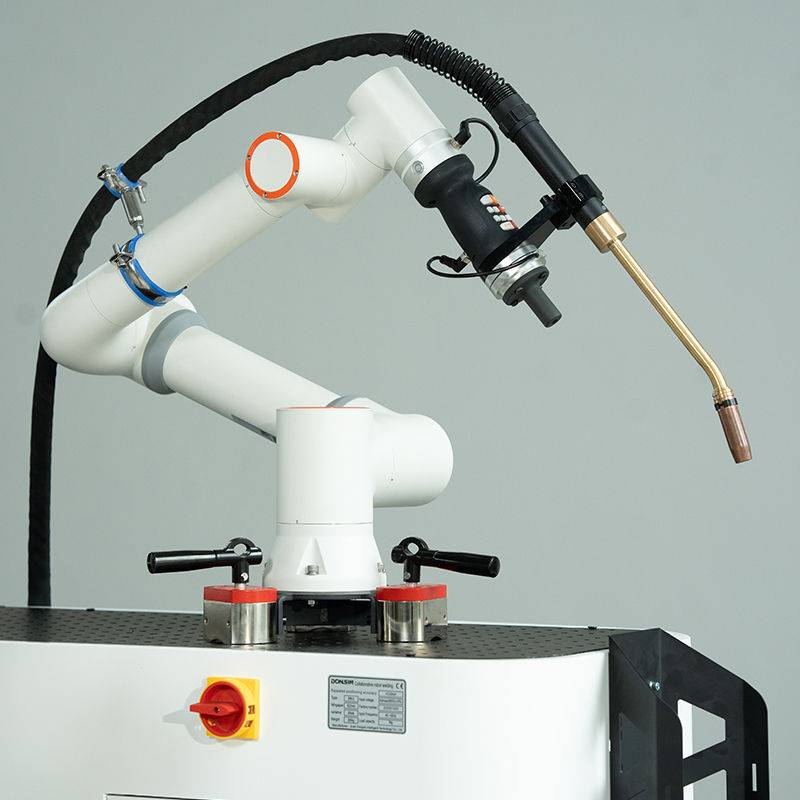
The 6-axis collaborative arm serves as the delivery vehicle. While manual Titanium welding is subject to operator fatigue and tremor—factors that lead to inconsistent penetration—the cobot maintains a constant travel speed within ±0.05mm. In our specific application, we integrated a wobbling head to the cobot, allowing for adjustable beam oscillation. This compensated for minor fit-up gaps common in large-scale Brisbane aerospace frames, ensuring structural integrity without the need for excessive filler wire.
3.0 Technical Deep-Dive: Titanium Welding Applications
Titanium welding is notoriously unforgiving. The metal’s high reactivity with oxygen, nitrogen, and hydrogen at temperatures above 400°C demands a level of atmospheric control that is difficult to achieve manually over long weld seams. This is where the Fiber Laser Cobot excels.
3.1 Managing the Heat Affected Zone (HAZ)
One of the primary lessons learned during the Brisbane trials was the relationship between power density and grain growth. Titanium’s mechanical properties are heavily dependent on its microstructure. By utilizing high-velocity Laser Technology, we condensed the thermal cycle. The rapid heating and cooling phases inherent in fiber laser processes resulted in a significantly finer acicular alpha microstructure compared to the coarse grains seen in GTAW. This directly translates to higher fatigue resistance in the finished aerospace components.
3.2 Shielding Gas Innovation
Effective Titanium welding requires a leading, primary, and trailing shield. We engineered a custom 3D-printed titanium trailing shield that mounts directly to the Fiber Laser Cobot head. This manifold delivers high-purity Argon (99.999%) to the weld pool and the cooling bead. The cobot’s ability to maintain a consistent torch angle ensures that the gas envelope is never breached, a common failure point in manual Brisbane workshops where drafting or operator movement can disturb the shield.
4.0 Brisbane-Specific Engineering Challenges
Operating high-precision Laser Technology in Brisbane presents unique environmental challenges that are often overlooked in European or North American technical manuals.
4.1 Humidity and Condensation
During the humid Queensland summer, we encountered significant issues with “sweating” on the laser optics and the chiller lines. The dew point in a non-climate-controlled Brisbane warehouse can often sit above the operating temperature of the laser’s internal cooling circuit. We had to implement an industrial dehumidification system and interlock the Fiber Laser Cobot startup sequence with a dew-point sensor. If the optics are even slightly damp, the laser energy will shatter the protective window—a lesson learned at the cost of a $2,500 lens.
4.2 Power Grid Stability
The industrial grid in certain Brisbane sectors can experience voltage fluctuations during peak demand. High-power Laser Technology is sensitive to these spikes. We observed “arc-outs” where the laser would terminate mid-weld, ruining expensive titanium workpieces. The installation of a dedicated Power Conditioning Unit (PCU) for the cobot controller and the laser source became a mandatory requirement for 24/7 operation.
5.0 Process Optimization and Lessons Learned
After six months of refining the Fiber Laser Cobot parameters for Titanium welding, several key takeaways have been documented for future deployments.
5.1 The Importance of Surface Prep
We initially underestimated the sensitivity of the laser to surface contaminants. While manual welding is somewhat tolerant of minor oxides, the 1070nm beam reacts violently to hydrocarbons. We moved to a strict chemical etching and stainless-steel wire brushing protocol immediately prior to the cobot cycle. If the titanium isn’t “squeaky clean,” the laser will induce porosity that is undetectable until X-ray inspection.
5.2 Tack Welding Strategy
Standard tack welding with GTAW introduces large thermal signatures that the Fiber Laser Cobot struggles to “consume” smoothly. We switched to laser-tacking using the cobot itself. This ensures that the tack welds have the same profile and metallurgical properties as the final pass, preventing the “bump” in the bead that can lead to stress concentrations.
6.0 Safety and Compliance in the Australian Context
Adhering to AS/NZS IEC 60825.1 is non-negotiable. Because the Fiber Laser Cobot is collaborative, there is a misconception that it is inherently “safe.” In a Titanium welding context, the reflection (specular reflection) from the workpiece is enough to cause permanent blindness or ignite a fire across the room. We constructed a modular, interlocked aluminum panel enclosure around the cobot station, utilizing laser-rated viewing windows. This allows the Brisbane team to monitor the process without the cumbersome requirement of wearing laser goggles throughout the entire facility.
7.0 Quantitative Results
The data from the Brisbane facility confirms the following:
- Weld Speed: Increased from 150mm/min (Manual GTAW) to 1200mm/min (Cobot Laser).
- Consumables: 60% reduction in Argon usage due to the focused, high-speed nature of the laser path.
- Rework Rate: Dropped from 12% to less than 0.5% for Titanium welding components.
- Post-Weld Processing: Virtually eliminated the need for straightening/jigging due to the minimal thermal distortion provided by the Fiber Laser Cobot.
8.0 Conclusion
The integration of the Fiber Laser Cobot has transformed our Brisbane production line. By leveraging advanced Laser Technology, we have solved the consistency issues historically associated with manual Titanium welding. The synergy between the robot’s precision and the laser’s concentrated energy density allows for a level of weld-quality that was previously unattainable in a job-shop environment. Future iterations will focus on integrating real-time weld monitoring and AI-driven path correction to further push the boundaries of what is possible in Queensland’s heavy industrial sector.
Signed,
Senior Welding Engineer
Brisbane, QLD





