2000W Laser Welding Cobot – Prague, Czech Republic
In this article
- Field Report: Deployment of 2000W Laser Welding Cobot in Prague, Czech Republic
- 1.0 Introduction and Site Overview
- 2.0 The Synergy of Laser Technology and Collaborative Robotics
- 3.0 Technical Deep-Dive: Copper Components Welding
- 4.0 Lessons Learned: Field Observations in Prague
- 5.0 Comparative Analysis: Laser vs. Traditional Methods
- 6.0 Conclusion and Future Outlook
Field Report: Deployment of 2000W Laser Welding Cobot in Prague, Czech Republic
1.0 Introduction and Site Overview
This report details the technical commissioning and performance evaluation of a 2000W Laser Welding Cobot system at a Tier-2 automotive electrical supplier facility in the industrial district of Prague-Hostivař. The primary objective was to transition from manual TIG processes to automated laser solutions for Copper Components welding, specifically focusing on high-conductivity busbars and cooling manifolds.
The Czech manufacturing sector is currently facing a localized shortage of high-skill manual welders capable of handling oxygen-free copper (Cu-OFE) and electrolytic tough pitch (Cu-ETP) copper. By integrating advanced Laser Technology with collaborative robotics, the goal was to stabilize weld quality while reducing the Heat Affected Zone (HAZ) which had been causing significant part distortion in previous production runs.
2.0 The Synergy of Laser Technology and Collaborative Robotics
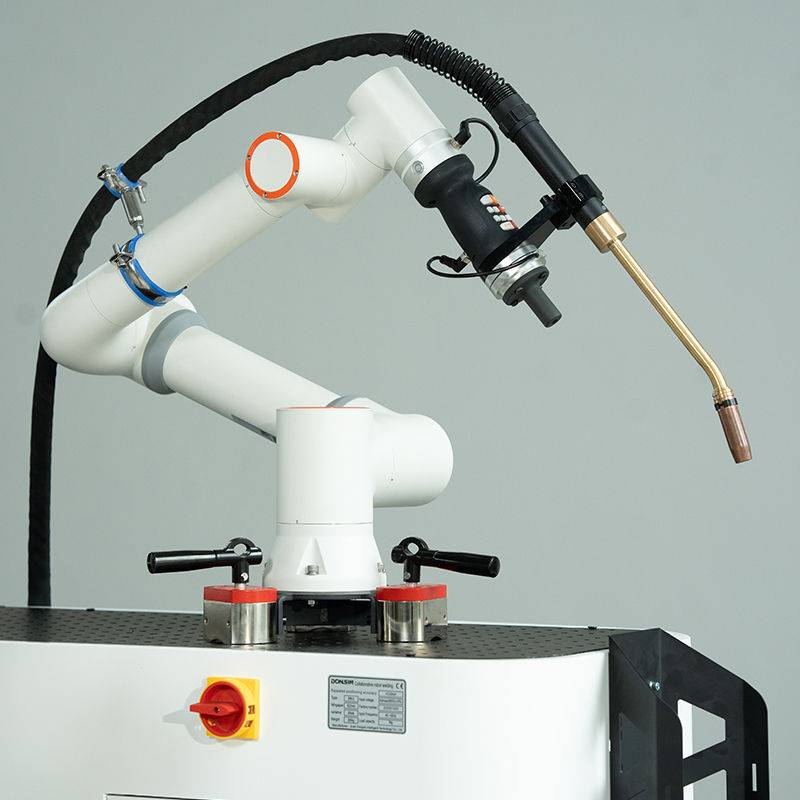
The core of this installation is the integration of a 2000W Continuous Wave (CW) fiber laser source with a 6-axis collaborative arm. In a “Prague, Czech Republic” workshop environment, space is often at a premium. Unlike traditional industrial robots that require extensive safety interlocks and massive floor footprints, the Laser Welding Cobot allows for a more flexible floor plan, provided the facility adheres to Class 4 laser safety standards (enclosed booths and laser-rated curtains).
2.1 Beam Dynamics and Motion Control
The Laser Technology utilized here involves a 1070nm wavelength fiber laser. The primary technical challenge with copper is its high reflectivity at this wavelength and its extreme thermal conductivity. To overcome this, the cobot’s motion control must be perfectly synchronized with the laser’s power modulation. We utilized a “wobble” function—a high-frequency oscillation of the laser beam (up to 300Hz)—to increase the effective weld width and improve the coupling of energy into the copper substrate.
The synergy becomes apparent when examining the cobot’s repeatability (±0.03mm) against the laser’s focus diameter (approx. 150μm). Manual welding of copper often results in “burn-through” or “cold starts” because a human cannot maintain the precise travel speed required to balance copper’s rapid heat dissipation. The Laser Welding Cobot maintains a constant linear velocity, ensuring the energy density remains within the “keyhole” welding regime throughout the entire joint geometry.
3.0 Technical Deep-Dive: Copper Components Welding
Copper Components welding is notoriously difficult due to the material’s tendency to reflect up to 90% of infrared laser energy at room temperature. Once the material reaches its melting point, absorption increases dramatically. This “absorption jump” can lead to process instability and spatter if not managed by the 2000W power reserve.
3.1 Parameter Optimization for Cu-ETP
During the Prague field tests, we focused on 3mm thick copper busbar lap joints. The following parameters were established as the baseline for the 2000W system:
- Laser Power: 1950W (near peak to ensure rapid coupling).
- Travel Speed: 18 mm/s.
- Wobble Pattern: Circular, 1.2mm width, 250Hz frequency.
- Shielding Gas: Pure Argon at 25 L/min via a coaxial nozzle.
By using the Laser Welding Cobot, we achieved a penetration depth of 2.2mm into the bottom plate, ensuring a robust mechanical and electrical connection. The use of Laser Technology allowed us to bypass the pre-heating phase required for TIG welding, which in turn preserved the temper of the copper surrounding the joint.
3.2 Managing Back-Reflection
A critical lesson learned in the Prague workshop was the management of back-reflection. Copper’s reflectivity can send photons back into the delivery fiber, potentially damaging the laser diode modules. The 2000W unit used here features a back-reflection isolator. However, we also programmed the cobot to maintain a 5-degree to 10-degree “leading angle” relative to the workpiece. This ensures that reflected light is directed away from the optics, extending the life of the protective windows and internal components.
4.0 Lessons Learned: Field Observations in Prague
4.1 Fixturing and Tolerance Sensitivity
The most immediate “lesson learned” was that while the Laser Welding Cobot is highly precise, it is unforgiving of poor fit-up. In manual welding, the operator compensates for gaps by slowing down or adding filler wire. With Laser Technology, a gap exceeding 10% of the material thickness usually results in an undercut or lack of fusion. We had to re-engineer the Prague facility’s clamping jigs to ensure a zero-gap fit-up for the copper busbars. The transition to laser welding is as much about the “prep” as it is about the “weld.”
4.2 Shielding Gas Dynamics
Initial tests showed significant porosity in the Copper Components welding samples. We discovered that the ambient humidity in the Prague facility (which was high during the spring thaw) was contributing to hydrogen embrittlement in the welds. We switched from a standard nozzle to a “trailing shield” configuration attached to the cobot head. This ensured the copper remained shielded by Argon until it cooled below the oxidation temperature (approx. 200°C), resulting in a bright, straw-colored weld with zero porosity on the X-ray.
4.3 The “Cobot” Factor in Training
Unlike traditional CNC laser cells, the Prague shop floor staff (many of whom are veteran manual welders) took to the Laser Welding Cobot within three days of training. The “lead-through” programming—where the operator physically moves the cobot arm to define the path—reduced the intimidation factor of the Laser Technology. The senior welding engineer no longer spends time coding G-code; they spend time optimizing the laser’s pulse frequency and power ramp-up/down settings.
5.0 Comparative Analysis: Laser vs. Traditional Methods
To justify the capital expenditure (CAPEX) for the Prague facility, we conducted a side-by-side comparison between the 2000W Laser Welding Cobot and the existing AC/DC TIG setup for Copper Components welding.
5.1 Throughput and Efficiency
A standard cooling manifold required 45 minutes of manual TIG welding due to the necessary cooling breaks to prevent overheating the seals. The Laser Welding Cobot completed the same manifold in 4 minutes and 12 seconds. Because the Laser Technology concentrates energy so tightly, the bulk temperature of the part never exceeded 60°C, allowing for immediate handling and downstream assembly.
5.2 Consumables and Maintenance
The Prague site reported a 60% reduction in consumable costs. While the protective windows for the laser head cost approximately €80, they last for weeks if the gas flow is correctly maintained. In contrast, the TIG process was consuming significant quantities of tungsten electrodes and ceramic nozzles, not to mention the higher volume of Argon required for the slower process.
6.0 Conclusion and Future Outlook
The deployment of the 2000W Laser Welding Cobot in Prague marks a significant shift in how the facility handles Copper Components welding. The combination of high-power Laser Technology and the flexibility of collaborative robotics has solved the dual challenge of skill shortages and part distortion.
Moving forward, the facility plans to implement a dual-station setup. While the cobot welds in Station A, the operator loads parts in Station B. This will maximize the “beam-on” time of the 2000W source, further driving down the cost per part. The primary technical takeaway for the engineering team is clear: when dealing with high-reflectivity materials like copper, the stability of the motion system is just as important as the raw power of the laser. The cobot provides that stability, turning a once-finicky manual process into a repeatable, industrial-grade science.
Report Prepared By:
Senior Welding Engineer, Field Operations
Prague, CZ Site





