Robotic Welding Cell with Narrow Gap welding for LNG Projects

In this article
- Optimizing LNG Infrastructure with Robotic Narrow Gap MAG Welding
- Technical Implementation of Narrow Gap MAG Geometries
- System Architecture and Seam Tracking Dynamics
- Maintenance Protocols for High-Duty Cycle Operations
- Quantifying Labor ROI and Economic Impact
- Standardization and Quality Assurance
- Conclusion of Engineering Strategy
Optimizing LNG Infrastructure with Robotic Narrow Gap MAG Welding
The construction of Liquefied Natural Gas (LNG) processing facilities and storage tanks requires high-integrity welds capable of withstanding extreme cryogenic temperatures. Conventional welding methods for thick-walled components often lead to excessive material consumption and extended lead times. Implementing a Robotic Welding Cell specifically configured for narrow gap MAG (Metal Active Gas) welding addresses these bottlenecks. By narrowing the groove angle to less than 20 degrees, the volume of weld metal required decreases exponentially as wall thickness increases.
From an industrial engineering perspective, the transition to automated narrow gap welding is not merely a technical upgrade but a strategic shift in throughput management. The process relies on specialized Gas Metal Arc Welding (GMAW/MAG) variants that utilize pulsed spray transfer or modified short-circuiting to ensure deep penetration while maintaining a manageable heat-affected zone. This is critical for maintaining the fracture toughness of nickel-alloy steels typically used in LNG containment.
Technical Implementation of Narrow Gap MAG Geometries
Traditional V-groove preparations require massive amounts of filler wire and multiple passes, increasing the cumulative heat input and the risk of distortion. Narrow gap configurations typically utilize a U-shaped or tight-gap preparation with a width often under 12mm for thicknesses exceeding 50mm. The robotic system must manage precise torch positioning to ensure sidewall fusion without trapping slag or creating lack-of-fusion defects.
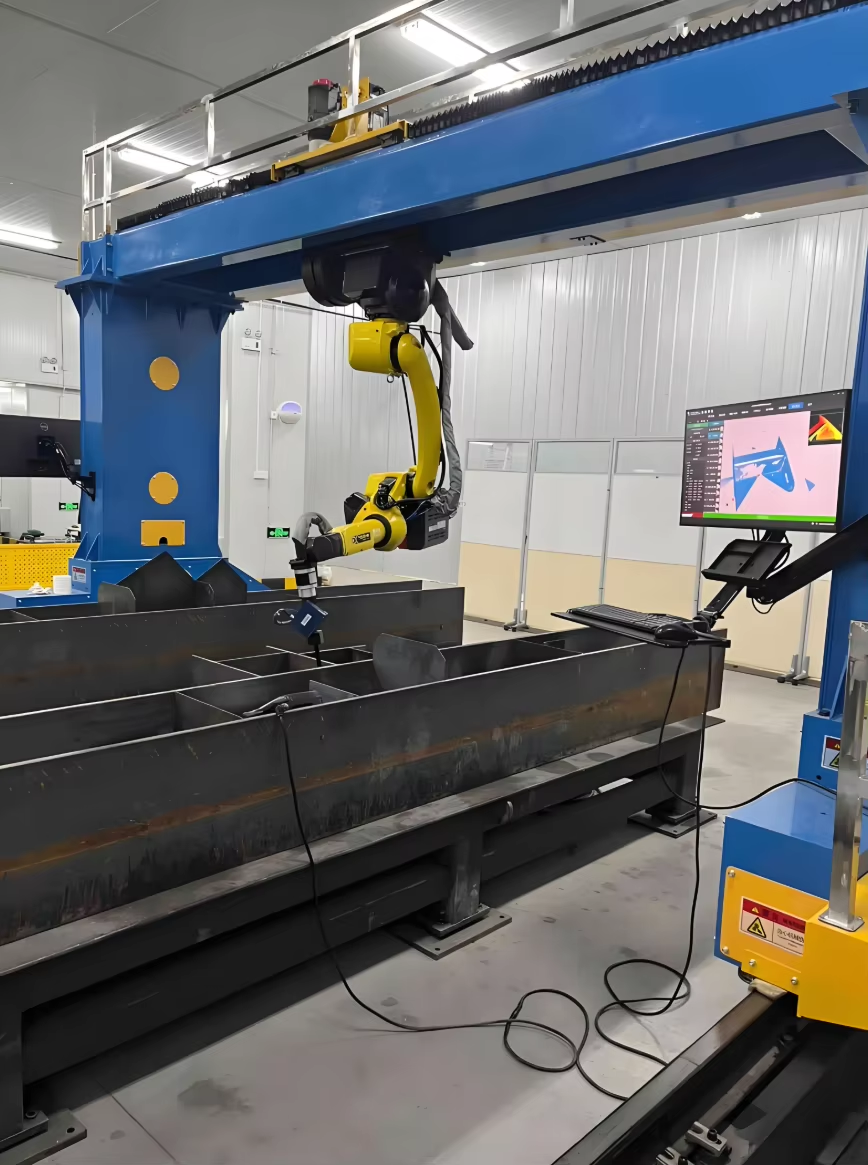
The integration of Narrow Gap Welding technology within a robotic cell involves high-precision oscillating torches or specialized wave-form control. The robot’s controller must synchronize the wire feed speed with the travel speed and oscillation frequency to create a uniform bead profile. For LNG applications, this consistency is paramount, as even minor inclusions can lead to failure during radiographic or ultrasonic testing, resulting in costly repairs.
System Architecture and Seam Tracking Dynamics
The robotic cell architecture for LNG components usually features a high-payload articulated arm mounted on a linear track or gantry system. Because large-scale vessels and pipes often possess slight geometric variances, the robot cannot rely on pre-programmed paths alone. Through-the-arc sensing (TASP) and laser-based seam tracking are integrated to provide real-time corrections.
The MAG process in a narrow gap requires a specialized torch nozzle designed for deep reach. Industrial engineers must account for gas shielding efficiency; as the torch descends into a deep, narrow groove, turbulence can occur, leading to porosity. Advanced cells utilize custom diffusers to maintain laminar flow of the shielding gas (typically Argon-CO2 mixes), ensuring the chemical integrity of the weld pool remains uncompromised by atmospheric nitrogen or oxygen.
Maintenance Protocols for High-Duty Cycle Operations
To maintain a high Overall Equipment Effectiveness (OEE), a rigorous preventive maintenance schedule is mandatory. Robotic MAG welding in heavy industrial environments subjects the equipment to significant thermal stress and spatter accumulation.
Consumable Management
The contact tip is the most frequent point of failure. In narrow gap applications, the tip is often extended, making it more susceptible to wear and “burn-back.” Automated tip changers and torch cleaning stations (reamers) should be programmed to activate every 30 to 60 minutes of arc-on time. This prevents wire feed instability that could cause a defect mid-pass in a deep groove.
Liner and Wire Feed Calibration
The wire delivery system must be inspected weekly. for LNG Projects using high-tensile or nickel-based filler wires, the friction inside the conduit liners can lead to erratic feeding. Industrial engineers should specify low-friction liners and ensure that the drive rolls are calibrated to the specific diameter and hardness of the LNG Infrastructure grade wire being used.
Quantifying Labor ROI and Economic Impact
The primary driver for robotic adoption in LNG projects is the labor ROI. The global shortage of highly skilled welders certified for 6G or heavy-wall pressure vessel work has driven labor costs to an all-time high. A single robotic cell can perform the work of three to four manual welders while maintaining a duty cycle of 75-85%, compared to the 20-30% typically seen in manual heavy-wall welding.
Financial modeling for these cells must include:
Deposition Rate Efficiency
Robotic MAG systems can achieve deposition rates of 4-6 kg/hr, whereas manual welding often struggles to exceed 2 kg/hr in constrained narrow-gap positions. This doubling of output significantly shortens the project timeline, reducing the “time to first gas” for the LNG facility.
Rework Reduction
In manual welding of thick sections, rework rates of 5-10% are common due to fatigue and human error. A robotic system, once optimized, can reduce rework to under 1%. Considering the cost of gouging out a 100mm thick weld and re-welding it, the savings from high first-pass yields often pay for the robotic system within the first year of operation.
Standardization and Quality Assurance
Adhering to ASME Section IX and ISO 15614-1 standards is non-negotiable for LNG projects. The robotic cell allows for digital data logging of every weld parameter—voltage, amperage, travel speed, and heat input. This “digital birth certificate” for each joint simplifies the documentation process for quality auditors and provides a data-driven approach to continuous improvement.
By utilizing Weld Deposition Rate as a primary KPI, industrial engineers can fine-tune the MAG pulse parameters to find the “sweet spot” between speed and metallurgical properties. The result is a highly repeatable, low-risk manufacturing process that scales effectively across large-scale energy infrastructure projects.
Conclusion of Engineering Strategy
The deployment of a robotic narrow gap MAG welding cell represents a convergence of mechanical precision and economic necessity. For the LNG sector, where wall thicknesses and safety requirements are extreme, the ability to deposit high-quality weld metal consistently while reducing total filler material usage is the ultimate competitive advantage. Through meticulous maintenance and a focus on automated seam tracking, firms can mitigate the risks of labor shortages and ensure the structural integrity of the world’s most critical energy assets.






