Intelligent Robotic Welder with Narrow Gap welding for Bridge Trusses

In this article
Optimizing Bridge Truss Fabrication with Intelligent Robotic MAG Systems
The fabrication of bridge trusses represents one of the most demanding environments for structural engineering. Traditionally, these massive components require extensive manual welding of thick-section plates, leading to high thermal distortion and significant labor costs. The transition toward narrow gap welding within a robotic framework addresses these challenges by optimizing the weld preparation geometry. In conventional V-groove preparations, the volume of weld metal increases exponentially with plate thickness. By utilizing a narrow gap approach—typically reducing the groove angle to less than 10 degrees—the required filler metal volume is reduced by up to 40% to 60%. This reduction directly correlates to decreased arc-on time and lower overall heat input, which is critical for maintaining the metallurgical properties of high-strength structural steels.
The Technical Mechanics of Robotic MAG in Heavy Sections
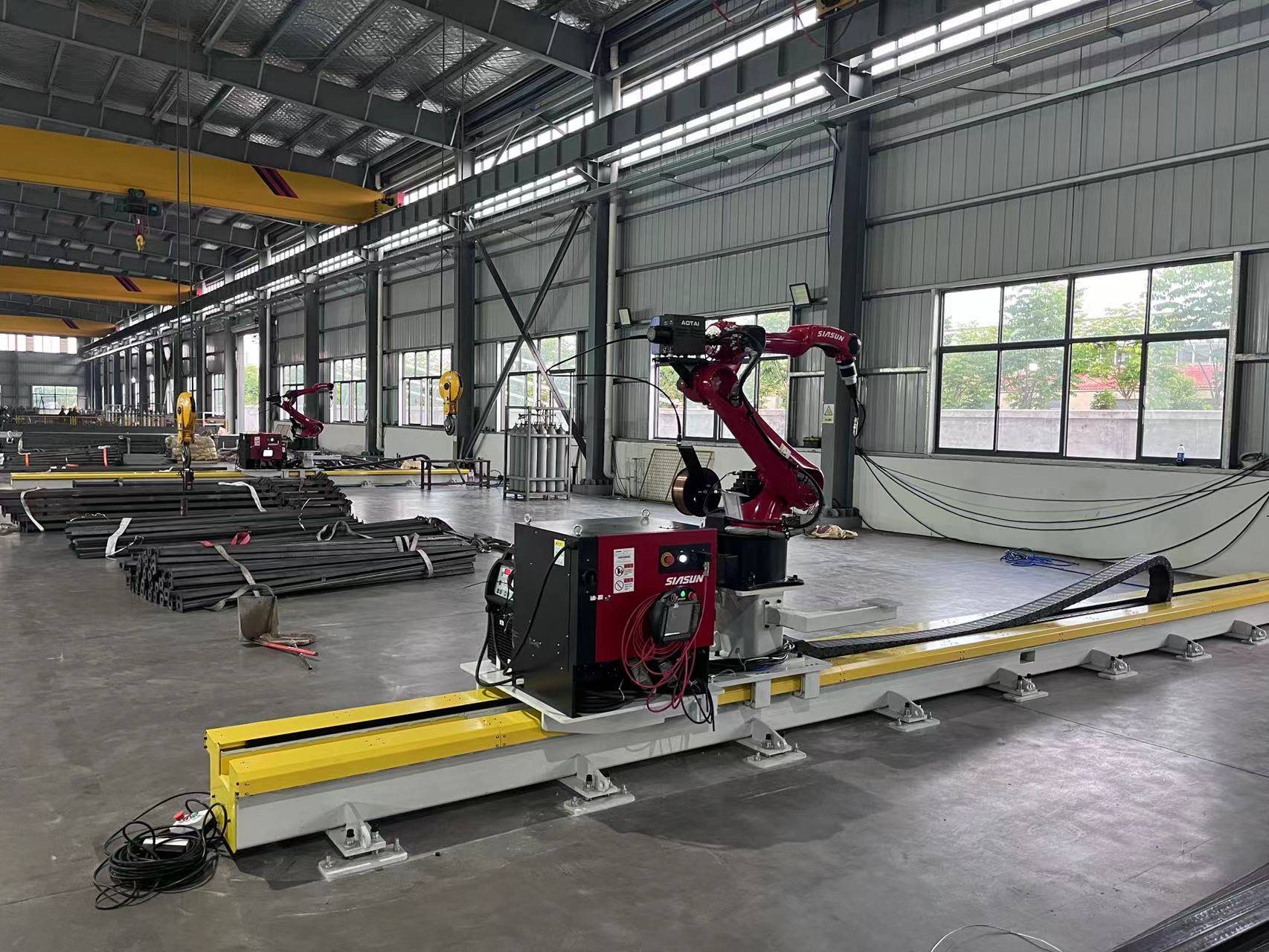
Metal Active Gas (MAG) welding is the preferred process for Bridge Trusses due to its high deposition rates and suitability for automation. When integrated with an intelligent robotic arm, the process moves beyond simple path execution. Modern systems utilize advanced power sources capable of pulsed-spray transfer, which minimizes spatter and ensures deep penetration even in the confined spaces of a narrow gap. The robotic controller manages the wire feed speed, voltage, and travel speed in real-time, adjusting for the specific thermal conductivity of the truss members. Because narrow gap welding requires precise positioning—often within tolerances of +/- 0.5mm—the role of the robot is indispensable. A human welder cannot consistently maintain the torch orientation required to avoid sidewall lack-of-fusion defects in deep, narrow grooves over the course of a 10-hour shift.
Adaptive Sensing and Multi-Pass Consistency
Intelligent robotic cells for bridge trusses are equipped with “through-the-arc” sensing and laser seam tracking. These systems allow the robot to compensate for variations in part fit-up and thermal expansion during the welding process. As the first root pass is laid, the heat induces localized warping. An intelligent system detects these deviations and modifies the tool center point (TCP) for subsequent filler passes. In bridge truss fabrication, where a single joint may require thirty or more passes, this adaptive capability ensures that each layer is perfectly fused to the previous one and the sidewalls. This level of consistency is paramount for fatigue resistance, as bridges are subject to cyclic loading over decades of service.
Maintenance Protocols for High-Duty Cycle Robotic Cells
From an industrial engineering perspective, the reliability of a Robotic Welding cell is dictated by its maintenance regime. Unlike manual equipment, a robotic MAG system often operates at a duty cycle exceeding 80%. This puts immense stress on the consumables. A structured preventive maintenance (PM) schedule must be implemented to avoid unplanned downtime. The primary focus of this schedule is the wire delivery system. Over time, friction within the liners can cause micro-slippage in the wire feeder, leading to arc instability. Engineers should mandate the replacement of liners based on the mass of wire consumed rather than elapsed time.
Nozzle maintenance is another critical factor. In narrow gap applications, the proximity of the gas nozzle to the weld pool increases the risk of spatter buildup, which can obstruct shielding gas flow and cause porosity. Automated torch cleaning stations, which ream the nozzle and apply anti-spatter compound, should be programmed to trigger every 30 to 60 minutes of arc-on time. Furthermore, the integrity of the robotic cable harness (the dress pack) must be inspected weekly. The repetitive motions required to navigate the complex geometry of a bridge truss can cause internal fatigue in the power cables and gas hoses, leading to subtle changes in electrical resistance that can degrade weld quality before a total failure occurs.
Labor ROI and Economic Feasibility in Heavy Infrastructure
The financial justification for an Intelligent Robotic Welder is often centered on the ROI in automation. To calculate an accurate Return on Investment, one must look beyond simple hourly wage comparisons. In the current market, certified welders qualified for bridge work (D1.5 code) are increasingly scarce and command high premiums. A single robotic cell can perform the work of three to four manual welders when accounting for the increased deposition rate and the elimination of human fatigue. While the initial capital expenditure (CAPEX) for a narrow gap robotic system is substantial, the reduction in “non-value-added” time—such as chipping slag, flipping parts, and taking breaks—dramatically lowers the cost per pound of weld metal deposited.
Throughput Gains and Defect Reduction
In bridge construction, the cost of rework is astronomical. If a flaw is detected in a thick-section joint via ultrasonic testing (UT) or radiography (RT), the process of gouging out the defect and re-welding can cost five times the original labor estimate. Robotic systems, by virtue of their precision and digital logging of weld parameters, provide a “digital twin” of the welding process. This traceability reduces the defect rate to near zero. When throughput is increased—often by 200% in heavy truss applications—the manufacturer can bid more competitively on large-scale infrastructure projects, effectively shortening the payback period of the robotic investment to less than 24 months in high-volume environments.
Long-Term System Reliability and Scaling
To maximize the lifespan of the investment, the robotic system must be integrated into a broader factory data framework. Monitoring the power consumption and motor torque of each robotic axis can predict mechanical failures before they occur. For example, a gradual increase in the torque required to move the ‘J3’ axis may indicate a bearing issue. By addressing these indicators during scheduled weekend downtime, the facility avoids the catastrophic costs of a mid-production breakdown. As the firm gains experience with robotic MAG welding, the logic used for one truss type can be modularized and applied to future designs, further reducing the engineering overhead for new projects.
Conclusion: The Industrial Imperative
The shift toward intelligent robotic welders for bridge trusses is no longer an optional upgrade but a necessity for firms aiming to remain viable in the global infrastructure market. By mastering narrow gap MAG techniques, manufacturers can deliver higher-quality structures with less material waste and lower thermal stress. The convergence of adaptive sensing, rigorous maintenance protocols, and clear labor ROI metrics provides a robust framework for operational excellence. As we continue to rebuild and expand our transportation networks, the precision of the robot combined with the strategic oversight of the industrial engineer will be the defining factor in structural safety and project profitability.






