Intelligent Robotic Welder with Arc Voltage Control for Pressure Vessels

In this article
Technical Implementation of Intelligent Robotic MAG Welding in Pressure Vessel Fabrication
Pressure vessel manufacturing demands rigorous adherence to international standards such as ASME Section VIII. Traditionally, these vessels—ranging from air receivers to complex chemical reactors—have relied on manual or semi-automatic welding processes. However, the variables inherent in manual Metal Active Gas (MAG) welding often lead to inconsistencies in penetration and bead morphology. The introduction of Intelligent Robotic Welders, specifically those integrated with Arc Voltage Control (AVC), represents a fundamental shift in production efficiency and quality assurance.
An intelligent robotic welder for Pressure Vessels is not merely a mechanical arm; it is a closed-loop system that perceives and reacts to the welding environment in real-time. In the context of heavy-wall vessels, where multi-pass welding is mandatory, maintaining a consistent arc length is critical. This is where AVC becomes the primary driver of weld integrity. By monitoring the voltage across the arc, the system can adjust the torch height (standoff distance) instantaneously to compensate for surface irregularities or thermal expansion of the workpiece.
The Mechanics of Arc Voltage Control in MAG Systems
In a standard MAG setup, the distance between the contact tip and the workpiece directly influences the electrical resistance of the circuit. For pressure vessels, which often feature large diameters and long longitudinal seams, even a minor deviation in the vessel’s roundness can change this distance during a 360-degree circumferential weld. Arc Voltage Control (AVC) functions by utilizing a high-speed feedback loop. If the distance increases, the voltage rises; the controller detects this change and signals the robot’s Z-axis to lower the torch, maintaining a constant voltage and, consequently, a uniform heat input.
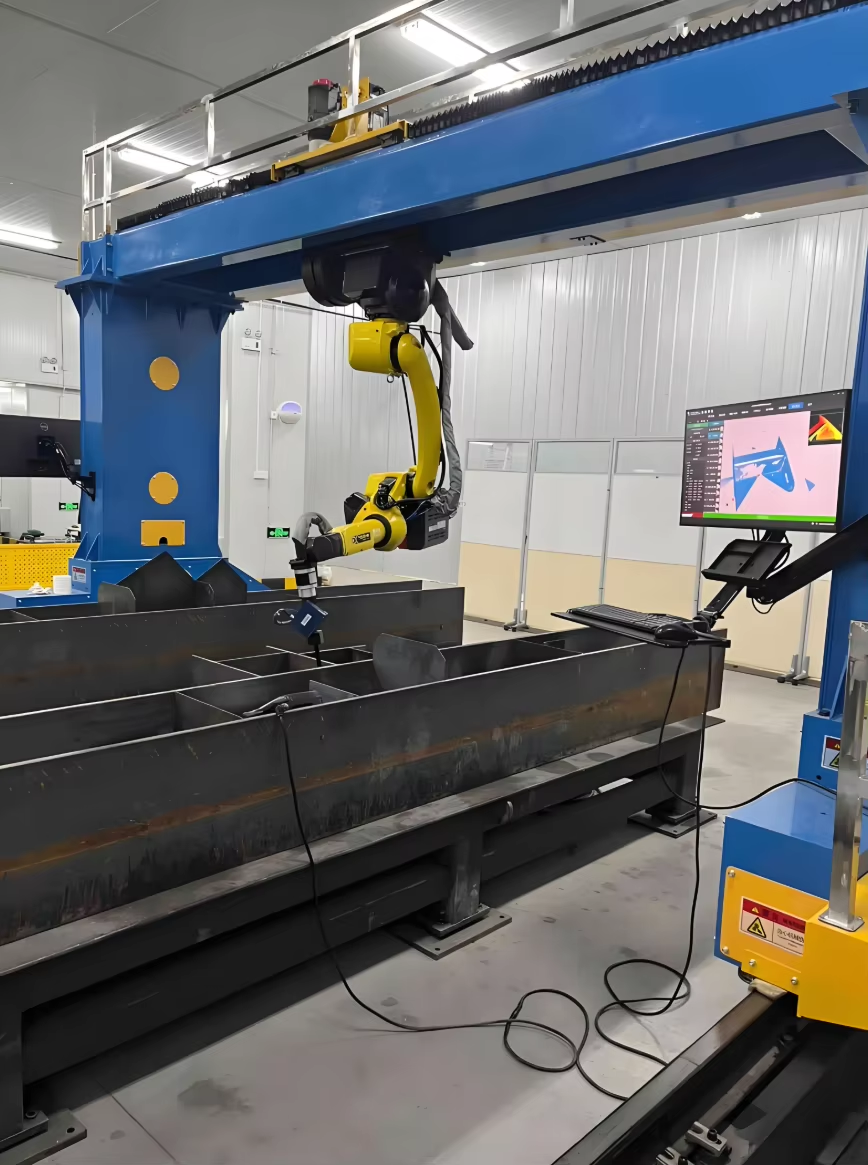
This level of precision is vital for deep-groove welds. Without AVC, a robot following a pre-programmed path might encounter a section where the groove is slightly shallower or deeper due to fit-up tolerances. This would result in either a lack of fusion or excessive burn-through. With AVC, the intelligent system adapts to the actual geometry of the joint rather than strictly following a theoretical path. This adaptability ensures that the Pressure Vessel Welding process remains within the qualified parameters of the Weld Procedure Specification (WPS) at all times.
Operational Efficiency and Throughput Gains
From an industrial engineering perspective, the primary metric for welding success is the deposition rate combined with the duty cycle. Manual welders typically operate at a duty cycle of 20% to 30% due to the need for repositioning, heat breaks, and electrode changes. Robotic systems, conversely, can achieve duty cycles exceeding 70%. When combined with high-performance MAG power sources capable of pulse or spray transfer modes, the deposition rate per hour can triple compared to manual operations.
Intelligent systems also reduce the “arc-off” time during multi-pass sequences. In pressure vessel fabrication, slag removal (if using flux-cored wire) and interpass cleaning are necessary. A robotic cell can be equipped with automated cleaning stations and thermal sensors to monitor interpass temperatures, ensuring that the next bead is deposited at the optimal moment for metallurgical stability. This synchronization minimizes idle time and maximizes the output of the welding cell.
Labor ROI and Economic Impact
The economic justification for Robotic Automation ROI in the welding sector is increasingly driven by the scarcity of “Grade A” certified welders. The cost of a Robotic Welding cell is a capital expenditure that typically sees a payback period of 18 to 24 months in a multi-shift environment. When calculating ROI, engineers must look beyond just the hourly wage of a welder. The calculation must include:
1. Labor Burden: Including benefits, insurance, and recruitment costs.
2. Rework Mitigation: The cost of grinding out a failed weld on a pressure vessel, re-inspecting it via X-ray or UT, and re-welding is often five times the cost of the initial weld. Robotic precision reduces the defect rate to near zero.
3. Consumable Savings: Automated MAG systems optimize shielding gas flow and wire usage, reducing waste by up to 15% through precise arc starts and stops.
By delegating the repetitive, physically taxing welds to a robot, the existing skilled workforce can be moved to higher-value tasks such as fit-up, inspection, and complex nozzle attachments where human dexterity is still superior. This optimization of human capital is a core component of modern industrial ROI modeling.
Maintenance Protocols for Robotic Welding Cells
To maintain the high uptime required for a positive ROI, a rigorous preventative maintenance (PM) schedule is non-negotiable. Robotic MAG systems operate in harsh environments characterized by metallic dust and high thermal radiation. The maintenance strategy should be categorized into daily, weekly, and quarterly actions.
Daily Maintenance Tasks
The operator must inspect the contact tip and gas shroud for spatter buildup. Even with an automatic reamer or “torch cleaner,” manual inspection ensures that the gas flow remains laminar. Additionally, the wire feeder drive rolls should be checked for tension and alignment to prevent bird-nesting, which can halt production for hours.
Weekly and Monthly Systems Checks
On a weekly basis, the wire liner should be blown out with dry compressed air to remove copper shavings and dust. A clogged liner increases friction, leading to erratic wire feed speeds which the AVC system might struggle to compensate for. Monthly checks should focus on the robot’s cable harness. The constant twisting of the “seventh axis” or the torch cable can lead to internal fatigue in the power lead, resulting in voltage drops that interfere with the AVC feedback loop.
Integration of Data Analytics for Continuous Improvement
Modern intelligent welders are IoT-enabled devices. Every weld performed on a pressure vessel generates a data log containing voltage, current, wire feed speed, and gas flow rates. This “digital birth certificate” for each vessel provides total traceability. Industrial engineers can analyze this data to identify trends—for example, if certain weld seams consistently require more AVC correction, it may indicate an issue with the upstream plate rolling or beveling process.
By closing the data loop between the welding floor and the engineering department, manufacturers can refine their manufacturing tolerances. If the AVC data shows that the robot is constantly adjusting for a 2mm gap variation, the engineering team can investigate the root cause in the fit-up jig, leading to a leaner, more precise production flow across the entire factory.
Conclusion
The transition to intelligent robotic welding with Arc Voltage Control is a strategic necessity for pressure vessel manufacturers facing a competitive global market. By focusing on the MAG process and leveraging AVC for real-time path and parameter adjustment, companies can achieve levels of quality and throughput that are impossible with manual labor alone. While the initial investment is significant, the long-term ROI—measured in reduced rework, higher deposition rates, and the optimization of the skilled workforce—provides a clear path toward sustainable industrial growth.






