Intelligent Robotic Welder with Offline Programming for Shipbuilding

In this article
- Strategic Implementation of Intelligent Robotic Welding in Naval Architecture
- The Role of Metal Active Gas (MAG) in Heavy Plate Fabrication
- Maximizing Throughput with Offline Programming (OLP)
- Maintenance Protocols for High-Utilization Robotic Systems
- Economic Analysis: Labor ROI and Total Cost of Ownership
- Conclusion: Engineering the Future of Maritime Production
Strategic Implementation of Intelligent Robotic Welding in Naval Architecture
The shipbuilding industry is currently facing a dual challenge: an aging skilled workforce and an increasing demand for structural integrity in massive steel assemblies. To maintain global competitiveness, shipyards are transitioning from traditional manual processes to the Intelligent Robotic Welder. Unlike general manufacturing, shipbuilding involves unique complexities, including large-scale workpieces, variable fit-up gaps, and confined spaces. The application of Metal Active Gas (MAG) welding via robotic arms offers a solution that stabilizes the heat-affected zone while maximizing the deposition of filler metal.
Industrial engineers focus on the optimization of the duty cycle. In a manual welding environment, a welder’s arc-on time rarely exceeds 25 to 30 percent due to fatigue, repositioning, and environmental factors. An automated system, supported by robust programming, can push this metric beyond 70 percent. The efficiency gain is not merely in the speed of the torch movement, but in the consistency of the weld bead and the reduction of post-weld rework.
The Role of Metal Active Gas (MAG) in Heavy Plate Fabrication
In shipbuilding, the MAG process is preferred for its versatility and high deposition rates. When integrated with a robotic system, the control over parameters such as wire feed speed, voltage, and travel angle becomes granular. The Metal Active Gas (MAG) process allows for deep penetration in thick-walled sections, which are common in bulkheads and hull plating. Intelligent systems utilize through-arc seam tracking (TAST) to compensate for deviations in the joint path, ensuring that the robot adjusts in real-time to the physical reality of the steel plates.
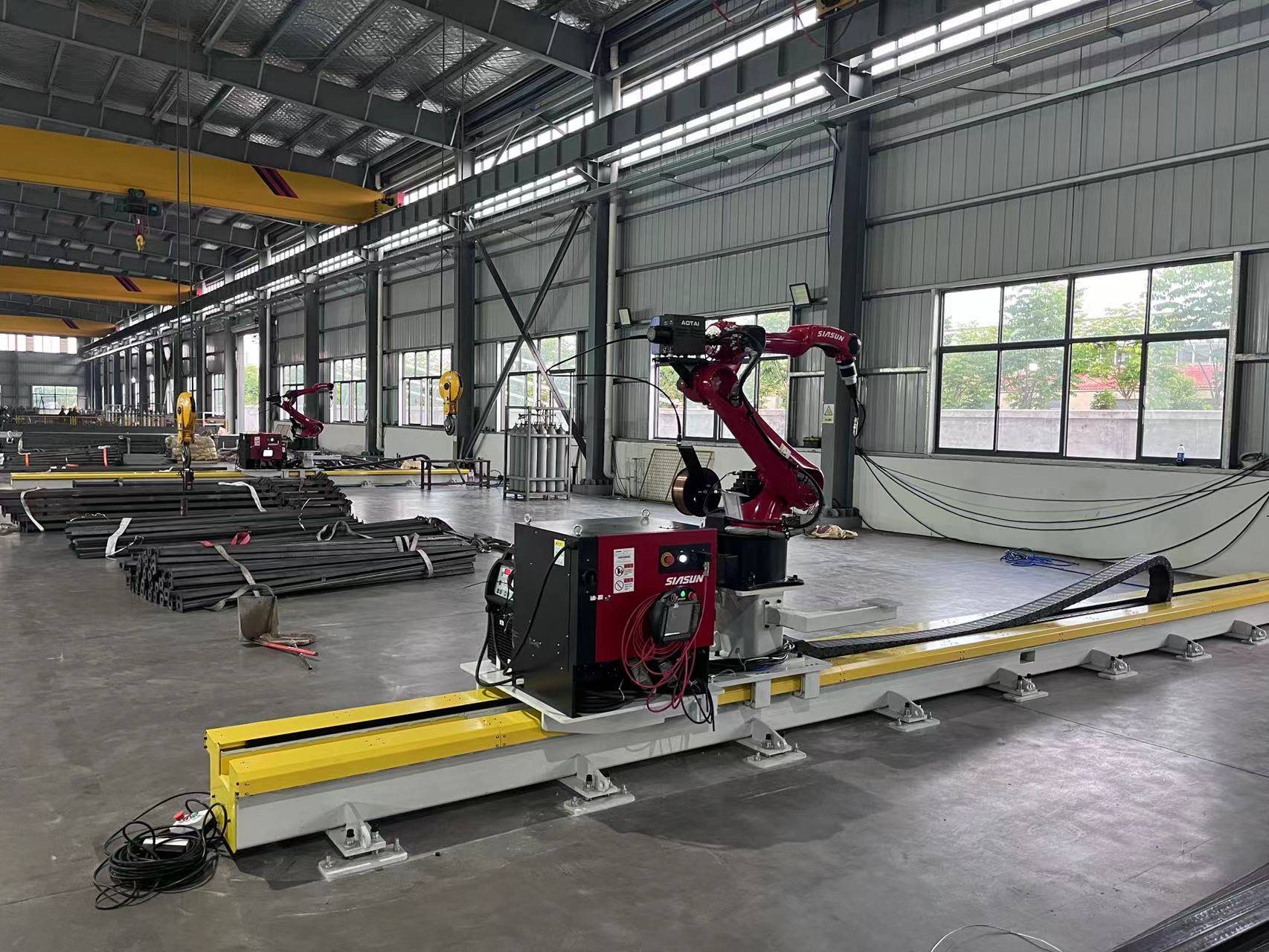
By using a mixture of Argon and CO2, the robotic system can minimize spatter, which significantly reduces the time spent on secondary grinding. From a process engineering perspective, the transition to robotic MAG welding necessitates a standardized approach to joint preparation. The precision of the robot is only as effective as the consistency of the upstream fit-up. Therefore, implementing intelligent welding requires a holistic view of the fabrication sequence, ensuring that plate edges are machined to tolerances that the robotic sensors can reliably interpret.
Maximizing Throughput with Offline Programming (OLP)
One of the primary bottlenecks in robotic adoption has historically been the downtime required for “lead-through” teaching. In a shipyard where every vessel may have custom configurations, stopping production to teach a robot every weld path is economically unviable. This is where Offline Programming (OLP) becomes the critical enabler. OLP allows engineers to create, simulate, and optimize welding paths in a 3D digital twin environment while the physical robot is still executing the previous task.
Digital Twin Calibration and Collision Avoidance
OLP software utilizes the CAD data of the ship’s sections to generate complex toolpaths. However, the software must account for the physical constraints of the robotic cell. Intelligent OLP systems simulate the kinematics of the robot arm to detect potential collisions with stiffeners, brackets, or the hull itself. By validating the reach and accessibility of the torch in a virtual space, engineers eliminate the risk of equipment damage and reduce the “dry run” time on the shop floor to near zero. This simulation also allows for the optimization of the torch angle to ensure gas coverage remains optimal in tight corners.
Reducing Non-Value-Added Time
From an industrial engineering standpoint, OLP converts what was once “on-floor” programming (non-productive time) into “office-based” engineering (pre-production planning). This shift ensures that the robot remains in a state of value-addition for the maximum possible duration. Furthermore, OLP enables the generation of multi-pass welding strategies for thick joints without manual intervention. The software calculates the overlap and layer thickness required to fill a V-groove or J-groove joint, maintaining structural integrity across thousands of meters of welding.
Maintenance Protocols for High-Utilization Robotic Systems
To sustain the high duty cycles promised by automation, a rigorous preventive maintenance schedule is mandatory. Robotic welding in a shipyard is a high-wear activity. The primary components requiring attention are the torch consumables, the wire delivery system, and the robotic axis motors. Unlike manual welding where a welder might compensate for a worn contact tip, a robot requires consistent electrical conductivity to maintain arc stability.
Consumable Management and Automatic Cleaning
Modern intelligent welders are equipped with automatic torch cleaning stations (reamers). At set intervals or after a specific number of weld cycles, the robot moves to a cleaning station to remove spatter from the nozzle and apply anti-spatter spray. This automated maintenance routine prevents gas flow turbulence. Engineers must track the lifecycle of contact tips and liners, using data analytics to predict failure points rather than waiting for weld quality to degrade. High-quality wire feeding is also paramount; any friction in the conduit can lead to “bird-nesting” at the feeder, causing hours of downtime.
Kinematic Accuracy and Calibration
Over time, the mechanical repeatability of a robot can drift due to thermal expansion or minor collisions. Periodic calibration of the Tool Center Point (TCP) is essential. Intelligent systems often include touch-sensing routines where the robot uses the welding wire or a dedicated probe to “find” the workpiece location. This data is fed back into the OLP model to adjust the coordinate system, ensuring that the digital plan aligns perfectly with the physical steel.
Economic Analysis: Labor ROI and Total Cost of Ownership
The justification for an intelligent robotic welding system rests on the Labor ROI. In shipbuilding, the cost of labor is not just the hourly wage, but includes the overhead of safety equipment, insurance, training, and the logistical challenge of moving personnel through complex structures. A single robotic cell can often replace the output of three to four manual welders in terms of pure deposition volume, but the real value lies in the elimination of human error.
Quantifying Productivity Gains
When calculating ROI, engineers must look at the “cost per kilogram of weld metal.” A robot provides a constant travel speed and wire feed rate, leading to predictable material consumption. Manual welding often results in overwelding (applying more metal than necessary), which increases both material costs and heat distortion. By controlling the exact volume of the weld bead through OLP, shipyards can reduce filler metal consumption by 10 to 15 percent. This reduction in heat input also minimizes the need for flame straightening, further accelerating the production timeline.
Addressing the Skilled Labor Gap
The implementation of robots does not eliminate the need for skilled personnel; rather, it shifts the required skillset. The “welder” becomes a “robot operator” or “OLP technician.” This transition allows shipyards to utilize their most experienced welders as quality controllers and process supervisors, while the repetitive, high-heat, and ergonomically challenging tasks are handled by the machine. This shift improves workplace safety and reduces the long-term healthcare costs associated with fume exposure and physical strain, which are significant factors in the total cost of labor.
Conclusion: Engineering the Future of Maritime Production
The integration of intelligent robotic welding with offline programming represents a fundamental shift in shipbuilding methodology. By focusing on the MAG process and leveraging OLP for path optimization, shipyards can overcome the constraints of traditional fabrication. The move toward automation is an engineering necessity to meet the precision and volume requirements of modern naval architecture. Through meticulous maintenance and a clear understanding of labor ROI, the transition to robotic systems ensures that the heavy-duty fabrication of tomorrow is both efficient and economically sustainable.






